Sui Surges 14% on Privacy Paper as Traders Eye Potential Privacy Token
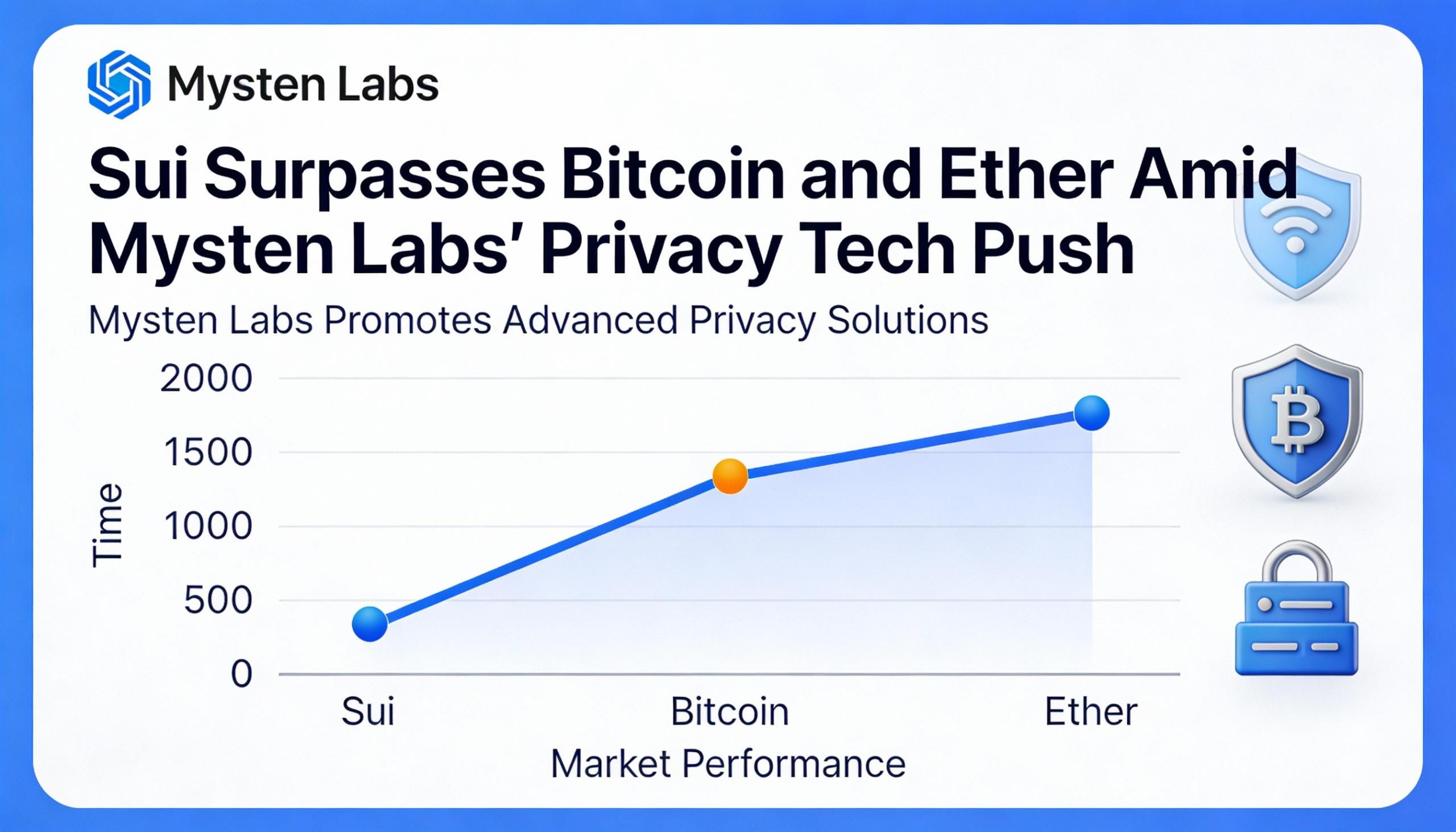
Layer 1 blockchain Sui (SUI) jumped more than 14% over the past 24 hours, sharply outperforming Bitcoin (BTC $91,661) and Ether (ETH $3,200), which gained roughly 1% and 1.2%, respectively. The rally makes SUI the strongest large-cap performer of the day, signaling a token-specific catalyst rather than a broader market move.
The surge comes amid market speculation that Sui could one day support privacy-preserving transactions, following a recent research paper co-authored by Mysten Labs, the core developer of the Sui blockchain.
The paper, structured as a systematization of knowledge, outlines a framework for incorporating privacy features in modern blockchains without fully adopting legacy privacy coin designs. It categorizes privacy into levels ranging from basic confidentiality — hiding transaction amounts — to k-anonymity and full anonymity, which obscure sender and receiver identities.
Placing Sui within the account-based model alongside Ethereum and Solana, the research explores methods for implementing confidential balances, limited anonymity sets, and sender-receiver unlinkability using cryptographic tools such as homomorphic encryption and zero-knowledge proofs. The paper also notes trade-offs, including higher computational overhead, challenges for resource-limited clients, and regulatory considerations.
Renewed Focus on Digital Cash
Investors have shown growing interest in privacy-focused assets. During the second half of 2025, coins like Zcash and Monero outperformed broader markets as Bitcoin and Ether faced macro pressures and dollar strength. Analysts see this as a rotation toward digital cash — assets designed for spending rather than yield — where zero-knowledge proofs allow confidential transactions without sacrificing speed or selective compliance.
While Mysten Labs’ paper does not propose a timeline for a Sui privacy token or introduce new technology, investors interpret it as a signal of potential future developments and a re-emerging demand for financial privacy in crypto markets.