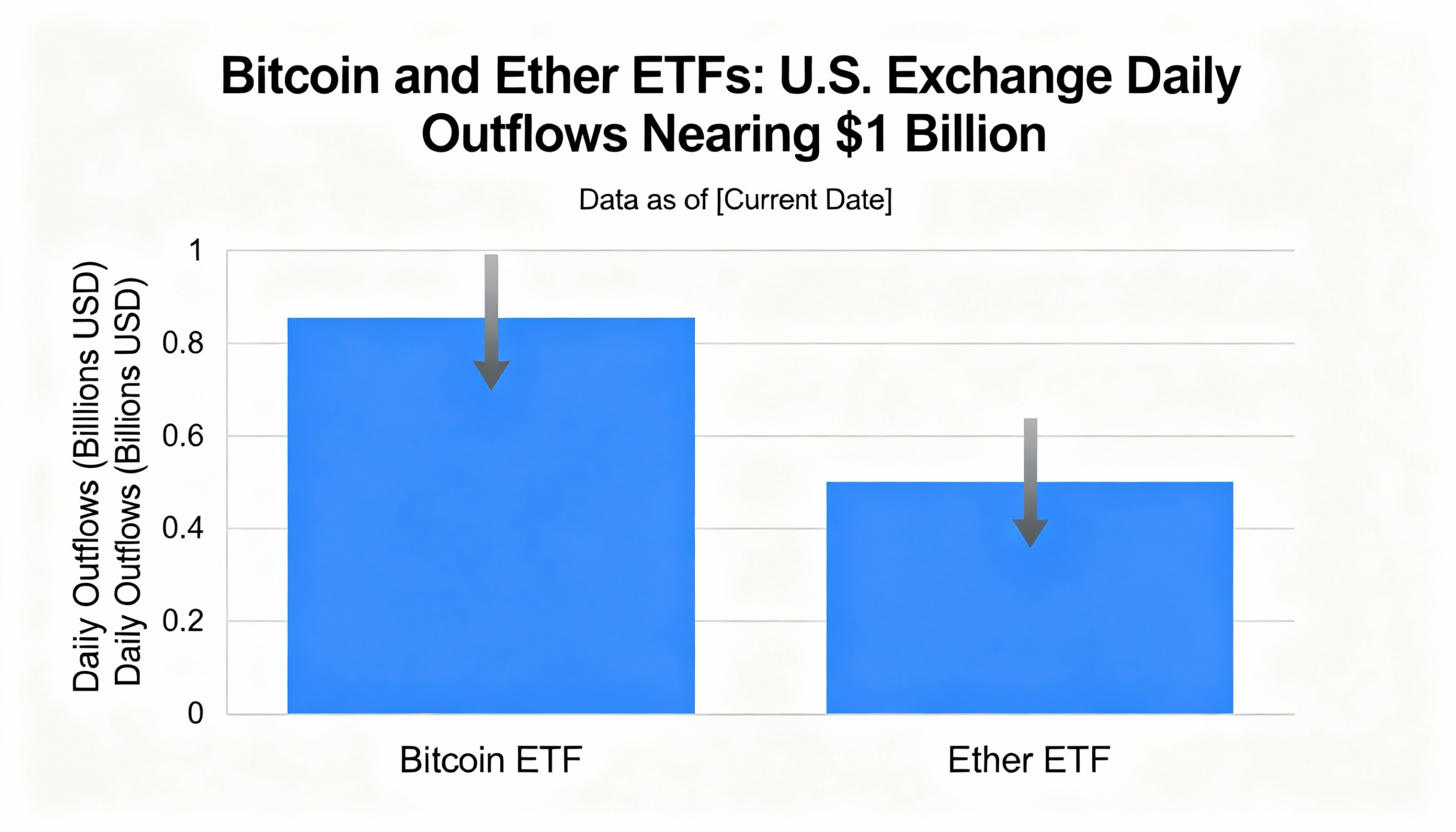
U.S.-Listed Bitcoin and Ether ETFs Suffer Nearly $1 Billion Outflows Amid Crypto Selloff
U.S.-listed spot bitcoin and ether exchange-traded funds (ETFs) experienced one of their largest combined outflow days of 2026 on Thursday, as falling crypto prices, rising volatility, and macroeconomic uncertainty prompted investors to cut exposure.
Data from SoSoValue shows that U.S. spot bitcoin ETFs saw $817.9 million withdrawn on Jan. 29, marking their largest single-day outflow since Nov. 20. Ether ETFs also faced sustained selling pressure, losing $155.6 million in the session.
The outflows coincided with sharp declines in crypto markets. Bitcoin fell below $85,000 before sliding toward $81,000 during U.S. trading hours, later stabilizing near $83,000 in Asian markets Friday morning. Ether dropped more than 7% over the day.
Among bitcoin ETFs, BlackRock’s IBIT saw the heaviest redemptions, shedding $317.8 million. Fidelity’s FBTC lost $168 million, while Grayscale’s GBTC experienced $119.4 million in outflows. Smaller funds, including Bitwise, Ark 21Shares, and VanEck, also posted notable withdrawals.
Ether ETFs followed a similar trend. BlackRock’s ETHA lost $54.9 million, Fidelity’s FETH saw $59.2 million exit, and Grayscale’s ether products continued to bleed assets. Total ether ETF holdings fell to $16.75 billion from more than $18 billion earlier this month.
The broad-based selling across both bitcoin and ether ETFs suggests institutional investors were reducing overall crypto exposure rather than rotating between assets. Earlier in January, inflows into ether funds had often offset weakness in bitcoin products.
Analysts attribute the selloff to heightened volatility across risk assets and renewed uncertainty over U.S. economic policy. Speculation around Federal Reserve leadership, with Kevin Warsh viewed as bearish for bitcoin, added to the cautious sentiment.
“Rising implied volatility, weakness in equities, and speculation around future Federal Reserve leadership weighed on sentiment. At the same time, leveraged positions in crypto markets were unwound aggressively, putting additional pressure on spot prices,” the report noted.
ETF flows continue to track price action rather than lead it. Analysts expect demand for bitcoin and ether ETFs to remain fragile while prices are under pressure, with investors waiting for volatility to ease before re-entering the market.
“Bitcoin crashed to $81k due to a risk-off wave: hawkish Fed holding rates with no cuts soon, heavy spot BTC ETF outflows ($1B+ recently), geopolitical tensions (US-Europe trade spats, Middle East), and a brief gold/silver dip,” said Andri Fauzan Adziima, Research Lead at Bitrue, in a Telegram message.
“This triggered massive leveraged liquidations after breaking key support (~$85k 100-week SMA), creating a self-reinforcing sell-off in thin liquidity. It’s a leverage shakeout amid macro pressure, not the start of a bear market, with rebound potential if supports hold,” Adziima added.