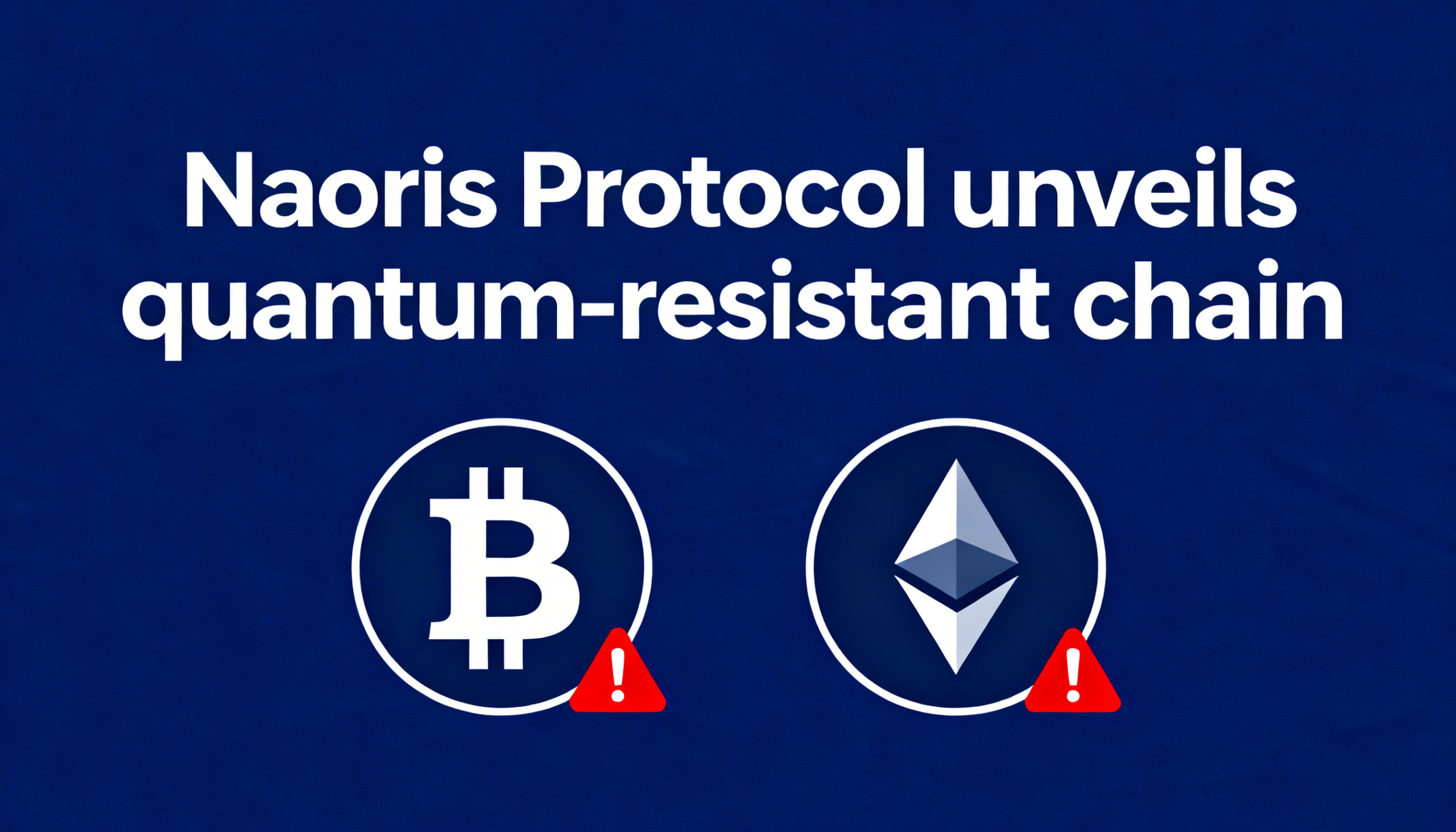
Naoris Protocol has rolled out its quantum-resistant mainnet, aiming to future-proof blockchain infrastructure against the potential threat of quantum computers capable of breaking today’s encryption standards.
The launch marks the project’s transition from testing to fully operational deployment. According to chief growth officer Nathaniel Szerezla, the network has already processed more than 100 million transactions using post-quantum cryptography, highlighting its readiness at scale rather than relying on theoretical projections.
The debut comes amid growing concern over “Q-Day”—a scenario in which advanced quantum machines could compromise the cryptographic foundations of networks like Bitcoin and Ethereum. Recent research has intensified those fears, suggesting that breaking Bitcoin’s encryption may require significantly fewer qubits than previously estimated, while separate findings have pointed to potential risks within Ethereum’s ecosystem.
Given the permanent nature of blockchain records, any vulnerabilities in current cryptographic systems could be exploited in the future once quantum capabilities mature, raising long-term security concerns across the industry.
Naoris seeks to address this challenge by designing its blockchain from the ground up with post-quantum cryptography. The protocol relies on algorithms approved by the U.S. National Institute of Standards and Technology (NIST) to secure user accounts, transactions, and digital assets.
A central feature of the system is its “irreversible security transition.” Once users adopt post-quantum keys, all future transactions must use quantum-resistant signatures. The network blocks any attempts to revert to older cryptographic methods, ensuring continuous protection even if traditional encryption becomes obsolete.
For now, these capabilities are limited to Naoris’ own mainnet, but the protocol is designed with broader integration in mind, including potential support for wallets, exchanges, Layer 2 networks, and DeFi applications.
The mainnet initially launched with a select group of participants operating validator nodes, forming the network’s foundational trust layer before wider rollout. During its testnet phase, the system demonstrated scalability and resilience, processing over 106 million post-quantum transactions, creating more than 3.3 million wallets, activating over one million security nodes globally, and detecting and mitigating more than 603 million threats.
The network is powered by its native NAORIS token, which facilitates transaction validation, governance, and overall network security. At the time of launch, the token’s market capitalization stood at around $36 million.