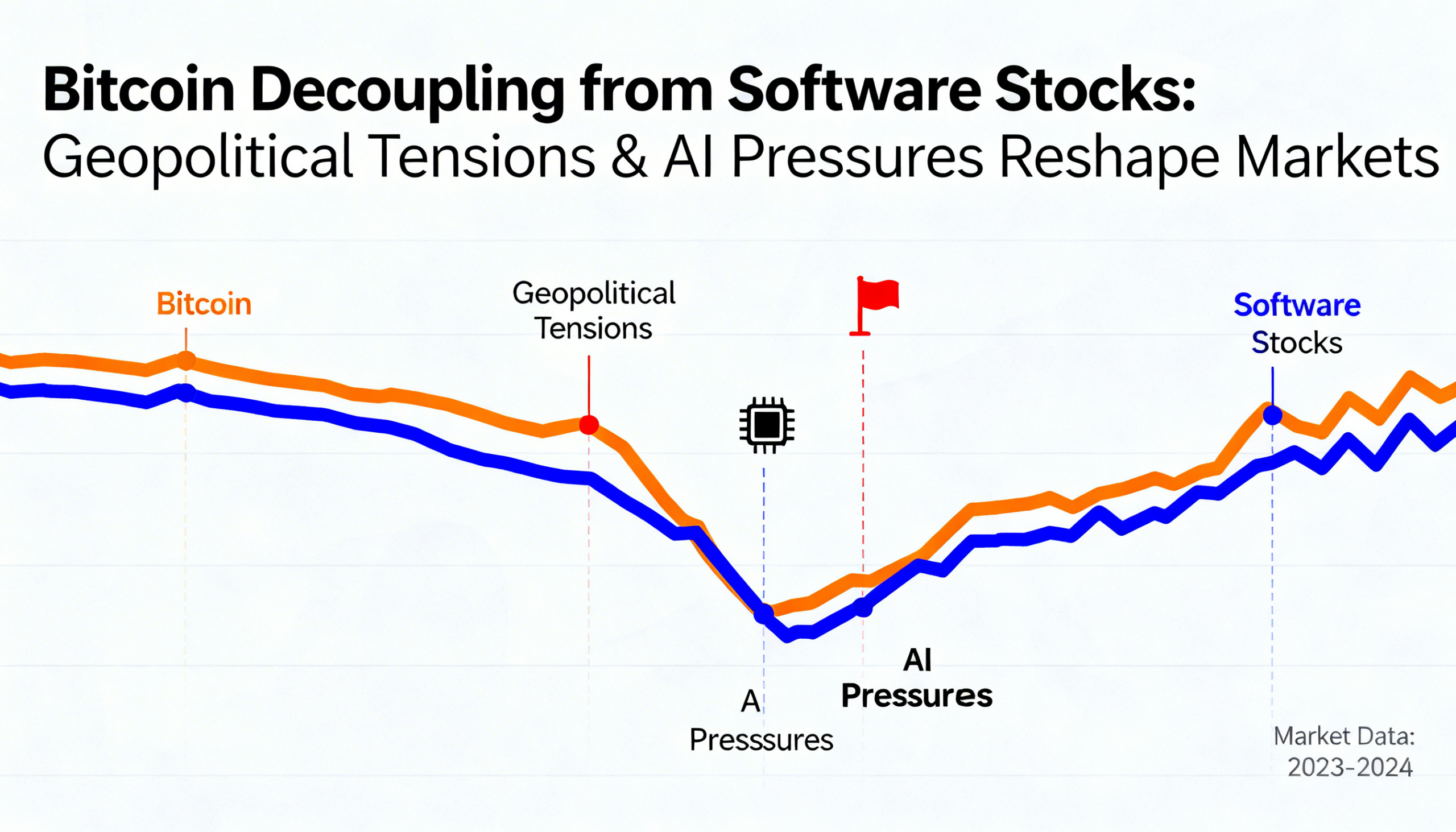
Bitcoin has begun to decouple from software equities following the outbreak of the Iran conflict, with correlation between the two dropping sharply from near-perfect alignment to almost zero.
Since Feb. 28, when tensions escalated, Bitcoin has diverged from the iShares Expanded Tech-Software Sector ETF (IGV), a widely used benchmark for software stocks. The shift marks a break from the strong co-movement that had defined recent months.
In terms of performance, Bitcoin has taken the lead. The asset has gained more than 5% over the period, climbing back above $69,000 and posting a modest 24-hour increase. IGV, meanwhile, has moved in the opposite direction, declining more than 2% since the conflict began.
The widening gap suggests a change in how investors are positioning across the two assets, with Bitcoin increasingly viewed through a different lens than software equities.
This divergence comes after a prolonged period of close alignment. Over the past three months, Bitcoin dropped around 26%, while IGV fell roughly 23%. On a year-to-date basis, both are down करीब 21%. Over a five-year horizon, Bitcoin has delivered an 18% gain compared with 10% for IGV, albeit with significantly higher volatility.
The contrast is also evident in peak-to-trough declines. Bitcoin has fallen about 50% from its October high, while IGV—after peaking earlier—has declined approximately 35%.
Correlation metrics highlight the structural shift. In early February, Bitcoin and IGV showed a correlation near 1.0, indicating near-identical movement. After the conflict began, that figure dropped sharply to 0.13, pointing to near-total decoupling, before rebounding to around 0.7. Correlation values range from -1 to +1, with zero indicating no relationship.
IGV’s composition is heavily tilted toward large-cap software and services companies such as Microsoft, Oracle, and Salesforce. The sector is facing growing concerns around artificial intelligence, which could pressure margins and compress valuation multiples, particularly within the SaaS space as competition intensifies.
Bitcoin, in contrast, is increasingly trading as a macro-sensitive asset, drawing support from geopolitical risk and shifting global sentiment rather than sector-specific fundamentals.