Jefferies is forecasting a new wave of crypto and blockchain-related initial public offerings, as institutional investors increasingly shift their focus from speculative trading to real-world financial infrastructure built on blockchain technology.
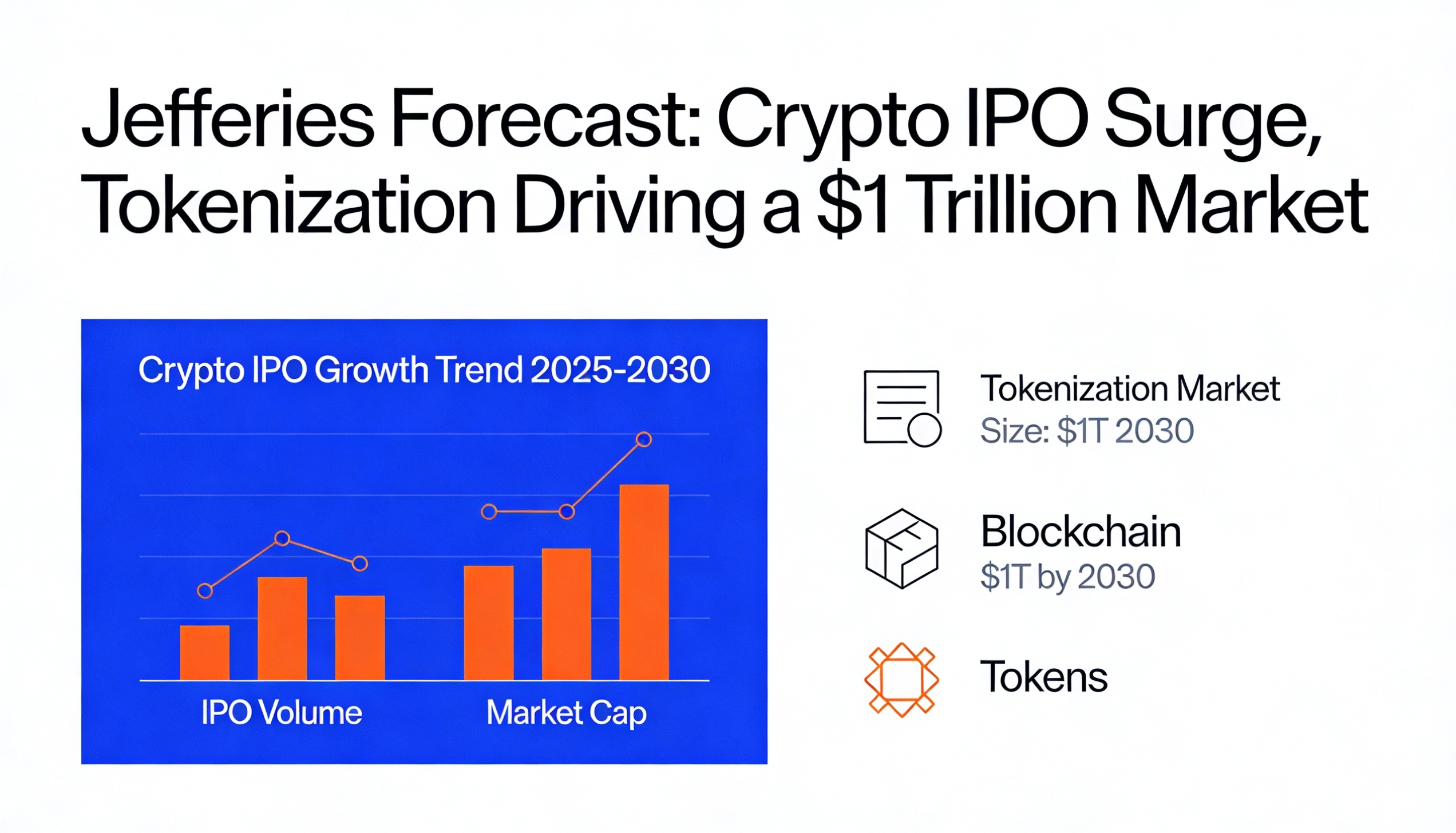
In a report following its inaugural Digital Assets Investor Conference in New York, the Wall Street bank said it expects a surge in public listings from crypto firms over the next two years. It also projected that the sector could evolve into a $1 trillion public market within the next five years.
The event brought together executives from 35 digital asset companies and roughly 150 institutional investors, with discussions centered less on bitcoin price movements and more on the integration of blockchain systems into traditional financial services.
According to Jefferies, client conversations indicate a growing conviction that blockchain technology is transitioning from experimental use cases to core financial infrastructure. Interest is increasingly concentrated on companies positioned to benefit from this shift, including banks, exchanges, asset managers, fintech firms and payments providers adopting blockchain rails.
Although the crypto IPO market cooled in 2026 following a strong wave of listings in 2025, the slowdown has largely mirrored broader macroeconomic uncertainty. Jefferies expects activity to pick up again, noting that several firms — including Securitize and Payward, the parent company of Kraken — are already advancing IPO plans.
Tokenization is emerging as a central driver of this transformation. Industry participants highlighted that tokenized money market funds, private credit instruments and blockchain-based settlement systems are already moving into production, aided by recent regulatory guidance that has reduced legal ambiguity around digital assets.
The broader trend reflects a shift across Wall Street, where major financial institutions are increasingly adopting blockchain technology irrespective of short-term cryptocurrency price movements. Rather than focusing on market volatility, firms are exploring how distributed ledger systems can improve efficiency, reduce costs and enable new financial products.
This theme has been echoed across major industry events, where tokenization and stablecoins have taken center stage over speculative trading narratives. Market participants see these technologies as foundational to the next phase of financial innovation.
Jefferies also emphasized the importance of regulatory clarity in accelerating adoption, particularly for heavily regulated institutions. The bank pointed to proposed U.S. legislation aimed at establishing a clearer market structure for digital assets, suggesting it could act as a key catalyst for institutional investment.
At the same time, traditional financial firms are increasingly partnering with crypto-native infrastructure providers rather than competing directly with them. This collaboration is helping build an ecosystem where blockchain networks are used to streamline settlement processes, enhance capital efficiency and support new types of financial instruments.
Recent industry developments underscore this trend. Partnerships between tokenization platforms and traditional financial service providers are enabling the issuance of blockchain-based securities within existing systems, while acquisitions aimed at strengthening digital settlement infrastructure continue to gain momentum.
Stablecoins and blockchain-based payment systems were repeatedly identified as near-term growth areas, particularly as companies seek faster, cheaper and always-on cross-border payment solutions.
Executives from a wide range of firms participated in the conference, reflecting the breadth of institutional engagement across the sector.
Overall, Jefferies said investor attention is increasingly shifting away from speculative segments of the market toward blockchain applications that generate sustainable revenue across trading, payments, lending and tokenized financial products.
The report concluded that while the pace of technological disruption may be overestimated in the short term, its long-term impact is likely to be significantly underestimated as blockchain infrastructure becomes more deeply embedded in the global financial system.