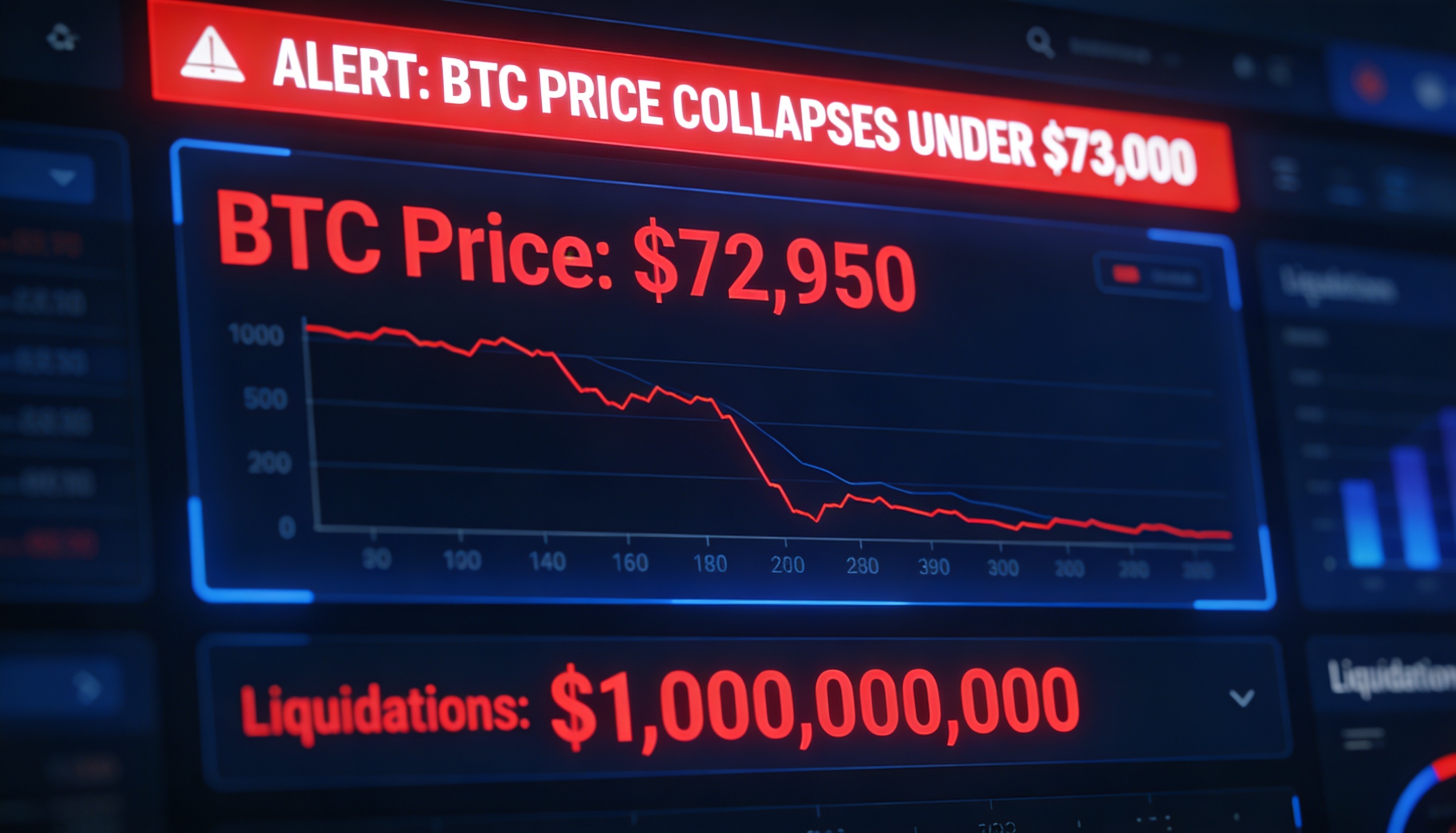
Crypto Markets Slide as U.S.-Iran Tensions Trigger $1B Liquidations
Major cryptocurrencies dropped between 3% and 4% after renewed geopolitical tensions in the Middle East sparked a broad risk-off move, erasing nearly $1 billion in leveraged positions. The sell-off followed U.S. airstrikes on an Iranian military site near the Strait of Hormuz, reviving a conflict that markets had largely begun to price out.
Bitcoin fell below $73,000 for the first time in months, leading declines across digital assets as fresh U.S. strikes on Iran pressured risk markets and triggered one of the largest liquidation events of the year.
Bitcoin traded at $72,978 during Asian hours on Thursday, down 3.4% over the past 24 hours and 6.3% on the week, according to CoinDesk data, after hitting an intraday low of $72,912. Ether declined 4.2% to $1,976, slipping below the $2,000 level and extending its seven-day loss to 7.7%. Solana dropped 3.5% to $80.57, XRP fell 3.6% to $1.28, and Dogecoin lost 3.2% to $0.0979.
Hyperliquid was the only major token to retain a weekly gain, despite falling 4.5% on the day, remaining up 2.4% over the past week. Tron also showed relative resilience, holding a 1.9% weekly gain amid the broader downturn.
The market move triggered a wave of liquidations among leveraged traders. Data from CoinGlass showed $958.8 million in liquidations over the past 24 hours across 167,706 traders, with long positions accounting for $897 million and shorts for $61 million.
Bitcoin led liquidation volumes at $386 million, followed by ether at $246 million. The largest single liquidation was a $15.34 million Bitcoin position on Hyperliquid.
The overwhelming long bias — with roughly 93% of liquidations on bullish positions — highlights how traders had positioned for a recovery, only to be caught off guard by the sudden reversal. Leverage accumulated during May’s consolidation phase was unwound rapidly in a single session.
The catalyst for the sell-off came from escalating tensions in the Middle East. U.S. Central Command confirmed airstrikes on an Iranian military installation near the Strait of Hormuz and reported intercepting four one-way attack drones targeting a commercial vessel. A U.S. official described the operation as defensive, aimed at preserving a ceasefire established last month.
In a further escalation, the U.S. Treasury imposed sanctions on Iran’s Persian Gulf Strait Authority, accusing it of extorting vessels transiting the waterway. Iran reportedly retaliated by targeting the U.S. airbase from which the strikes originated, according to a report citing the Islamic Revolutionary Guard Corps.
Kuwait also reported heightened threats, with its military stating that explosions heard across the country were the result of air defense systems intercepting incoming missile and drone attacks.
President Donald Trump said the Strait of Hormuz would remain open to international traffic. “It’s international waters,” Trump said during a cabinet meeting at the White House. “The strait’s going to be open to everybody,” he added, noting that the U.S. would continue to monitor the situation.
Risk assets weakened globally alongside crypto. The MSCI All Country World Index slipped 0.4% from record highs, Asian equities fell 1.7%, and futures tied to the S&P 500 and Nasdaq 100 pointed lower. Oil prices rose as the escalation clouded prospects for a deal to fully reopen the strait.
The sharp reaction underscores how quickly ceasefire optimism unraveled. Crypto markets had remained range-bound through weeks of Iran-related headlines, with bitcoin holding above $74,000 despite cooling ETF demand. Thursday’s breakdown below that level — combined with the scale of liquidations — suggests traders were heavily positioned for stability and caught offside by the sudden escalation.