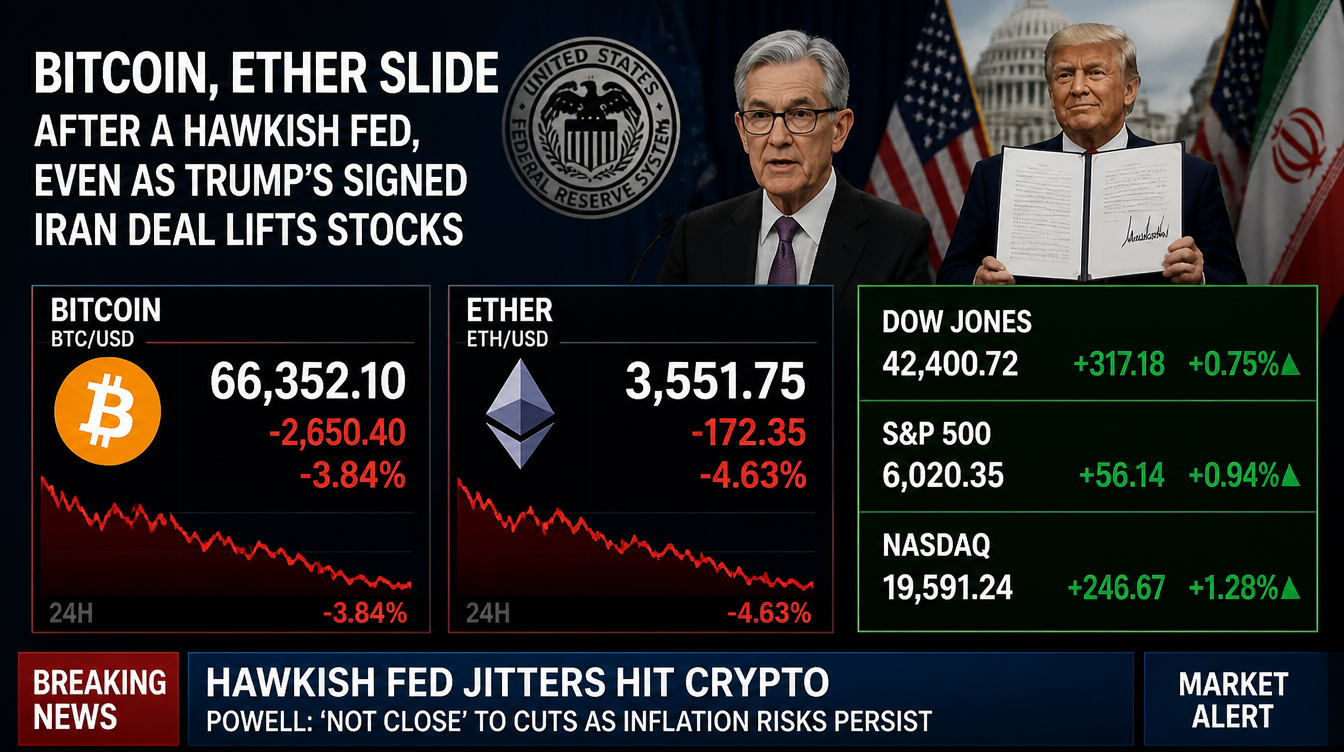
Crypto markets declined broadly on Thursday, largely ignoring the boost from a signed Iran peace agreement that supported equities, after the Federal Reserve held interest rates steady but delivered a more hawkish message, emphasizing inflation risks over economic growth.
Bitcoin was trading near $63,900, down about 3% over the past 24 hours, while still up roughly 2% on the week, according to CoinDesk data. Selling pressure was widespread across major assets: Ether slipped 3.4% to $1,733, XRP fell 3.9% to $1.17, and Solana declined 3.6% to $71. Hyperliquid’s HYPE, which had led gains earlier in the week, dropped the most—down 7.2% to $69—though it remains up about 28% over seven days. Tron was the only major token to post gains, rising 0.9%.
The Federal Reserve was the main driver of the move. Policymakers left rates unchanged at 3.5%–3.75%, as expected, but updated projections pointed to stickier inflation and a slower pace of future rate cuts, with some officials even suggesting rates could still move higher.
It was the first policy decision under new Fed Chair Kevin Warsh, who highlighted extensive internal debate and reaffirmed the central bank’s commitment to price stability. The overall tone leaned hawkish, reinforcing expectations of tighter financial conditions that typically weigh on liquidity-sensitive assets like crypto.
Equities moved in the opposite direction, supported by geopolitical news. President Donald Trump signed a preliminary peace deal with Iran aimed at ending hostilities and reopening the Strait of Hormuz, lifting sentiment in traditional risk markets.
S&P 500 futures rose as much as 0.9%, while Nasdaq futures gained up to 1.5%. Brent crude eased toward $78 per barrel. Crypto, however, failed to follow the equity rebound, underscoring its current focus on monetary policy over geopolitical developments.
Analysts expect Bitcoin to remain range-bound unless a fresh catalyst emerges. “We expect bitcoin to continue to trade in the $60,000 to $70,000 range in the coming weeks absent any major catalyst,” said Hashdex’s Gerry O’Shea, pointing to possible triggers such as the CLARITY Act becoming law or further US-Iran de-escalation.
He added that sentiment remains muted as attention shifts toward IPOs and AI equities, though institutional adoption and regulatory clarity could eventually bring capital back into crypto.
Overall, the price action still resembles consolidation rather than capitulation. Bitcoin holding in the low $64,000 area suggests selling pressure may be stabilizing, but upside remains limited as tighter Fed policy continues to cap liquidity.