Here’s another rewrite with a cleaner, more concise market-report style:
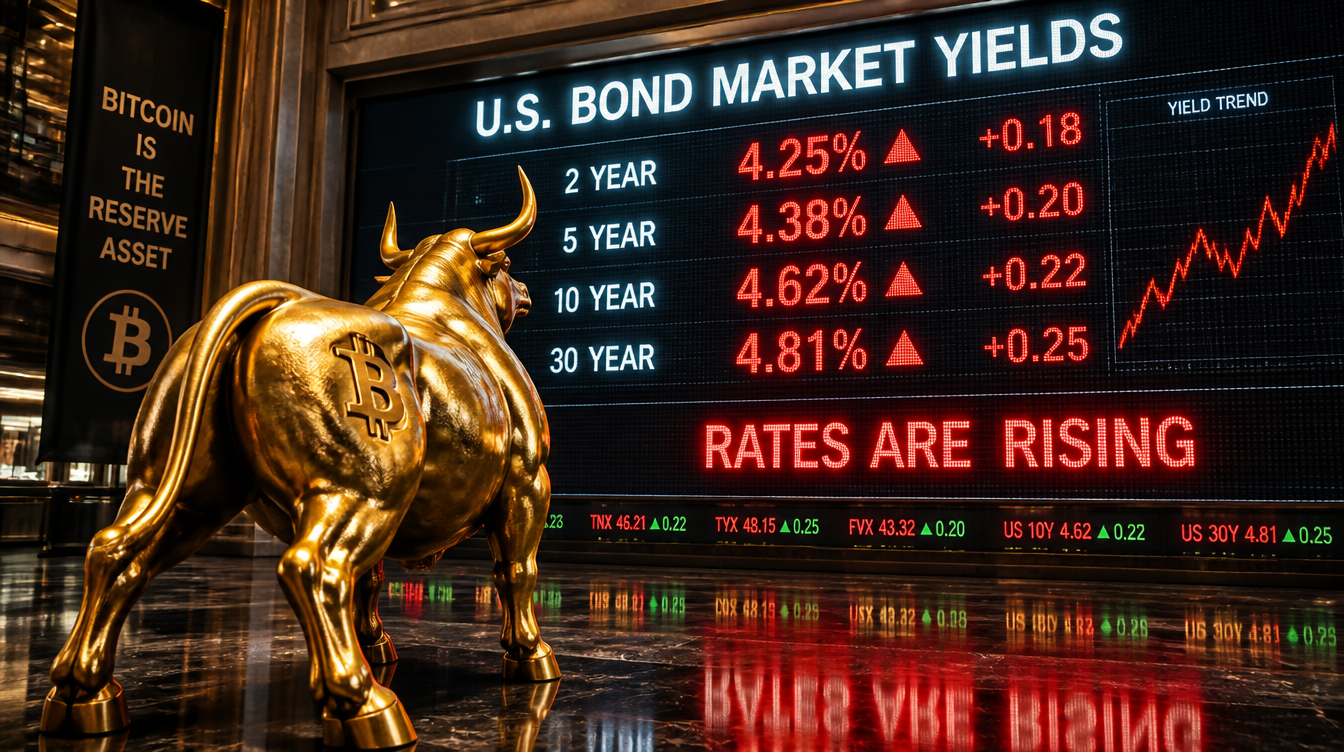
The bond market is signaling conditions that could weigh on any near-term Bitcoin rally.
A notable shift in fixed income markets is sending weaker signals to risk assets, including Bitcoin (BTC), which recently traded near $62,556.
The spread between the U.S. 10-year and 2-year Treasury yields has narrowed to 28 basis points, its tightest level since April 2025, according to TradingView data. This yield curve flattening is widely viewed as a sign that monetary policy is becoming more restrictive.
Skanda Amarnath of EmployAmerica said the move reflects a clear signal that the Federal Reserve is turning more hawkish.
A more hawkish stance generally implies higher interest rates for longer, which tends to pressure non-yielding assets like Bitcoin as investors favor income-generating fixed income securities.
The flattening is also evident further out the curve, with the 30-year to 5-year spread falling to its lowest level since April last year.
This marks a reversal from earlier in the year, when a steeper curve reflected expectations of rate cuts and supported risk assets, including crypto. That tailwind now appears to be fading.
Why it matters
The bond market is a key channel through which monetary policy is transmitted into financial conditions, making yield curve movements a closely watched signal of policy expectations.
The 2-year yield reflects near-term Fed policy expectations, while the 10-year captures longer-term growth and inflation outlooks.
Under normal conditions, the curve slopes upward as investors demand higher yields for longer-term lending risk. When it flattens, it typically signals expectations of prolonged higher rates or concerns about weaker growth.
At present, the flattening appears driven mainly by expectations that rates will remain elevated following the Federal Reserve’s latest decision. While rates were left unchanged, the tone was broadly interpreted as hawkish.
The updated dot plot reinforced that view, showing a higher projected rate path, with the median forecast rising to 3.8% for 2026 from 3.4% in March. Projections for 2027 and 2028 also moved higher.
The outlook among policymakers remains divided, with varying expectations ranging from steady rates to additional hikes.
Taken together, the signals suggest Bitcoin may face continued pressure in the near term. That would align with the widely discussed four-year halving cycle, which some analysts expect could see a potential market bottom forming around October.