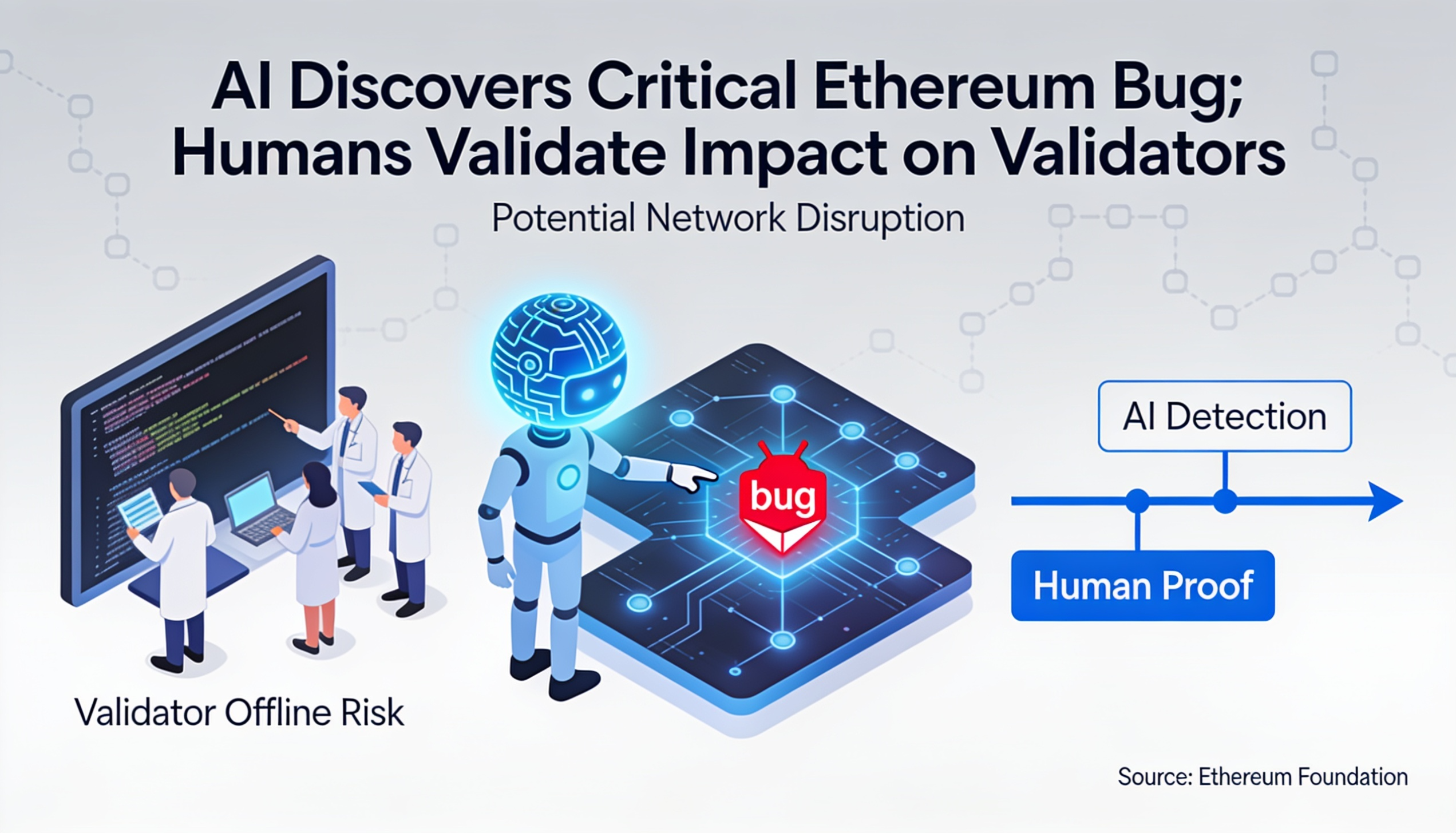
AI identified an Ethereum validator crash bug, but human verification proved essential
The Ethereum Foundation recently tested coordinated AI agents against the software used by Ethereum validators and discovered a remotely exploitable crash vulnerability. However, the experiment also generated a large number of convincing but incorrect bug reports, highlighting the importance of human expertise in evaluating AI-generated security findings.
Developers at the Ethereum Foundation used AI-powered tools to examine Ethereum’s underlying software infrastructure in an effort to uncover vulnerabilities and further strengthen the security of the blockchain network.
Although the AI systems successfully detected real issues, researchers found that human analysis was still required to determine which findings represented actual risks and which were false positives. The Foundation’s Protocol Security team later shared details from the experiment and provided recommendations for teams incorporating AI into their security workflows.
Ethereum’s network consists of thousands of nodes, which run the blockchain’s software, store copies of transaction history, and communicate with one another. Validators rely on this infrastructure to receive messages, verify blocks, and participate in network consensus.
The vulnerability discovered by the researchers was located in the gossipsub communication layer. The flaw allowed a remote attacker to force a node into a crash state by triggering an invalid calculation, causing the software to shut down. For validators, this could result in temporary downtime until the affected node was restarted.
The security issue was quickly fixed and disclosed as CVE-2026-34219, with credit assigned to the researchers involved. However, the main challenge of the AI experiment was not simply discovering bugs, but identifying which AI-generated reports reflected real vulnerabilities.
Nikos Baxevanis, who authored the Foundation’s report, noted that much of the effort went into separating genuine security flaws from findings that only appeared legitimate.
Unlike traditional fuzzing tools, which typically produce a crash report and technical details showing where a failure occurred, AI agents generate much more elaborate outputs. They can explain potential attack scenarios, describe the impact, suggest severity ratings, and create proof-of-concept code.
This ability makes AI reports sound highly convincing, even when the supposed vulnerability does not actually exist.
The Ethereum Foundation highlighted three major categories of recurring false positives.
The first involved crashes that only occurred in development builds. These versions contained additional safety checks that were not included in production software, meaning the issue could not affect real-world users.
The second involved theoretical attacks that required an attacker to manually place a harmful value into the system. In practice, external attackers could not deliver the value because existing safeguards blocked it before reaching the vulnerable point.
The third category involved formal verification mistakes, where AI misunderstood mathematical proofs. In some cases, the proof only confirmed a trivial statement rather than proving anything meaningful about the software’s security.
Researchers found that AI systems are also less effective at detecting vulnerabilities that depend on a sequence of normal actions occurring in a specific order. Many major crypto attacks do not rely on a single broken component but instead exploit combinations of legitimate operations.
Recent incidents across the crypto industry reflect this pattern. The Edel Finance attack involved manipulating the layer built around a valid Chainlink price feed, while the BONK governance exploit combined ordinary actions such as token purchases, voting, and proposal execution to create a malicious outcome.
The Ethereum Foundation’s conclusion is that AI can be a powerful tool for discovering potential weaknesses, but human experts remain necessary to verify findings, assess real-world impact, and determine whether a reported bug represents an actual threat.