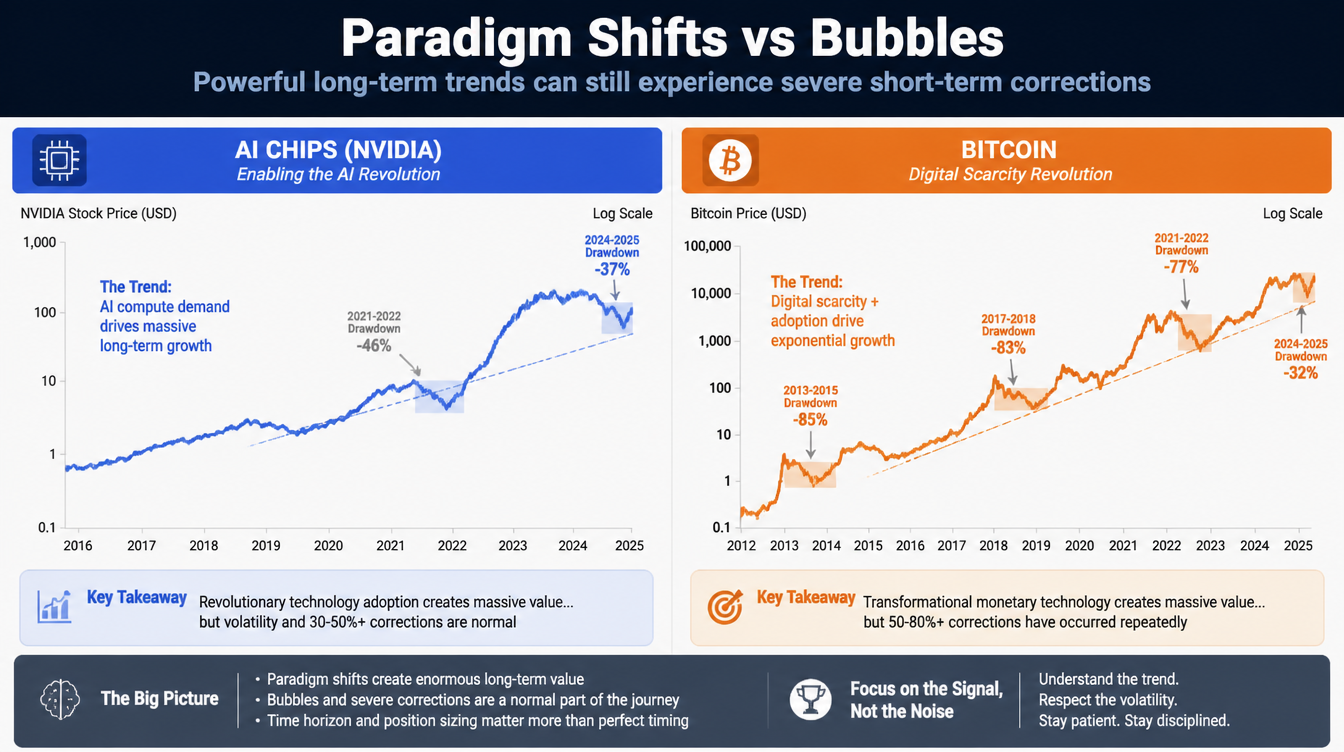
Structural transformations can deliver meaningful long-term growth opportunities, but the explosive gains across AI semiconductors, metals, and bitcoin highlight how quickly strong investment stories can turn into speculative excess.
The phrase “paradigm shift” is frequently applied to market trends that may sometimes be nothing more than rapid investor rotation into the latest high-growth themes. The recent AI-driven semiconductor surge is one example of how quickly capital can flow into a dominant market narrative.
Technology giants such as Amazon and Google are making massive investments in AI data centers filled with thousands of advanced computing chips. These facilities require huge volumes of high-bandwidth memory for AI processing and NAND flash storage for data management, creating tighter supply conditions and supporting higher chip prices.
Memory manufacturers such as Micron Technology (MU), which produces DRAM, NAND, and related products, and Sandisk (SNDK), which focuses on NAND flash and solid-state storage, benefited significantly from the AI boom. Micron’s stock climbed nearly 700% over the year, while Sandisk surged more than 4,000%. However, both companies later pulled back from their record highs, showing how quickly market sentiment can shift.
The AI investment wave also fueled major market milestones, including SpaceX (SPCX) completing the largest U.S. IPO in history. SK Hynix (00060), a key supplier of high-bandwidth memory chips, raised $26.5 billion in the largest U.S. listing ever by a foreign company. While its ADRs initially jumped, later volatility highlighted the danger of investing during periods of extreme optimism, with SK Hynix shares falling 15% during Asian trading.
Precious metals experienced a comparable cycle. Gold and silver rallied strongly during the “debasement trade,” driven by expectations that rising government debt, monetary expansion, and inflation could weaken fiat currencies. Silver surged by more than $120 in January 2026 before losing as much as half of those gains, while gold also experienced a smaller but notable correction.
Strategy (MSTR), the world’s largest corporate bitcoin holder, faced a similar shift in market perception. Its “infinite money glitch” approach — issuing shares at a premium to its bitcoin holdings and using the capital to accumulate more BTC — eventually lost momentum. The company’s stock has since declined roughly 80% from its peak as the valuation premium narrowed toward its underlying net asset value.
The broader lesson is that genuine structural trends can coexist with highly cyclical valuations. Transformative technologies and assets may have strong long-term potential, but excessive enthusiasm can still create sharp corrections when expectations move too far ahead of fundamentals.