Here’s a refined rewrite with a smoother, more cohesive narrative:
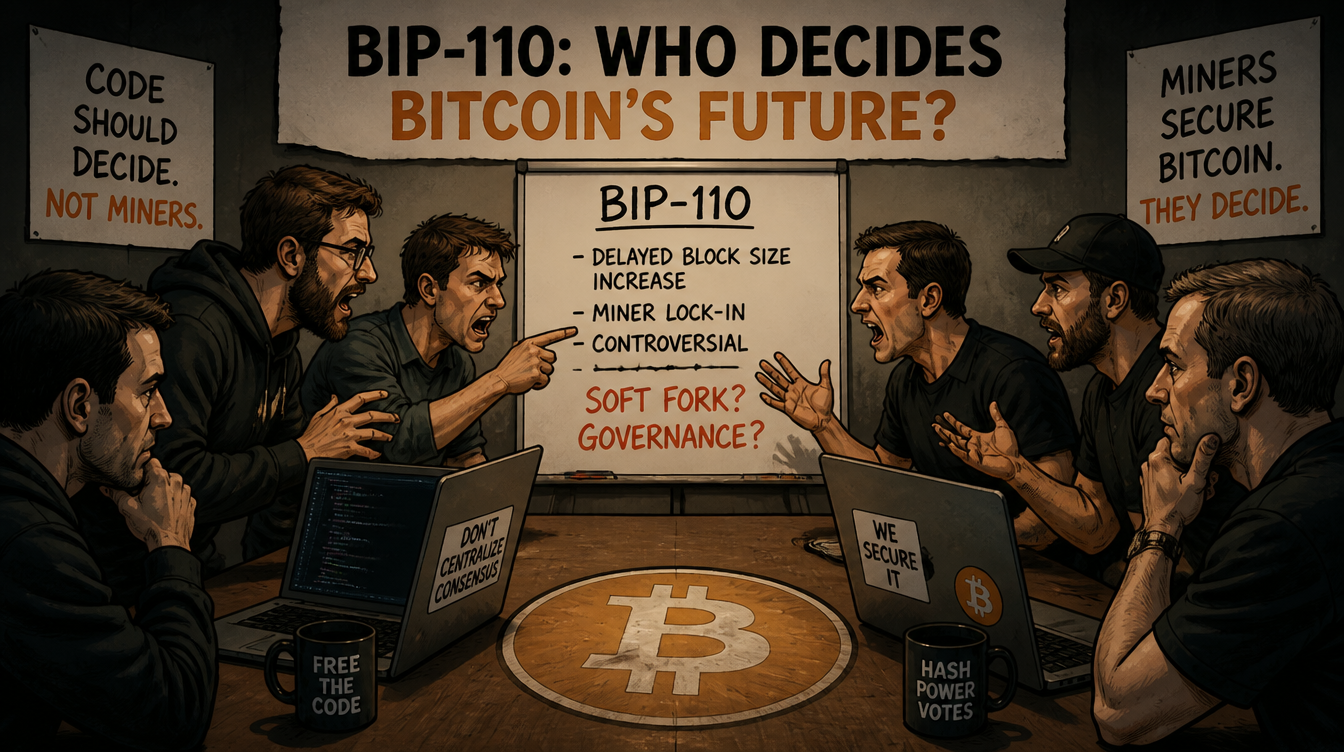
BIP-110 set out to reduce the use of Bitcoin’s blockchain for non-financial data, but instead it reignited a broader debate around censorship, neutrality, and decentralization.
Bitcoin has weathered exchange failures, regulatory pressure, and repeated disputes over scaling. Still, this proposal—focused on limiting certain types of data—quickly became one of the most contentious governance discussions in years.
The Bitcoin Improvement Proposal (BIP)-110 aimed to temporarily tighten consensus rules, making it significantly harder to include non-financial transactions on the network.
Supporters viewed it as a way to refocus Bitcoin on its original role as peer-to-peer digital cash. Critics, however, argued it risked restricting legitimate uses and introducing elements of censorship.
The proposal now appears unlikely to advance after failing to gain broad support, with several well-known developers and investors opposing it. Even so, the debate sheds light on how Bitcoin governance plays out in practice.
The Blockspace Debate
At the core of the issue is a long-standing question: what should Bitcoin’s blockspace actually be used for?
The Taproot upgrade in 2021 enabled users to embed data such as text and images into transactions. This gave rise to inscriptions, which powered Ordinals—Bitcoin’s NFT-like assets—and later Runes, a protocol often associated with memecoins.
Supporters argue these applications are valid because users pay for blockspace and should be free to use it as they choose. From this perspective, Bitcoin should remain neutral and not judge how its network is used.
Critics take a different view. Developers like Luke Dashjr argue these use cases exploit technical gaps rather than intended functionality. They warn that large amounts of non-financial data can bloat the blockchain, increase the cost of running full nodes, and make decentralization harder to maintain by favoring larger operators.
BIP-110 did not propose a permanent ban, but instead sought to tighten transaction rules in a way that would effectively block inscription methods for about a year, giving developers time to consider longer-term solutions.
However, opponents argued that introducing restrictions based on transaction type undermines Bitcoin’s principle of neutrality. Historically, valid transactions have been treated equally, and limiting one category could set a precedent for broader restrictions in the future.
Why the Proposal Stalled
The process for advancing BIP-110 also proved controversial. Bitcoin upgrades typically require widespread agreement across miners, developers, businesses, and users. In contrast, this proposal revived the idea of user-led activation, where nodes would enforce new rules if certain conditions were met.
Supporters saw this as a necessary fallback if miners failed to act. Critics warned it could split the network into incompatible versions—an outcome reminiscent of the 2017 block-size conflicts.
Ultimately, the proposal failed to gain traction. Miners had little incentive to reject transactions that generate fees, and institutional participants showed little appetite for renewed governance disputes.
Michael Saylor, founder of Strategy, criticized the proposal, warning that it could invalidate legitimate transactions and create a dangerous precedent.
Blockstream co-founder Adam Back also voiced opposition.
With support from only around 0.7% of miners, BIP-110 has effectively reached a dead end.
The Bigger Picture
Even if BIP-110 does not move forward, the debate highlights a deeper question about Bitcoin’s role and future direction.
It also reinforces a core reality: meaningful changes to Bitcoin require broad consensus among developers, miners, businesses, and users. Without that alignment, even well-intentioned proposals are unlikely to succeed.