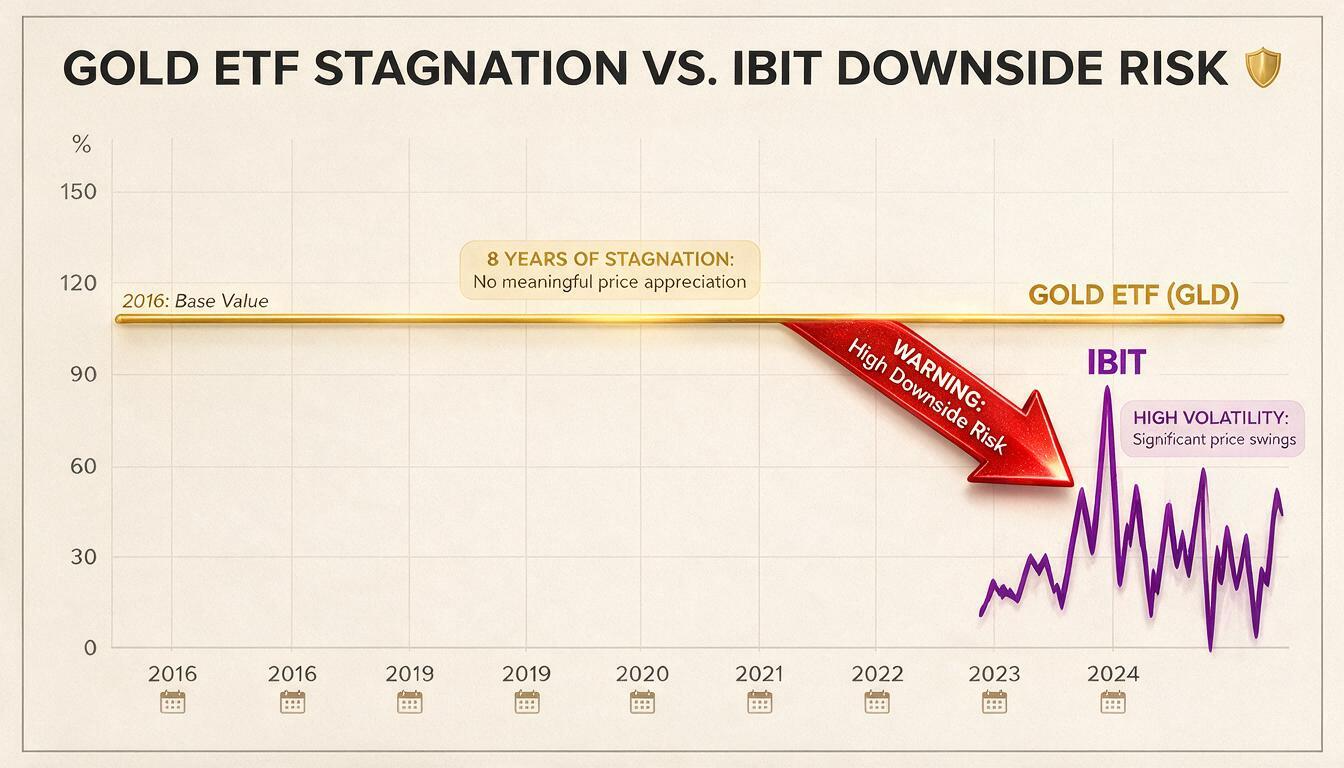
Eric Balchunas contends that gold ETF history offers the clearest playbook for Bitcoin ETF investors — a path that included nearly eight years of sideways movement before a renewed climb to record highs.
BlackRock’s IBIT has recently sold close to 100,000 BTC to meet redemption demand, trimming its holdings to just over 733,000 BTC. This comes as Bitcoin rebounds roughly 10% after slipping below $57,000 in early July 2026, a drop that represented more than a 50% decline from its October 2025 peak above $126,000.
In this context, Balchunas, senior ETF analyst at Bloomberg Intelligence, frames the current situation as a structural phenomenon rather than a temporary market shock. He points to the two-decade evolution of gold ETFs as the most relevant comparison for understanding how Bitcoin ETF cycles may unfold.
His argument centers on the nature of these products. Bitcoin and gold ETFs are both built on non-yielding assets, meaning their performance is largely dictated by shifts in investor sentiment rather than underlying cash flows or traditional valuation metrics.
As a result, volatility is inherent. Prices can swing quickly as demand rises or falls, without the stabilizing effect of income generation. Gold’s flagship ETF, GLD, briefly became the world’s largest ETF in 2011, only to lose that position and spend years struggling to regain momentum.
Balchunas sees a similar pattern emerging in Bitcoin ETFs. Since launching in January 2024, U.S. spot Bitcoin ETFs have attracted around $38 billion in net inflows, making them one of the fastest-growing ETF categories. Yet demand remains uneven, reinforcing the idea that sentiment — not fundamentals — drives the cycle.
Despite these fluctuations, the broader backdrop remains constructive. Gold’s market capitalization has expanded to nearly $28 trillion since the introduction of gold ETFs in 2004, demonstrating that long-term growth can coexist with extended periods of stagnation.
ETF Flows and Market Stability
The recent wave of redemptions from IBIT highlights the importance of fund flows as a short-term market signal. The liquidation of nearly 100,000 BTC underscores how quickly sentiment-driven outflows can impact prices, particularly in a fragile macro environment. Analysts at Bitfinex have warned that continued outflows could threaten the ongoing recovery.
At the same time, there are signs of resilience beneath the surface. Simon-Peter Massabni of XS.com notes that institutional demand remains steady, even as headline flow data suggests volatility. Continued inflows from large investors have helped absorb selling pressure during recent pullbacks.
This dynamic supports Balchunas’ broader thesis: institutional participation may act as a stabilizing force, potentially limiting the severity and duration of downturns compared to gold’s prolonged eight-year plateau. However, the current redemption cycle in IBIT has yet to provide a definitive answer.
Higher Peaks, Despite the Cycles
Balchunas maintains a constructive long-term view, emphasizing that each gold ETF cycle has ultimately produced higher highs. From this perspective, Bitcoin’s drop from above $126,000 appears more like a cyclical correction than a structural breakdown.
The key question for Bitcoin ETF investors is whether the current slowdown in demand will reverse on the back of a macro catalyst — such as a shift in Federal Reserve policy — or evolve into a longer period of consolidation similar to gold’s post-2012 phase.
While Bitcoin’s recovery from below $57,000 is consistent with this framework, it remains too early to confirm. The lesson from gold is clear: the absence of yield is not a fatal weakness, but sentiment-driven assets require patience, as their recovery unfolds on a longer and less predictable timeline.