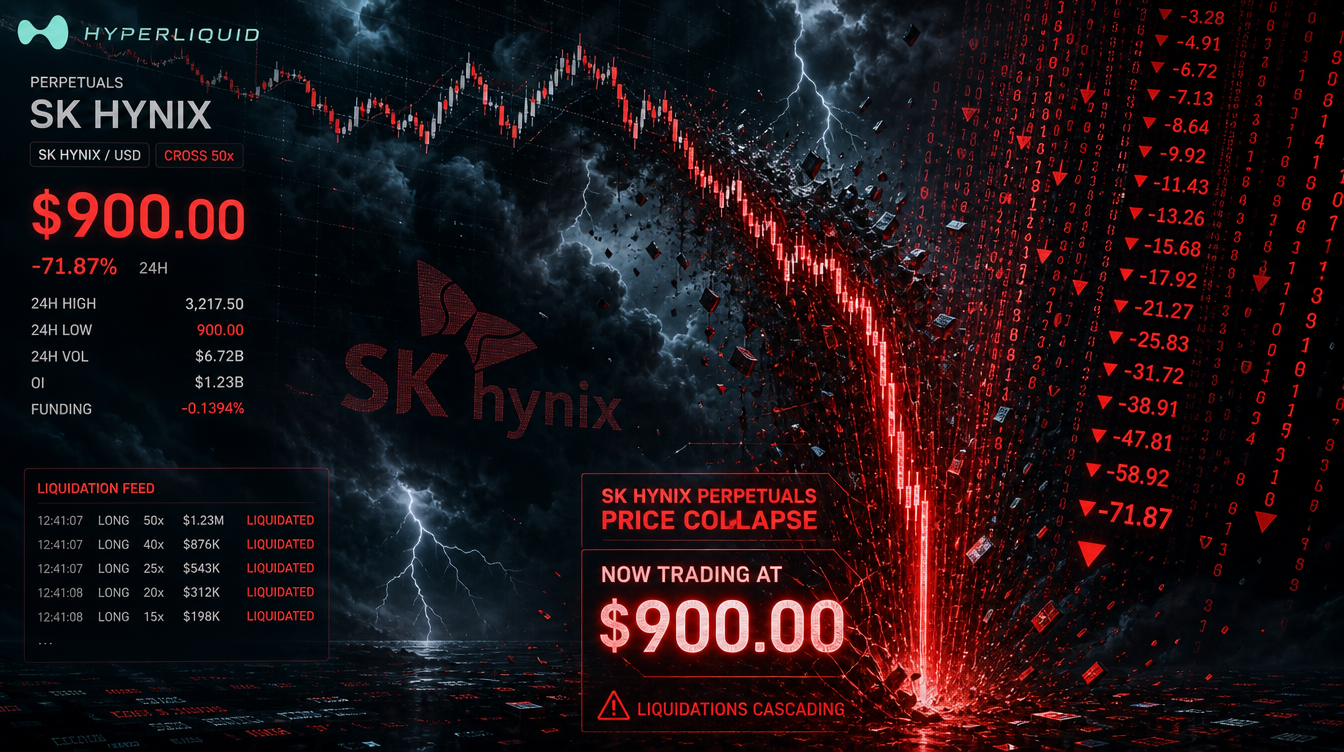
Perpetual futures connected to SK Hynix’s American depositary receipts (ADRs) experienced a sharp flash crash on Hyperliquid, briefly losing 20% of their value within a minute before quickly recovering above $1,000.
The sudden price collapse happened shortly before the South Korean semiconductor company’s shares came under pressure in its domestic market. The Hyperliquid contract tracks the company’s Seoul-listed stock through ADR-linked exposure following SK Hynix’s Nasdaq debut earlier this month.
Data from Hyperliquid showed the perpetual contract plunging to $900 between 23:00 UTC and 23:01 UTC before recovering past the $1,000 level just one minute later. The contract, which is quoted and settled in the dollar-backed stablecoin USDC, was recently trading at approximately $1,092.
Around an hour after the flash crash, South Korea’s stock market opened lower, led by losses in major chip companies. SK Hynix shares ended the session down 15% at 1,550,000 won ($1,762), while Samsung Electronics and Hyundai Motor were also among the biggest decliners. The benchmark Kospi index dropped 11%.
SK Hynix ADRs, with 10 ADR units representing one ordinary share, fell 4.5% in pre-market trading to $136.51.
Hyperliquid, a leading decentralized exchange specializing in perpetual futures, has gained popularity among traders seeking exposure to traditional financial markets through crypto-based products. Interest in these instruments has increased since the Iran conflict began in late February. Hyperliquid had not provided a statement regarding the incident at the time of publication.
Flash crashes are a recurring feature of crypto markets, especially during periods when U.S. trading hours end and Asian markets are yet to fully open. During these low-liquidity windows, markets can experience exaggerated price movements because exchanges have less depth to absorb large orders.
SK Hynix, one of the world’s largest suppliers of high-bandwidth memory (HBM) chips used in Nvidia’s artificial intelligence processors, has faced significant selling pressure in recent weeks. The company’s stock has fallen nearly 48% from its June 26 peak of 1,947 won.
The broader AI sector has also seen weakening momentum in traditional markets. Nvidia shares declined 5% on Monday after a Wall Street Journal report suggested the company could provide a financial guarantee of about $250 billion for an OpenAI-backed data center project.
The episode highlights the heightened volatility surrounding AI-related companies and the risks associated with trading traditional asset exposure through crypto-based derivatives during periods of thin liquidity.