Here is another rewritten version with a more engaging crypto-news style:
Solana’s latest governance push combines a major fee reform with a faster reduction in token issuance, but the proposal still needs nearly 40 million additional SOL in validator backing before it can move to a formal vote.
Validators have started signaling support for a pair of proposals that could significantly alter Solana’s supply mechanics by increasing the amount of SOL burned while slowing the pace of new emissions.
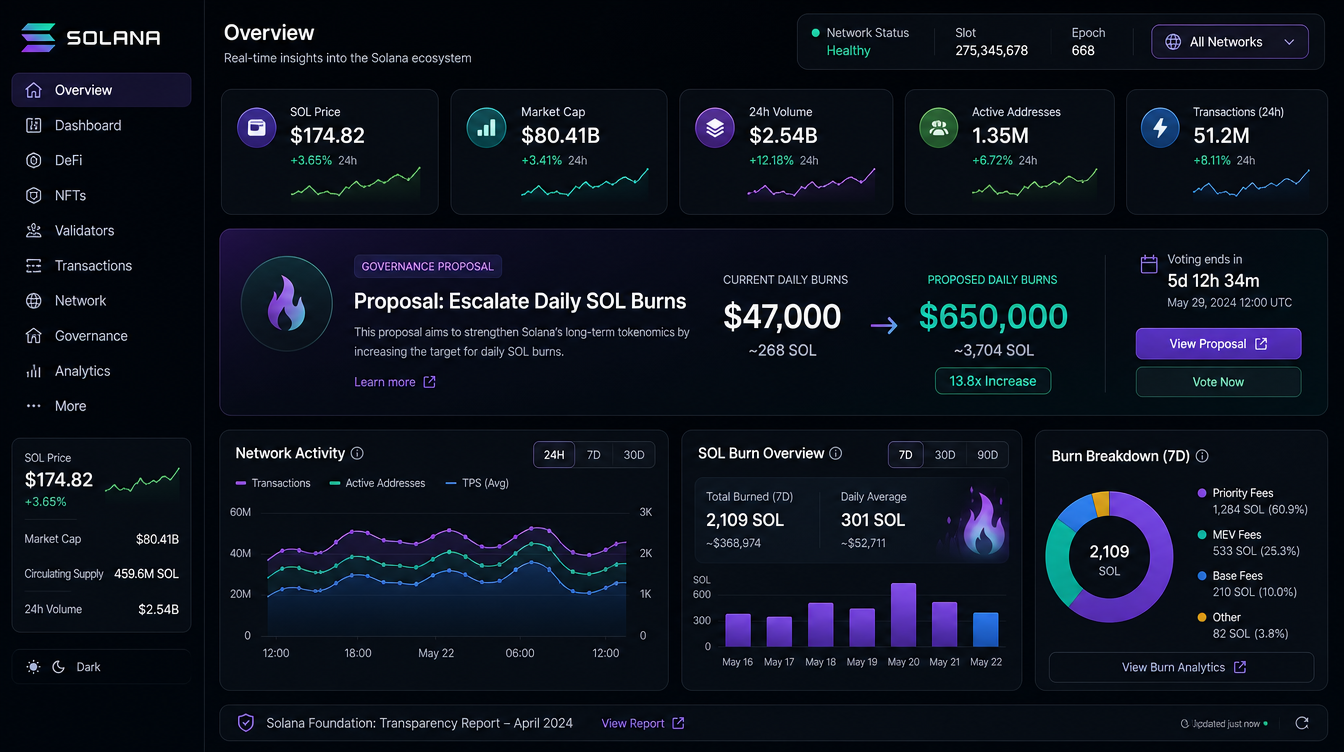
The first proposal, SIMD-0553, introduces a resource-based fee model that charges transactions based on the amount of network capacity they consume. If adopted, the change could raise daily SOL burns from around 650 tokens, worth roughly $47,000 at current prices, to between 7,500 and 9,000 SOL — potentially increasing daily burns to nearly $650,000.
The second proposal, SIMD-0550, focuses on inflation reduction by doubling Solana’s annual disinflation rate to 30%. The change would bring the network’s 1.5% inflation target forward to 2029, three years earlier than the current 2032 timeline, while cutting approximately 18.9 million SOL in future emissions over six years.
SIMD, short for Solana Improvement Document, is the framework developers use for proposing technical upgrades. SGP, or Solana Governance Proposal, is a newer stake-weighted governance process designed for broader validator decisions.
Combined, the proposals would apply pressure on SOL supply from both directions — removing more tokens through higher burns while reducing the number of new tokens entering circulation. Solana’s inflation rate currently sits around 3.8%, down from its initial 8% level under a schedule that lowers inflation by 15% annually.
Validator Support Determines the Next Step
The proposals have so far attracted 24.94 million SOL in support, representing 5.8% of the 432.65 million SOL currently staked. That leaves them about 38% of the way toward the 15% threshold required to advance to a formal vote.
Validators must contribute another 39.95 million SOL in support, valued at roughly $2.9 billion, before the signaling period ends on August 18.
Sixteen validators have backed the proposals so far, representing about 2.3% of the network’s validator set. Helius accounts for the majority of current support, contributing 16.03 million SOL — nearly two-thirds of the total. Blueshift ranks second with 3.6 million SOL, followed by Temporal Emerald with 1.24 million SOL.
Burn Proposal Alone Won’t Create Deflation
Despite the projected increase in burns, the change would not immediately make SOL deflationary. Even if daily burns reach the top estimate of 9,000 SOL, they would still be outweighed by roughly 60,000 SOL entering circulation each day through inflation.
That is why the two proposals are being considered together. SIMD-0553 focuses on increasing supply reduction, while SIMD-0550 targets the source by lowering future emissions.
Helius, the largest supporter of the proposals, also employs the developer behind SIMD-0550, linking one of the network’s major infrastructure providers with the inflation-reduction effort.
The 15% signaling requirement was introduced by the Solana Foundation in July to ensure only proposals with meaningful ecosystem impact proceed to validator-wide voting, while routine technical changes continue through the SIMD process.