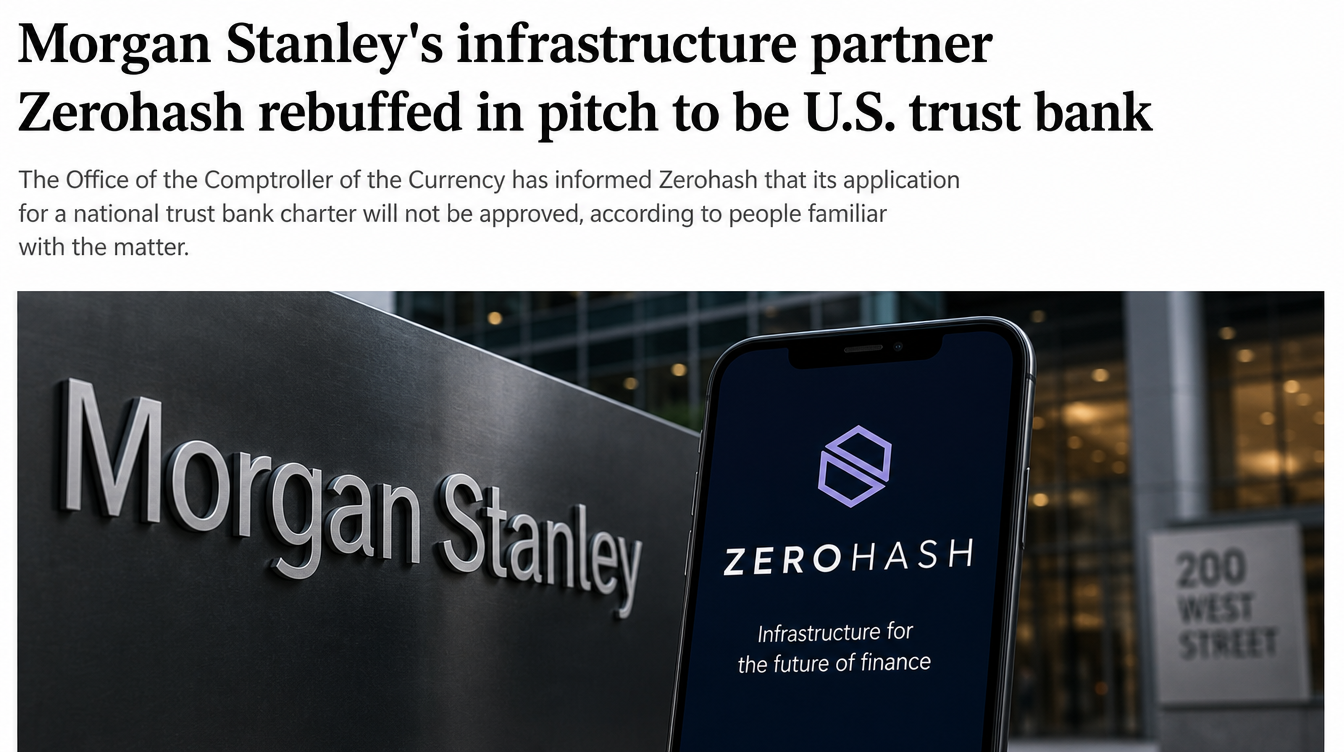
Zerohash, the crypto infrastructure provider serving financial institutions such as Morgan Stanley’s E*Trade, is preparing to refile its application for a U.S. national trust bank charter after regulators returned the original submission.
The Office of the Comptroller of the Currency sent back Zerohash’s application last month, preventing the Chicago-based company from joining the growing list of firms that have received provisional trust-bank approvals to offer digital-asset services.
The OCC did not formally deny the application. Instead, the filing was returned under a process used when regulators determine that an application is materially deficient. Zerohash said the move was administrative and made in coordination with the OCC, allowing the company to submit a revised application this month.
Zerohash said the return should not be interpreted as a decision on the merits of its proposal and stressed that its existing operations remain unaffected under its current regulatory approvals.
The company had recently promoted several positions at a planned “Zerohash National Trust Bank,” including national trust officer and chief operating officer roles. Its job listings described the charter application as pending, while Co-President Stephen Gardner’s LinkedIn profile identified him as CEO of the proposed bank.
The company suggested that its initial application may have attempted to cover too many activities at once. The proposal included a broad range of digital-asset and fiduciary services, while the revised application will take a more phased approach.
Zerohash now plans to seek approval for a narrower group of national trust activities that correspond with its intended rollout. The company said it is hoping for a quick review of the resubmitted application.
Zerohash Prepares to Try Again
Zerohash initially applied for the federal charter in March as crypto companies increasingly sought OCC approval to operate regulated trust banks. The wave of applications accelerated after the U.S. introduced a formal regulatory framework for stablecoin issuers under the Guiding and Establishing National Innovation for U.S. Stablecoins Act.
OCC records indicate that Zerohash’s filing was returned on July 17, although the records do not disclose the specific reason.
A returned application is different from a formal rejection and does not necessarily include a detailed explanation. Zerohash also did not voluntarily withdraw the filing and did not immediately announce that the regulator had returned it.
The OCC did not immediately comment on the application, while Morgan Stanley declined to provide a statement.
The regulator had recently explained that it can return applications that lack important information about a company’s finances, executives or other required areas. The OCC may also return a filing if an applicant fails to adequately respond to additional information requests during the review process.
Rapid Growth in Crypto Bank Applications
Zerohash’s application faced an objection from the Independent Community Bankers of America in April. The group argued that the rapid succession of crypto-related trust-bank applications and conditional approvals could make it difficult for regulators to develop policy in a careful and transparent manner.
The organization referenced applications or approvals involving Circle, Ripple, Paxos, BitGo, Fidelity Digital Assets, Crypto.com, Payoneer and Zerohash.
Zerohash was also reportedly seeking fresh investment earlier this year at a potential valuation exceeding $1.5 billion, when its federal charter application was still being reviewed.
The company provides crypto infrastructure for businesses including BlackRock, Franklin Templeton, Stripe, Interactive Brokers and DraftKings. It already operates under a state trust-bank charter, and a person familiar with the company said its E*Trade business does not depend on obtaining federal approval.
Compliance Lawsuit Adds Another Layer
Zerohash is also involved in a legal dispute with former Chief Compliance Officer Edgar Guerra, who alleges that he was fired after raising concerns about compliance practices.
Guerra, a former Federal Reserve official, claimed that he and his team identified more than 200 significant compliance gaps, including shortcomings in anti-money-laundering controls. He also alleged that some of the issues had been identified earlier but were not sufficiently addressed.
It remains unknown whether the OCC was aware of those allegations or whether they factored into the decision to return Zerohash’s application. The lawsuit is ongoing, and the company’s efforts to move the dispute into arbitration have encountered an initial setback.
Zerohash declined to comment on the case, while Guerra’s attorney did not immediately respond to requests for comment.
In a 2022 interview, Guerra said Zerohash had around two dozen compliance employees supporting a workforce of approximately 150 people. He also said the company’s leadership viewed compliance as an important competitive advantage.