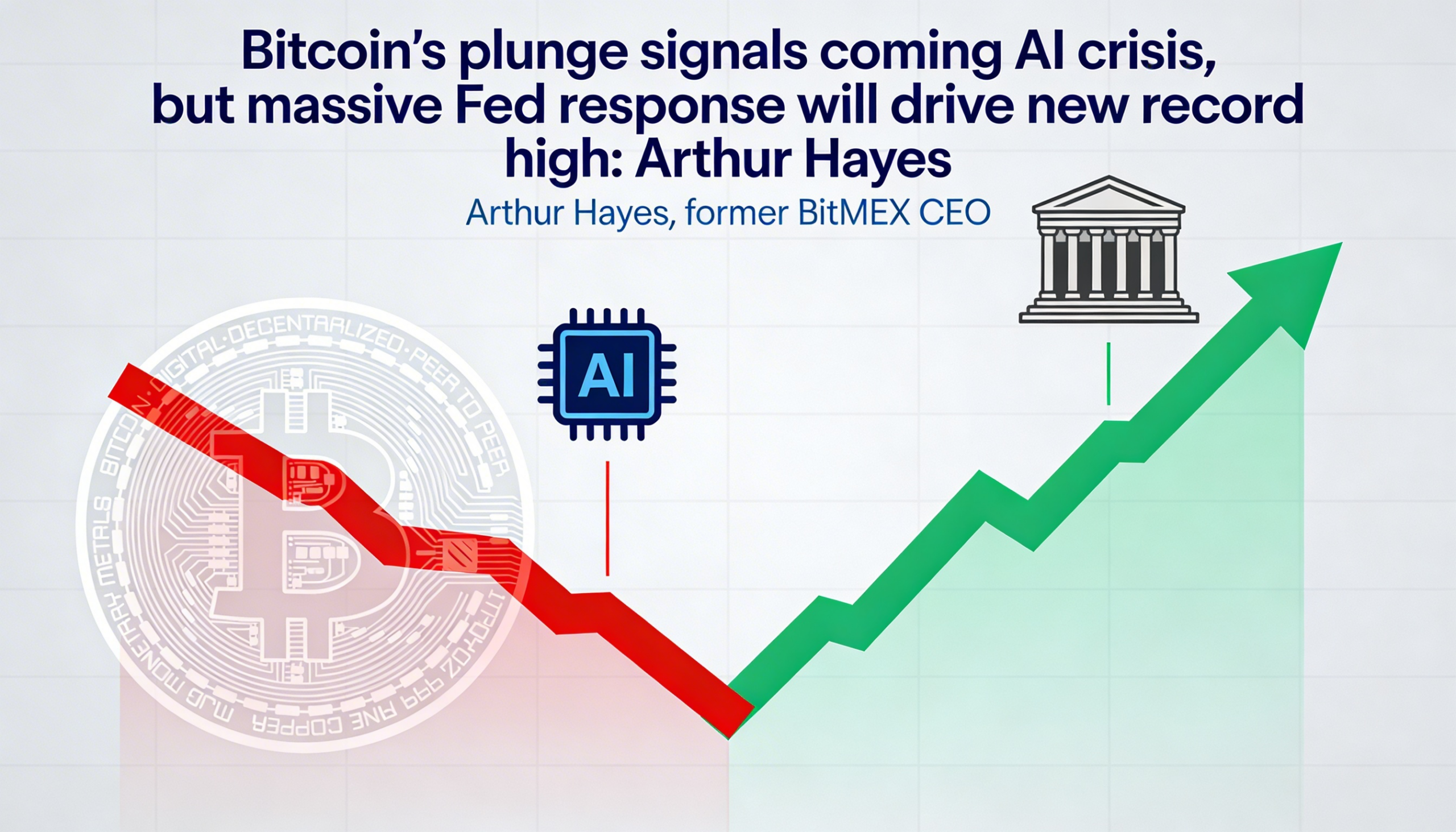
The rapid expansion of artificial intelligence could soon displace millions of workers, unleashing a wave of credit stress that reverberates through the banking system, according to Arthur Hayes.
The BitMEX co-founder argues that bitcoin’s 52% slide from its October peak is more than a standard correction. BTC has dropped from $126,000 to roughly $67,000, even as the Nasdaq has remained comparatively steady. Hayes views that divergence as a warning that crypto markets are pricing in financial stress well before equities.
In his latest essay, “This Is Fine,” Hayes characterizes bitcoin as the “global fiat liquidity fire alarm,” asserting that it reacts faster than traditional assets to shifts in credit conditions. In his view, the cryptocurrency’s decline reflects expectations of a major credit contraction that stock markets have yet to acknowledge.
Hayes outlines a scenario in which AI displaces 20% of the United States’ 72.1 million knowledge workers. Such a shock could lead to an estimated $557 billion in consumer credit and mortgage defaults — roughly half the scale of the 2008 financial crisis. Regional banks, he warns, would bear the brunt of that stress, potentially forcing the Federal Reserve into what he describes as the largest monetary expansion in history.
While deflationary shocks initially pressure risk assets, Hayes contends they ultimately set the stage for explosive rebounds once policymakers intervene. Markets typically price in the downturn first, he argues, before central banks respond with aggressive liquidity injections that reignite speculation.
He also flagged gold’s relative outperformance versus bitcoin as an additional signal of mounting risk aversion. A rising gold price paired with a weakening bitcoin, he suggests, reflects growing fears of a deflationary credit event within the U.S.-led financial system.
Hayes believes that once the Federal Reserve rolls out emergency liquidity measures — similar to its response during the regional banking turmoil in March 2023 — bitcoin will rebound sharply. Expectations of sustained money printing could then push the cryptocurrency to fresh record highs.
Still, he cautioned that further downside cannot be ruled out. Political dysfunction or delays in policy action could allow bitcoin to fall below $60,000 before a rescue materializes. In the meantime, Hayes advises investors to maintain liquidity, avoid leverage and wait for a clear signal from the Fed before aggressively rotating back into risk assets.