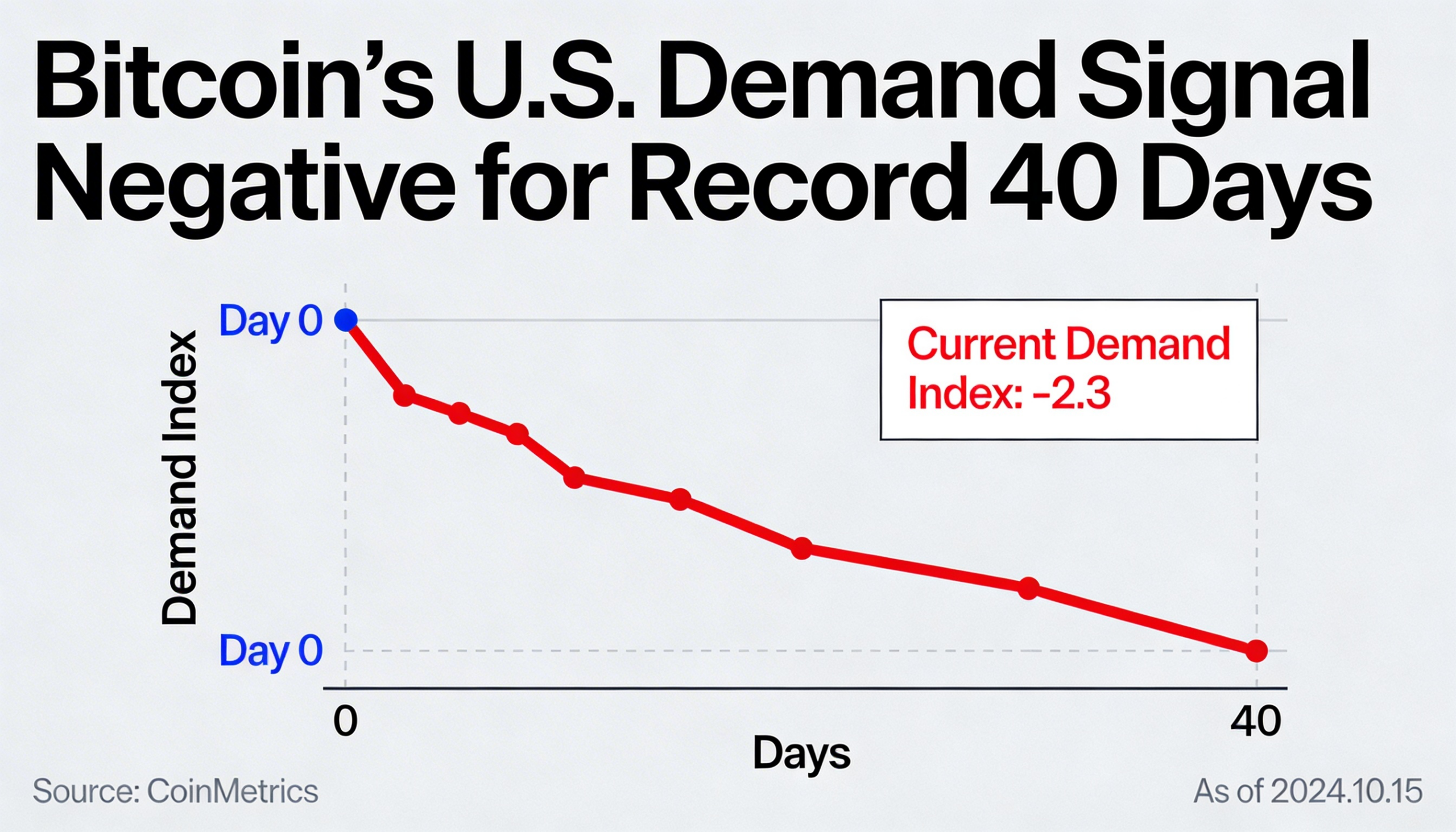
The indicator last registered a positive reading on Jan. 15, and its failure to reclaim that level following the Feb. 5 rebound suggests U.S. demand is structurally weak rather than simply on pause.
In the aftermath of the Feb. 5 sell-off, the closely watched Coinbase Bitcoin Premium Index briefly signaled a potential turnaround. That optimism faded quickly.
Data from Coinglass show the premium has now remained negative for 40 consecutive days — the longest sub-zero streak since 2023. The latest reading stands at -0.0467%, virtually unchanged from two weeks ago. At that time, a sharp contraction from -0.22% fueled hopes that American buyers were accumulating near cycle lows.
The index tracks the price difference between bitcoin on Coinbase and the broader global average. Because Coinbase is widely regarded as a proxy for U.S.-based institutional and dollar-denominated flows, a persistent negative premium indicates that American participants are either distributing into strength or remaining largely absent from the bid.
The previous record — roughly 30 straight days in negative territory — occurred during the October 2025 correction. That stretch ended when a strong recovery pulled U.S. capital back into the market. This time, despite bitcoin climbing as much as 15% from its Feb. 5 intraday low and reclaiming levels above $62,000, the premium never turned positive.
The divergence highlights a shift in demand composition. While price action improved, the recovery appears to have been driven primarily by non-U.S. flows, activity outside U.S. trading hours, or liquidity beyond Coinbase’s order books.
There is a mildly constructive development: since early February, the discount has steadily narrowed from -0.22% toward -0.05%. However, it has yet to cross into positive territory — a threshold that historically aligns with sustained accumulation phases rather than short-lived relief rallies.
At the same time, U.S. Google searches for “bitcoin zero” climbed to record highs earlier this month, even as global search interest remained relatively flat.
Together, the data points to a clear theme: American investor conviction is deteriorating at a pace not reflected in broader global markets.