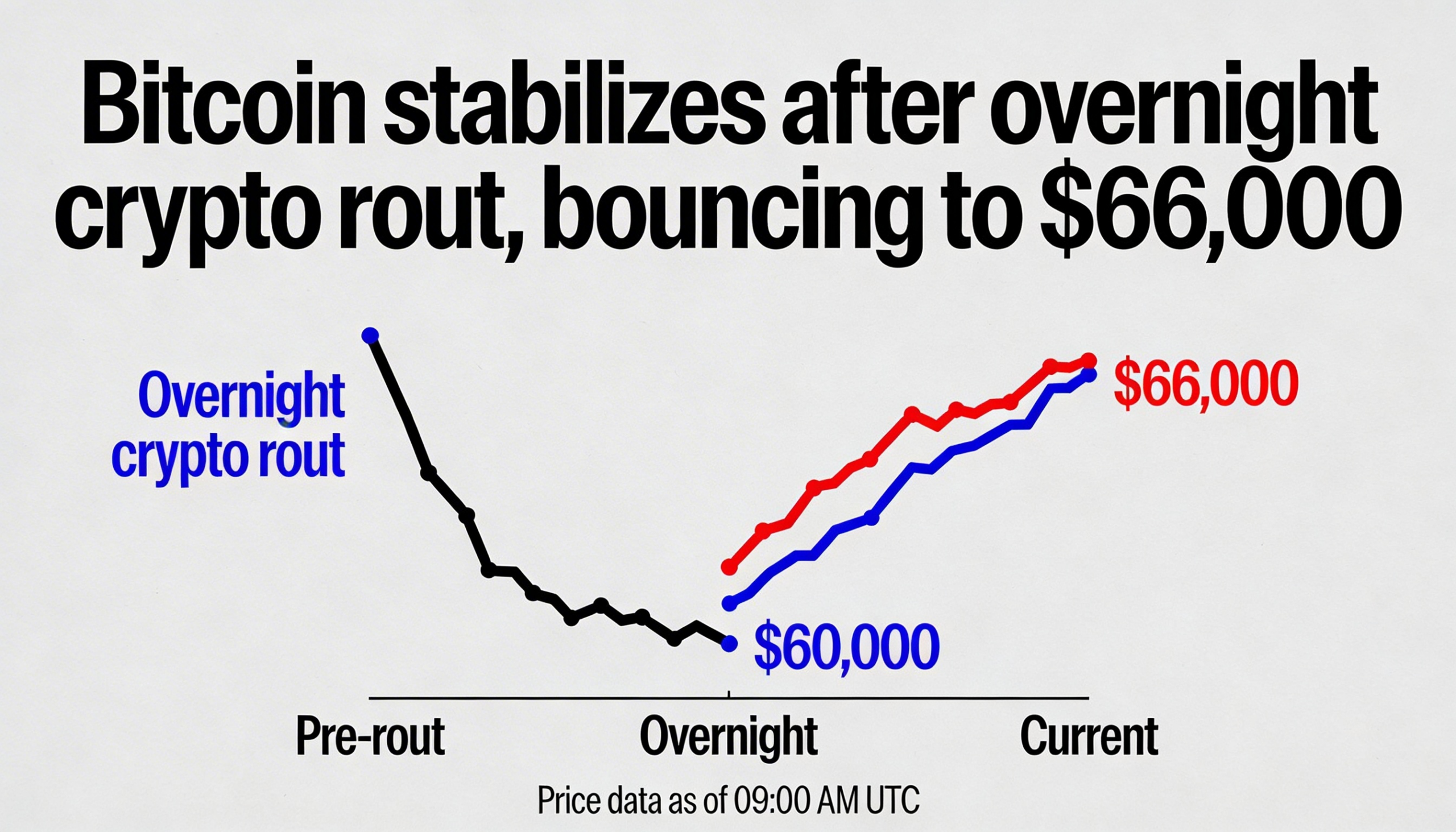
Bitcoin experienced sharp volatility during early Asian trading on Monday, sliding more than 5% to $64,270 shortly after midnight UTC before rebounding to around $66,300 by 11:00 UTC. Thin liquidity conditions appeared to magnify the move, which unfolded against the backdrop of renewed U.S. tariff threats and escalating geopolitical tensions.
The crypto market’s swings mirrored activity in traditional assets. Futures tied to the S&P 500 dropped 0.84% after opening Sunday evening, then began recovering several hours later. Gold futures, by contrast, surged at the open to their highest level since Jan. 30 before paring gains during European hours. Silver followed a similar trajectory.
The divergence between precious metals and risk assets came after U.S. President Donald Trump outlined plans for new 15% global tariffs on trading partners, while reports of an expanded U.S. military presence near Iran fueled demand for safe-haven assets.
Altcoins were hit particularly hard in the low-liquidity environment. Solana (SOL) and SUI fell between 7% and 8% overnight before staging a rebound during European hours. The sharp swings contributed to roughly $270 million in altcoin liquidations, according to CoinGlass.
Derivatives markets show caution
Demand for leverage remains muted. Total crypto futures open interest has stayed below $100 billion for more than two weeks, signaling restrained risk appetite.
Over the past 24 hours, exchanges forcibly closed approximately $500 million in crypto futures positions due to margin shortfalls. Meanwhile, traders have shown growing interest in futures linked to traditional-asset tokens. Open interest in Tether Gold (XAUT) futures jumped 14% in 24 hours, even as BTC, ETH, SOL, HYPE and DOGE saw capital outflows.
ZEC and CRO were the only tokens to post a positive 24-hour cumulative volume delta (CVD), indicating buyer dominance. In contrast, bitcoin and other major tokens recorded negative CVDs, suggesting selling pressure outweighed demand.
Bitcoin’s 30-day implied volatility index (BVIV) rose 9% to above 60%, reflecting heightened uncertainty. On Deribit, both bitcoin and ether put options traded at a premium to calls across maturities, underscoring persistent downside hedging. Traders showed particular interest in protective puts at $58,000, $60,000 and $62,000 strike levels following the tariff announcement.
Altcoins remain fragile
The broader altcoin market stayed under pressure after an outsized selloff triggered by bitcoin’s weakness and declines in U.S. equities.
Low liquidity amplified moves across smaller tokens. Pump.fun’s PUMP token dropped 8.5% before bouncing, while LayerZero’s ZRO lost 16.5% over 24 hours before recovering around 04:00 UTC. A handful of assets bucked the trend, with restaking protocol ETHFI rising more than 10% from its Monday low.
Telegram-linked toncoin (TON) displayed relative resilience, falling just 3.6% overnight before rebounding nearly 5%.
Among sector benchmarks, the CoinDesk DeFi Select Index (DFX) outperformed broader gauges, declining 1.84% over 24 hours. The CoinDesk Smart Contract Platform Select Index and CoinDesk Computing Select Index fell 3.56% and 3.23%, respectively.
Altcoins have largely tracked bitcoin’s direction throughout February, but thinner order books have exaggerated price swings. If bitcoin can establish a local bottom and reclaim levels above $70,000, several altcoins may be positioned for extended upside after early-month volatility flushed liquidity from the market.