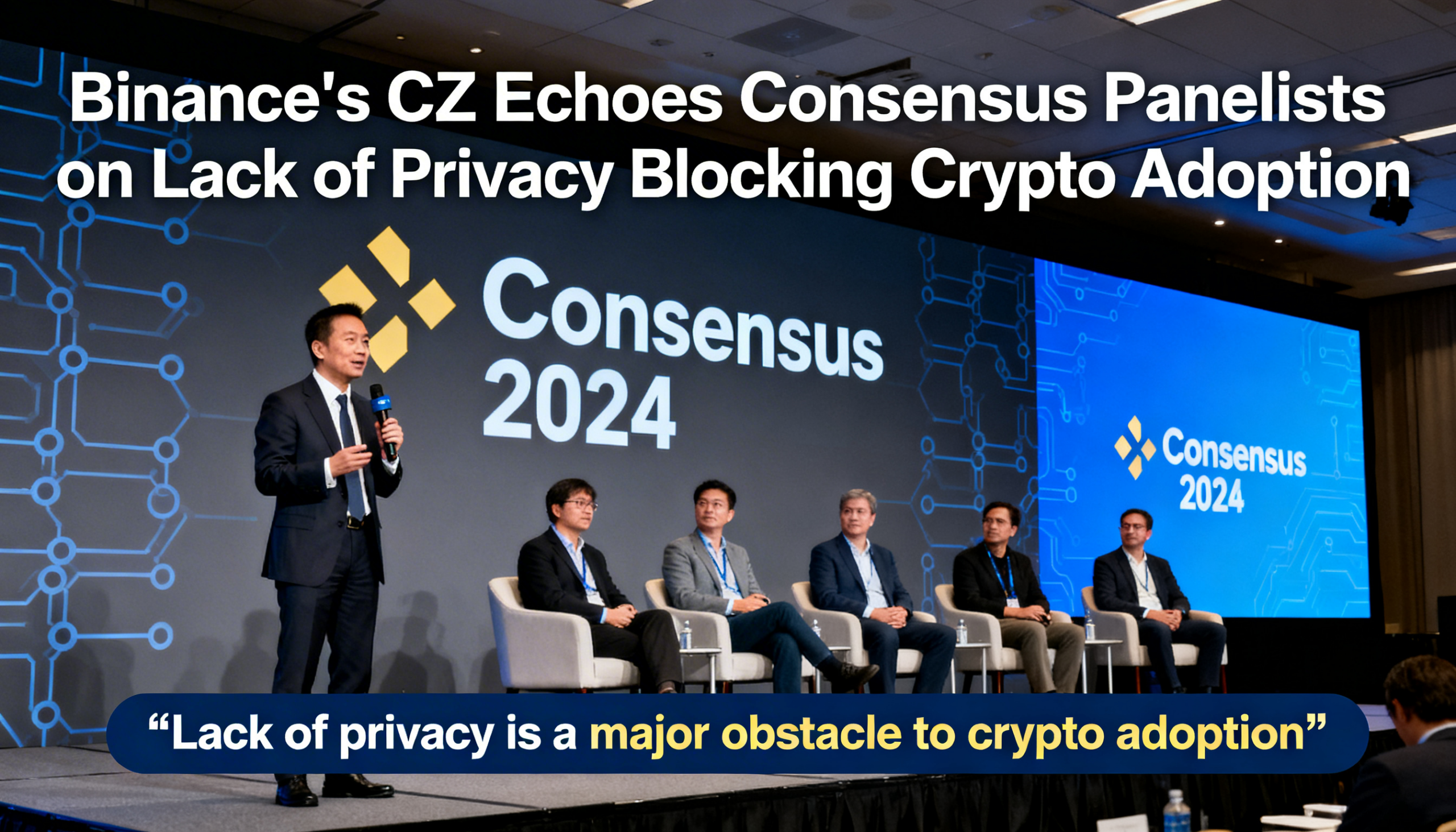
A lack of privacy remains one of the biggest obstacles to broader crypto and blockchain adoption, both for everyday users and large institutions, according to Changpeng Zhao and several industry executives speaking at CoinDesk’s Consensus event in Hong Kong.
The transparency of public blockchains has long been marketed as a feature — a break from opaque banking systems and backroom Wall Street dealing. But that same transparency means wallet balances, transaction amounts and counterparties can often be traced by anyone with the right tools.
For individuals, that raises uncomfortable questions. Paying salaries, transferring personal funds or executing a major business transaction on-chain can effectively expose sensitive financial information to the public.
Zhao, better known as CZ and co-founder of Binance, said this dynamic is holding back real-world crypto payments adoption.
“Privacy may be the missing link for crypto payments adoption,” Zhao wrote on X. “Imagine a company paying employees in crypto on-chain. In the current setup, you can pretty much see how much everyone in the company is paid.”
Institutional players share similar concerns. During a panel titled “The 2026 Outlook: The Institutional Market Cycle,” Fabio Frontini, CEO of Abraxas Capital Management, argued that privacy is essential for large-scale transactions if public blockchains are to become standard infrastructure on Wall Street.
“Total transparency isn’t particularly good,” Frontini said. While transactions should be auditable, he added, visibility should be limited to the relevant parties rather than fully public.
The discussion came in response to questions about when blockchain-based issuance of traditional instruments — such as commercial paper — might move from experimental trials to routine practice. In December, JPMorgan Chase arranged a $50 million U.S. commercial paper issuance for Galaxy Digital on the Solana network, with participation from Coinbase Global and Franklin Templeton. The deal used Circle’s USDC stablecoin for settlement, demonstrating the potential efficiency of tokenized debt markets.
While the transaction showcased the capabilities of public blockchains, it also underscored institutional hesitation around full transparency.
Emma Lovett, credit lead for the Markets Distributed Ledger Technology team at JPMorgan and a panelist at the event, said institutions need assurances that their activity will not be easily traceable by external observers.
“They need to be confident that it’s not going to take one person to identify their address and then see every transaction they’ve ever done,” she said.
Thomas Restout, group CEO of institutional liquidity provider B2C2, agreed that privacy is critical, but emphasized another factor: certainty of execution. Large financial institutions, he noted, do not experiment with small sums.
“If you’re a major institution, you’re not testing this with $10,000 — you’re thinking in terms of trillions,” Restout said. Operating at that scale requires a high degree of reliability, trusted counterparties and infrastructure that meets institutional standards.
Until privacy safeguards and execution certainty improve, panelists suggested, both Main Street users and Wall Street firms may remain cautious about moving significant financial activity onto fully transparent public blockchains.