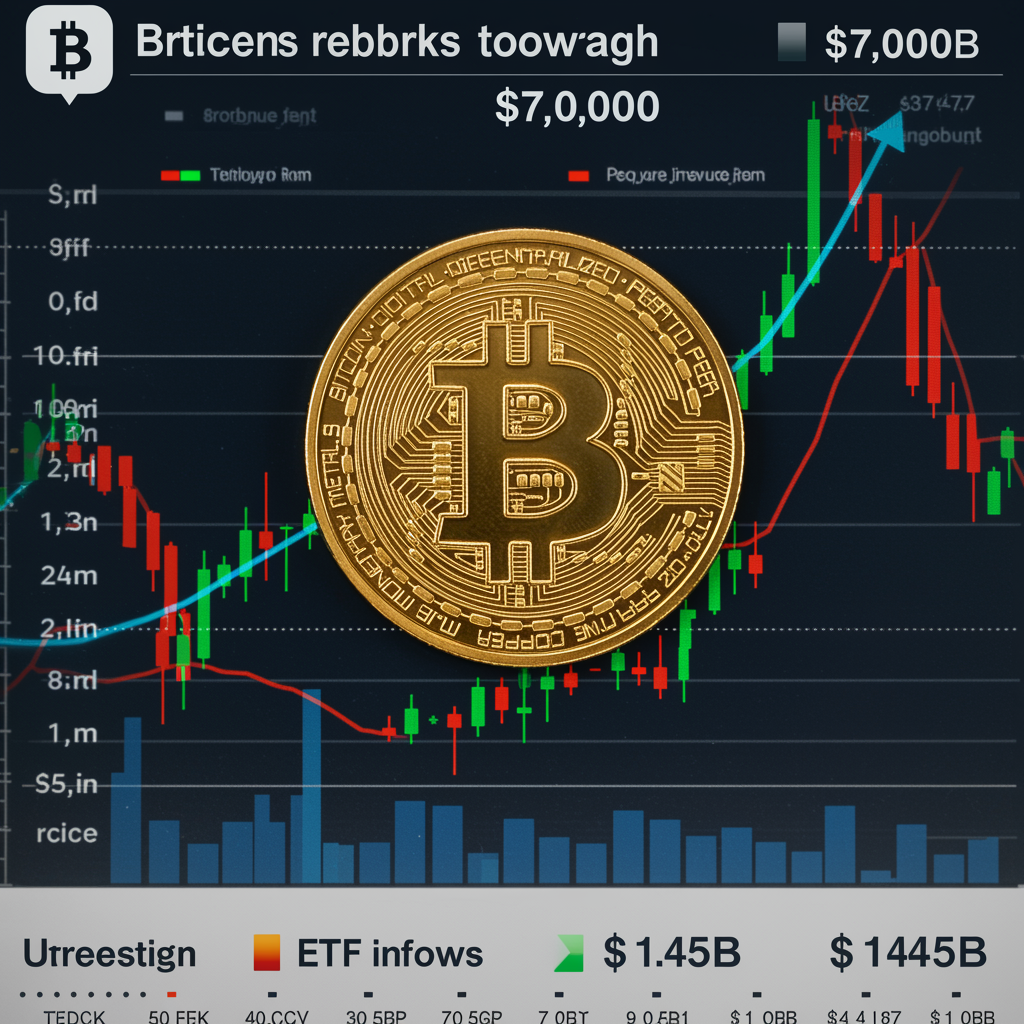
Bitcoin’s move back toward the $70,000 level appears to be driven more by market positioning than renewed bullish conviction, according to market maker Enflux. The firm said the rebound largely reflects traders closing short positions after betting against the market amid escalating geopolitical headlines.
The cryptocurrency was trading near $68,000 as midday trading began in Hong Kong, recovering from a weekend drop that briefly pushed prices toward $63,000. Enflux said the bounce began once fears of a rapid escalation into a broader regional conflict failed to materialize.
“The market is not pricing catastrophe, but it is not pricing resolution either,” the firm said in a note. Traders had built bearish positions following tensions tied to Iran over the weekend. When the situation did not quickly expand into a wider war threatening major Gulf trade routes, including those linked to Dubai, short sellers began covering positions, triggering a rebound.
The firm added that crypto markets often react more quickly than traditional financial assets during geopolitical shocks.
“When bombs fall or sanctions tighten, capital searches for exit routes. During periods of uncertainty, bitcoin can act as a pressure valve,” Enflux said.
Institutional demand has also offered support. Over the past five trading sessions, spot bitcoin exchange-traded funds have recorded approximately $1.45 billion in net inflows, helping stabilize prices after recent volatility.
Data from blockchain analytics firm Glassnode suggests that while conditions are improving, traders remain cautious. Momentum indicators have started to recover from recent weakness, with bitcoin’s relative strength index climbing to around 41 from about 36 the week before. However, the indicator remains below the neutral 50 level that typically signals stronger bullish momentum.
Spot market activity has also strengthened. Trading volumes have risen to roughly $9.6 billion from $6.6 billion a week earlier, while buying and selling pressure has become more balanced — a sign that the previous wave of aggressive selling is beginning to ease.
Derivatives markets, however, still show limited confidence. Glassnode said the cost of maintaining leveraged long positions has dropped sharply, while futures positioning continues to show sellers dominating buyers, indicating persistent caution among leveraged traders.
Prediction markets are reflecting similar uncertainty. On Polymarket, the probability of bitcoin falling to $65,000 during March has declined by 11 percentage points to 73%. The odds of a drop to $60,000 have also fallen by 10 points to 41%. Meanwhile, a separate contract tracking whether bitcoin reaches $60,000 before $80,000 has slipped 12 points to 61%.
Taken together, the data suggests bitcoin has found a degree of near-term support, though traders remain reluctant to price in either a sustained rally or a deeper downturn as geopolitical risks and macro uncertainty continue to weigh on sentiment.