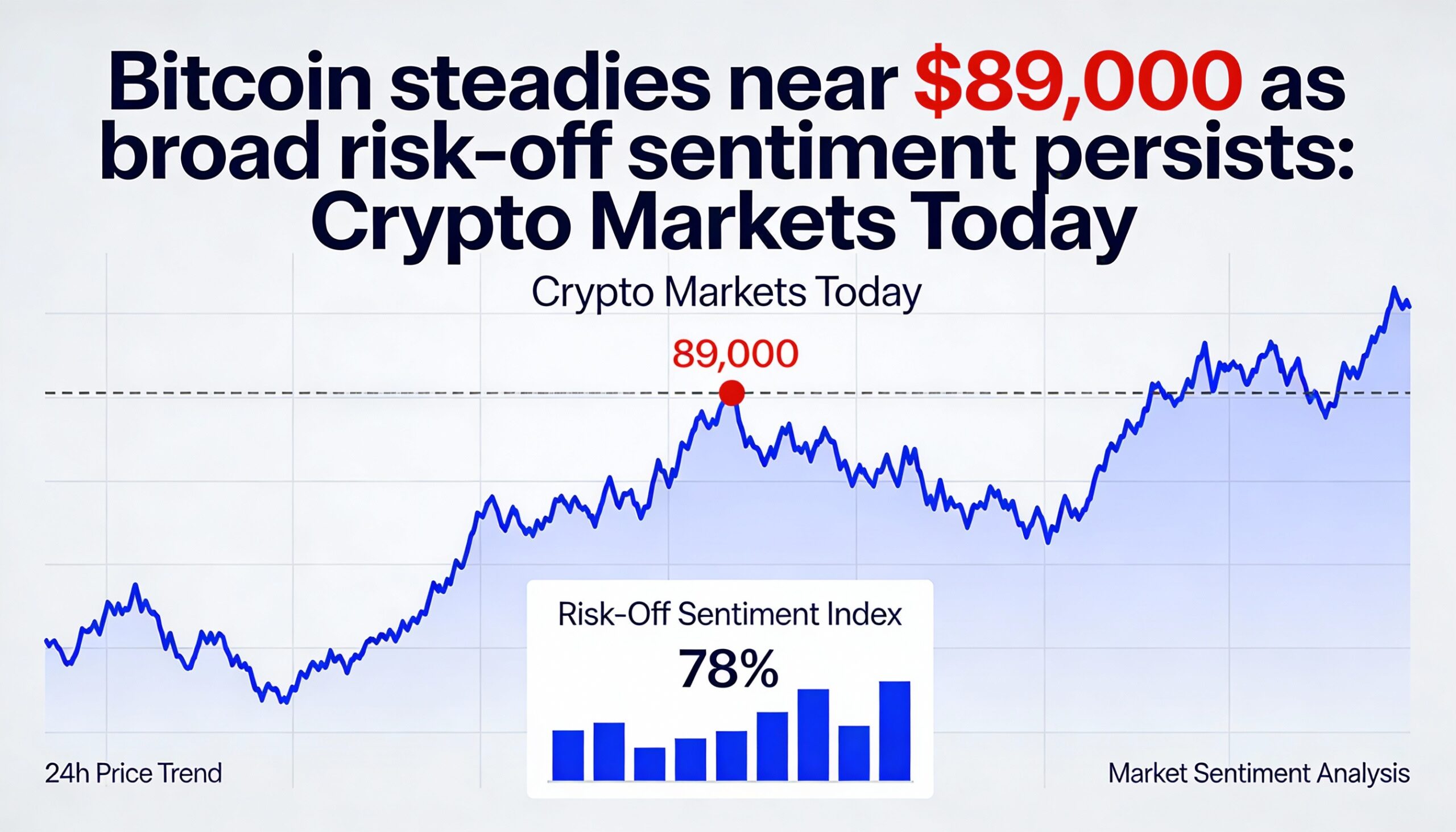
Bitcoin stabilized after Tuesday’s sharp selloff, tracking a broader risk-off move in global equities, while altcoins posted steeper losses amid elevated volatility across crypto markets.
The crypto market consolidated overnight following a bruising selloff that pushed bitcoin down to a low of $87,760. Since bottoming out around 23:00 UTC, the largest cryptocurrency has staged a modest recovery and was recently trading near $89,000. That places bitcoin back in the middle of a range that has largely held since Nov. 20, aside from a brief five-day breakout last week when prices climbed toward $98,000 after a relatively bullish start to the year.
The downside move this week coincided with a pronounced shift toward risk aversion in traditional markets. Nasdaq 100 and S&P 500 futures are both down about 2% since Sunday’s open, after Wall Street recorded its largest single-day decline since October.
That risk-off rotation sent gold and silver to fresh record highs as investors sought safe-haven assets amid rising concerns of a potential trade conflict between the United States and the European Union. Tensions were fueled by President Donald Trump’s threat to impose tariffs tied to Greenland’s ownership, alongside retaliatory tariff proposals from European officials.
In crypto markets, relatively thin liquidity amplified losses in altcoins. According to CoinGlass, roughly $500 million in altcoin futures positions were liquidated over the past 24 hours alone.
Derivatives positioning
Bitcoin saw heavy liquidations during Tuesday’s drop to $87,760, with $324 million in long positions wiped out amid heightened volatility. By contrast, the subsequent rebound triggered liquidations of about $34 million in short positions.
Bitcoin’s 30-day implied volatility surged to 44.34 on Tuesday, the highest level since Jan. 10, as traders turned to options markets to hedge downside risk.
Open interest in bitcoin futures fell 3.25% to $28.3 billion over the past 24 hours as prices declined roughly 2%. A notable $300 million drop in open interest around 05:00 UTC coincided with bitcoin’s brief push back toward $90,000, suggesting profit-taking among traders holding short positions.
Despite the selloff, global funding rates remained positive across major venues, offering a tentative bullish signal that leveraged traders continue to favor long exposure despite negative price action.
Elsewhere, a 2.5% decline in zcash open interest alongside a 1.5% price increase suggests traders who had built short positions following the Jan. 8 governance dispute may be starting to unwind bearish bets.
Token talk
Monero led losses among major altcoins over the past 24 hours, sliding 13.6% and extending its decline to 37.25% from its Jan. 14 record high.
Ether fell 4.5%, underperforming other large-cap tokens such as Solana and XRP, which were both down roughly 1.25%. Cardano proved comparatively resilient, shedding just 0.85%.
In contrast, blockchain gaming token Axie Infinity defied the broader downturn, jumping more than 16% on $2.1 billion in daily trading volume to reach its highest level since September. AXS is now up 165% since Jan. 13, highlighting relative strength among metaverse-related tokens.
The CoinDesk Metaverse Select Index (MTVS) has emerged as the year’s top-performing benchmark, rising 43.9% year-to-date, while DeFi and memecoin indices are down 4.2% and 3.6%, respectively.
Meanwhile, WLFI, the DeFi token linked to President Trump’s family, rose 6.6% since midnight UTC. The move appears tied to increased activity surrounding the platform’s USD1 stablecoin, whose circulation has expanded from $2.7 billion to $3.4 billion since Dec. 24.
CoinMarketCap’s “altcoin season” index remains subdued at 26 out of 100, signaling a bearish environment for altcoins relative to bitcoin. However, several tokens are now in oversold territory, raising the possibility of a short-term relief rally as early as Wednesday.