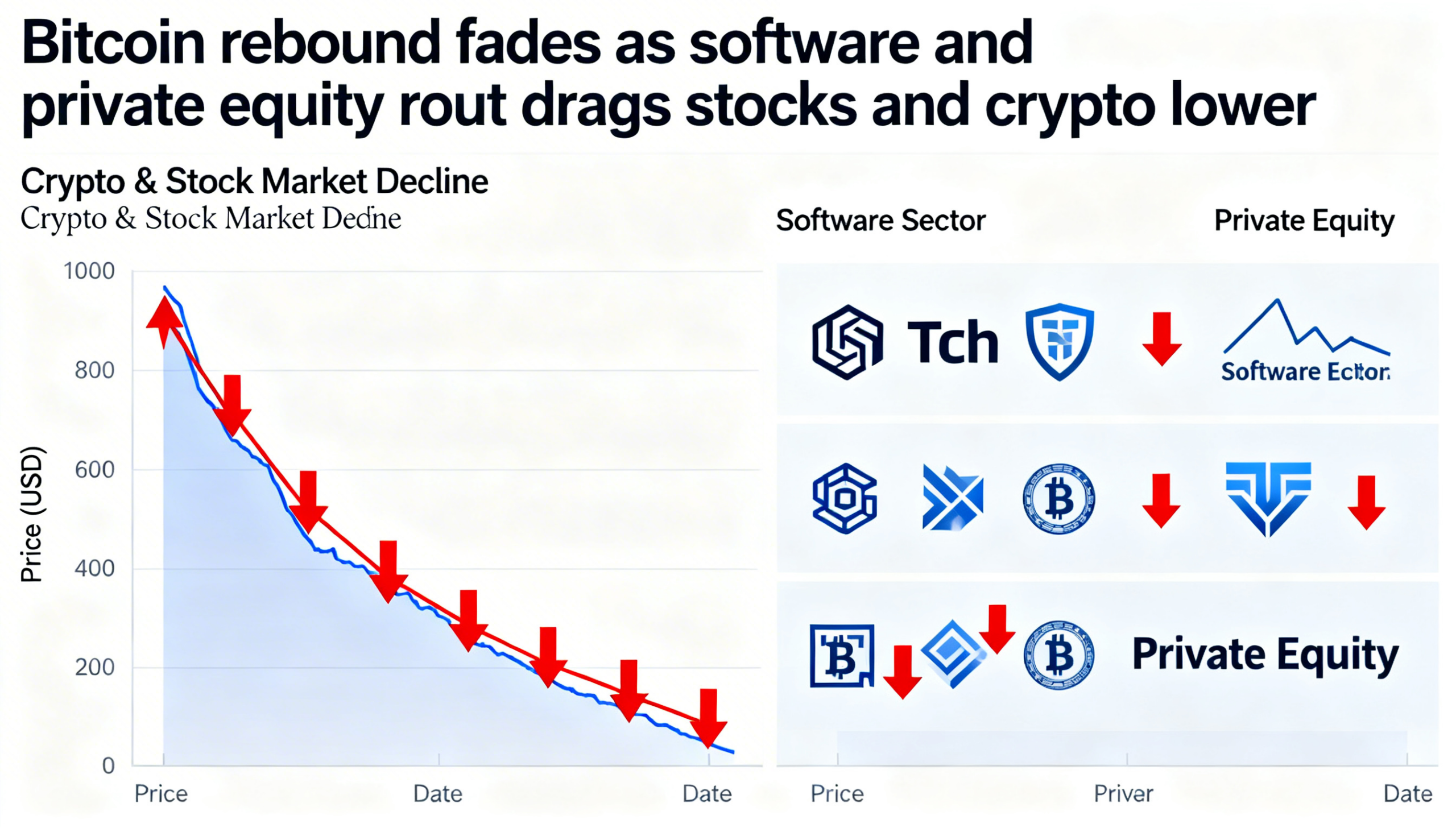
Crypto markets came under renewed pressure Monday, with digital assets moving almost in tandem with a sharp downturn in the software sector as a key industry ETF sank to another 52-week low.
Bitcoin attempted a modest bounce after an overnight selloff but quickly surrendered those gains during U.S. morning trading as broader risk appetite deteriorated. By midday on the East Coast, bitcoin hovered near $65,400, nursing steep losses over the previous 24 hours.
The weakness mirrored declines in U.S. equities. The S&P 500 and the Nasdaq-100 both fell more than 1%, pressured by continued selling in software names and private equity firms.
At the center of the move was the iShares Expanded Tech-Software ETF, which dropped another 5% to a fresh one-year low. The fund is now down nearly 35% since October as investors weigh the potential for generative AI to disrupt legacy software business models. Whether that narrative proves accurate or not, traders have increasingly treated crypto as part of the same trade, with bitcoin’s price action closely tracking IGV in recent weeks.
Broader macro concerns have compounded the pressure. Some market participants fear the rapid expansion of AI investment could be sowing the seeds of a credit unwind reminiscent of the 2008 financial crisis. Those anxieties are visible in private equity stocks, many of which maintain heavy exposure to software assets.
Blue Owl Capital — which recently moved to sell assets to meet liquidity demands — fell another 3.5% Monday and is now down roughly 32% year to date. Meanwhile, Blackstone, Ares Management, and Apollo Global Management extended their recent declines, sliding between 6% and 8%.
Crypto often behaves as a high-beta extension of the tech trade and a proxy for global liquidity conditions. Monday’s slide reinforced that pattern. While bitcoin has so far held above its early February troughs, it remains locked in a wide $60,000 to $70,000 range as confidence across risk assets stays fragile.
Adding to the cautious mood is lingering uncertainty around global trade policy after the Supreme Court of the United States curtailed President Donald Trump’s previous use of sweeping tariffs, according to Joel Kruger of LMAX Group.
The decision helped trigger a classic risk-off tone, with investors pulling back from speculative positions. In that environment, bitcoin has traded less like a defensive store of value and more like a leveraged bet on broader market sentiment.