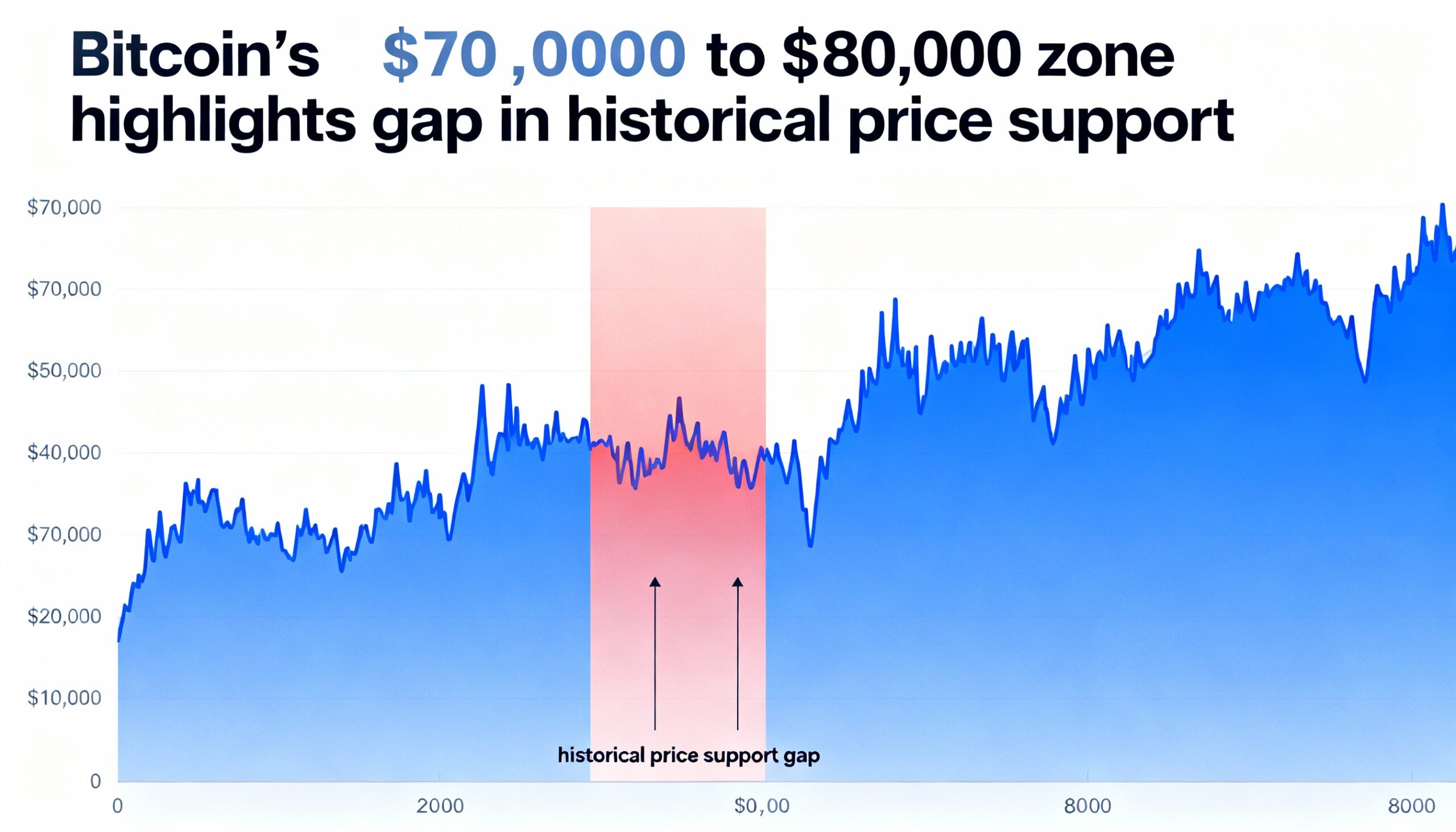
Five years of CME futures data offer insight into where bitcoin has historically built—or failed to build—meaningful price support.
Analyzing the past five years of bitcoin (BTC $87,913.36) CME futures trading allows for an assessment of where the crypto has spent significant time consolidating, and by extension, where support levels are stronger or weaker.
One useful approach is to examine the number of trading days bitcoin has spent within specific price bands. The longer price remains in a given range, the greater the opportunity for positions to be established, which can later translate into stronger support.
Data from Investing.com highlights significant disparities across price ranges. Excluding the brief period when bitcoin traded above $120,000, BTC has spent just 28 trading days in the $70,000–$79,999 range and 49 days in the $80,000–$89,999 range. By comparison, lower zones such as $30,000–$39,999 or $40,000–$49,999 saw nearly 200 trading days, reflecting extensive testing and consolidation in those areas.
For much of December, bitcoin has traded within the $80,000–$90,000 band following its sharp pullback from October’s all-time high. This retracement brings price back into a range where the market historically spent relatively little time, particularly compared with most of 2024, when bitcoin spent many days between $50,000 and $70,000. The uneven distribution suggests that support in the $80,000s—and especially between $70,000 and $79,999—is less developed than in lower ranges.
Glassnode data reinforces this view. Its UTXO Realized Price Distribution (URPD) shows where the current bitcoin supply last moved, using an entity-adjusted methodology that assigns each holder’s balance to its average acquisition price.
The URPD highlights a clear scarcity of supply concentrated between $70,000 and $80,000, aligning with the CME futures data. Together, these datasets indicate that if bitcoin undergoes another corrective phase, the $70,000–$80,000 zone could become a logical area for consolidation, allowing stronger support to form over time.