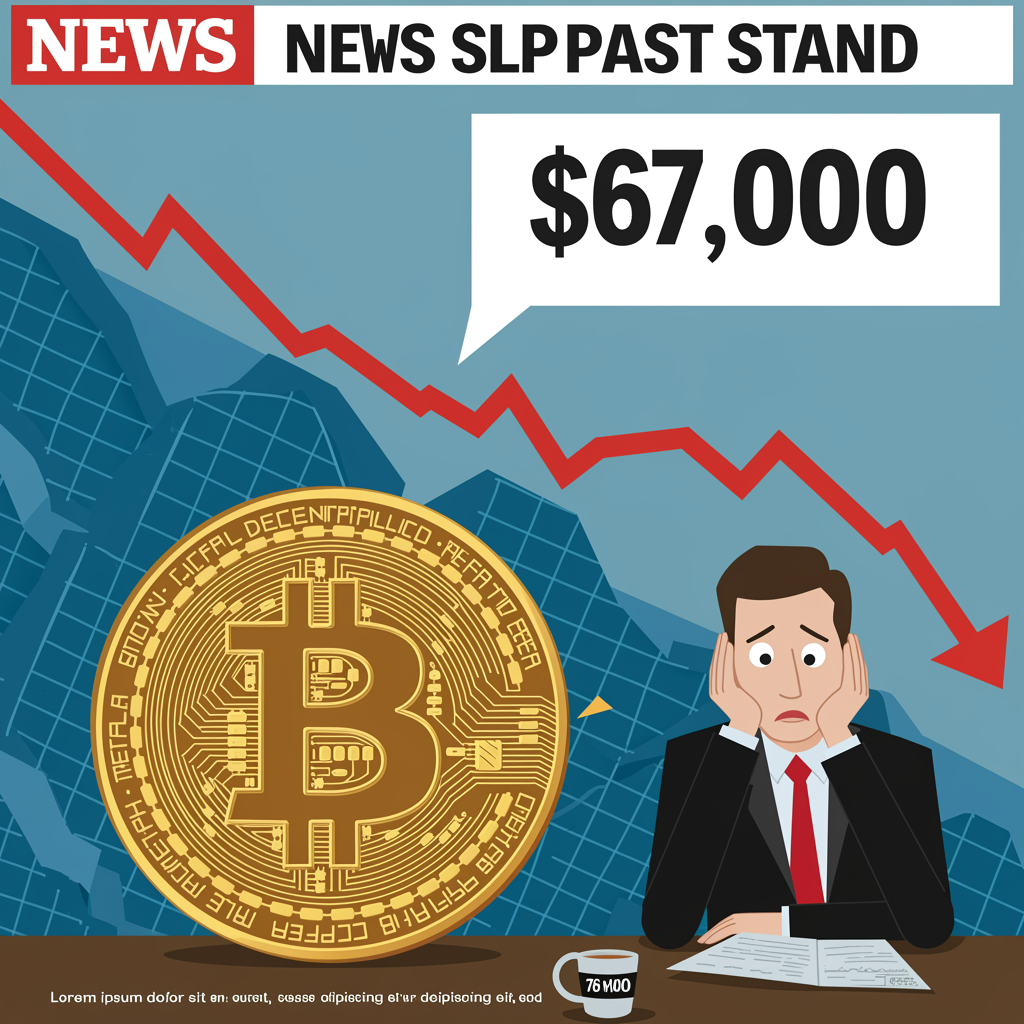
Major cryptocurrencies are trading softer even as Asian equities post modest gains, with investors balancing concerns over quantum computing risks, ETF flows and whether bitcoin’s broader trend is beginning to shift.
Bitcoin (BTC) has slipped back below $68,000 after briefly reclaiming $70,000 earlier in the week. The largest cryptocurrency attempted a breakout on Monday but quickly faced selling pressure near that level, retreating toward $67,000. Early Wednesday, it hovered around $68,000 — largely flat on the day but now trading beneath what had served as short-term support.
The move is technically significant. The $68,000–$70,000 zone had functioned as a floor through the first half of February. A sustained move below that range raises the likelihood that rallies will be met with selling rather than fresh buying. A decisive break under $67,000 would shift attention toward $65,000 and potentially the $60,000 level.
Over the past week, bitcoin, ether and BNB have each declined by as much as 3%. In contrast, select smaller-cap tokens — including Zcash’s ZEC and Cosmos’ ATOM — have gained up to 20%. Historically, however, weakness in large-cap tokens has made it difficult for broader altcoin rallies to maintain momentum.
“The decline of the largest coins is an ominous sign for smaller ones, as it may soon pull them down with it at an accelerated pace,” Alex Kuptsikevich, chief market analyst at FxPro, said in an email.
On-chain data from CryptoQuant suggests the market has entered a stress phase, though it has not yet seen the level of realized losses that typically accompanies a definitive cycle bottom. That dynamic implies the current correction may not be complete.
Fresh debate around quantum computing has also resurfaced, with some investors questioning long-term cryptographic risks even as developers argue that any meaningful threat remains decades away.
Separately, Adam Back, CEO of Blockstream, criticized a proposed BIP-110 update designed to curb network spam, warning that changes to transaction rules could introduce reputational risks for the protocol.
Institutional positioning is evolving as well. Harvard University’s endowment reduced its bitcoin ETF exposure by more than 20% in the fourth quarter, though the allocation remains its largest publicly disclosed crypto investment.
Beyond digital assets, Asian equities advanced during thin Lunar New Year trading. The MSCI Asia Pacific Index rose 0.6%, led by gains in Japan, while U.S. equity futures ticked higher after recent AI-driven volatility subsided.
For bitcoin, the near-term technical picture remains pivotal. A sustained move back above $70,000 would restore upward momentum. Another rejection, however, could reinforce expectations of a deeper retracement.