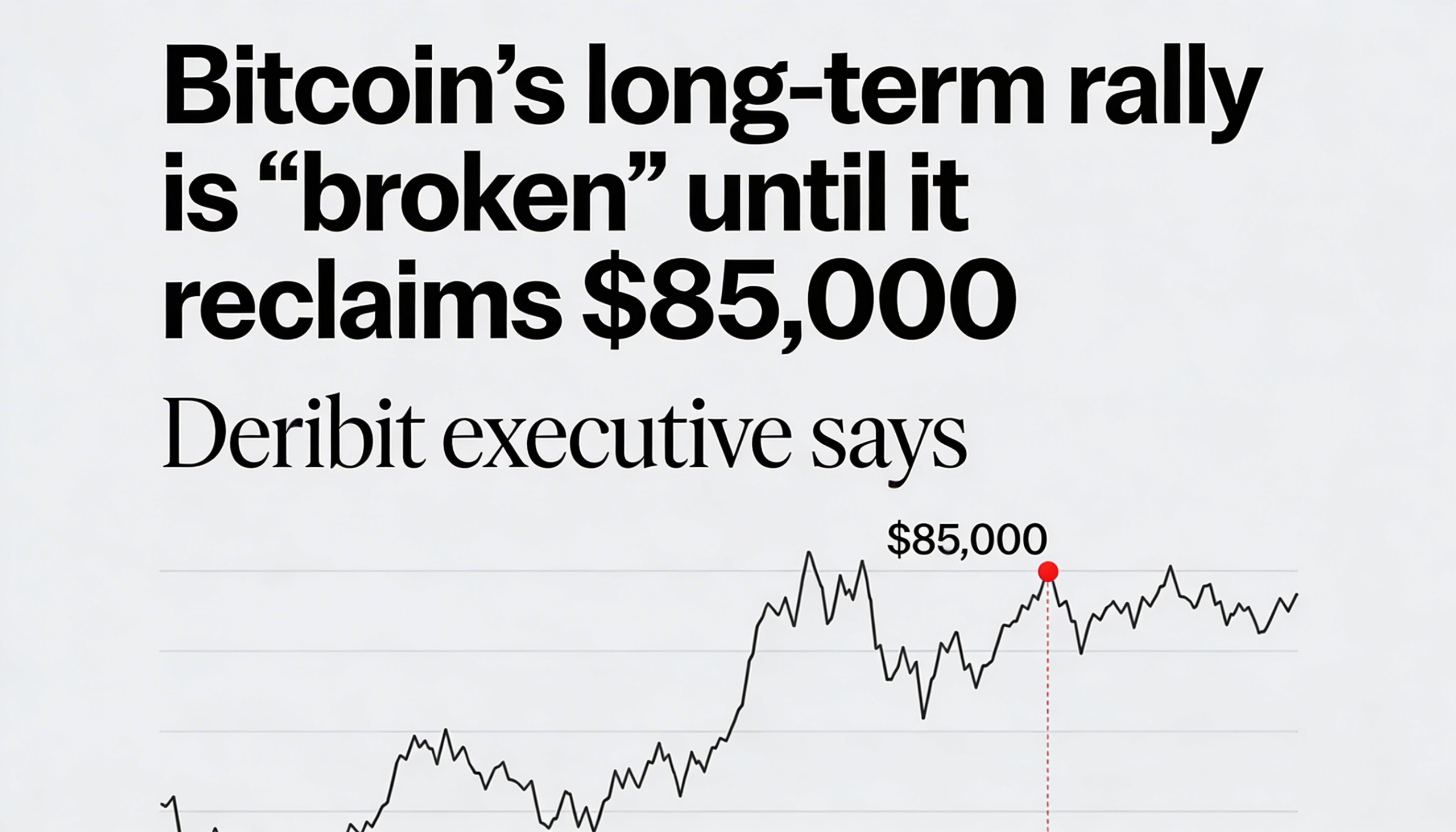
A deeper pullback toward $58,000 could ultimately reset sentiment and spark renewed demand for Bitcoin, according to a senior executive at Deribit.
Jean-David Péquignot, the exchange’s chief commercial officer, said Bitcoin’s long-term uptrend has effectively been “broken” and will remain so unless the price climbs back above $85,000. The cryptocurrency has spent the past week consolidating in the $60,000 to $70,000 range, roughly 45% below the record high it reached in October. It is also on pace for a fourth consecutive weekly decline after slipping under $85,000 in late January.
“Until the market reclaims $85k, the longer-term chart remains broken, and the path of least resistance technically remains lower,” Péquignot said during an interview at the Consensus Hong Kong conference.
A decisive move above $85,000 would signal that buyers have absorbed the excess supply that derailed the broader rally and reasserted control of the trend. Bitcoin was recently trading near $66,600 — well short of that threshold — leaving the market vulnerable to further downside pressure.
On the downside, Péquignot identified $60,000 as the next key support level. The price briefly approached that zone earlier this month as Bitcoin weakened in tandem with software stocks. He described $60,000 as an important psychological area, historically associated with sizable buy walls and concentrated purchase orders.
“If $60k fails to hold on a closing basis, the 200-week MA is the next logical, and possibly final stop for this correction,” he said.
The 200-week simple moving average (SMA) is widely viewed by long-term traders as a critical bear-market floor and a favored level for bargain hunters looking to time entries. Since 2015, several major Bitcoin downturns have found support near this indicator, reinforcing its importance in market analysis. The average currently sits around $58,000 — a level that could attract fresh buying interest if tested.