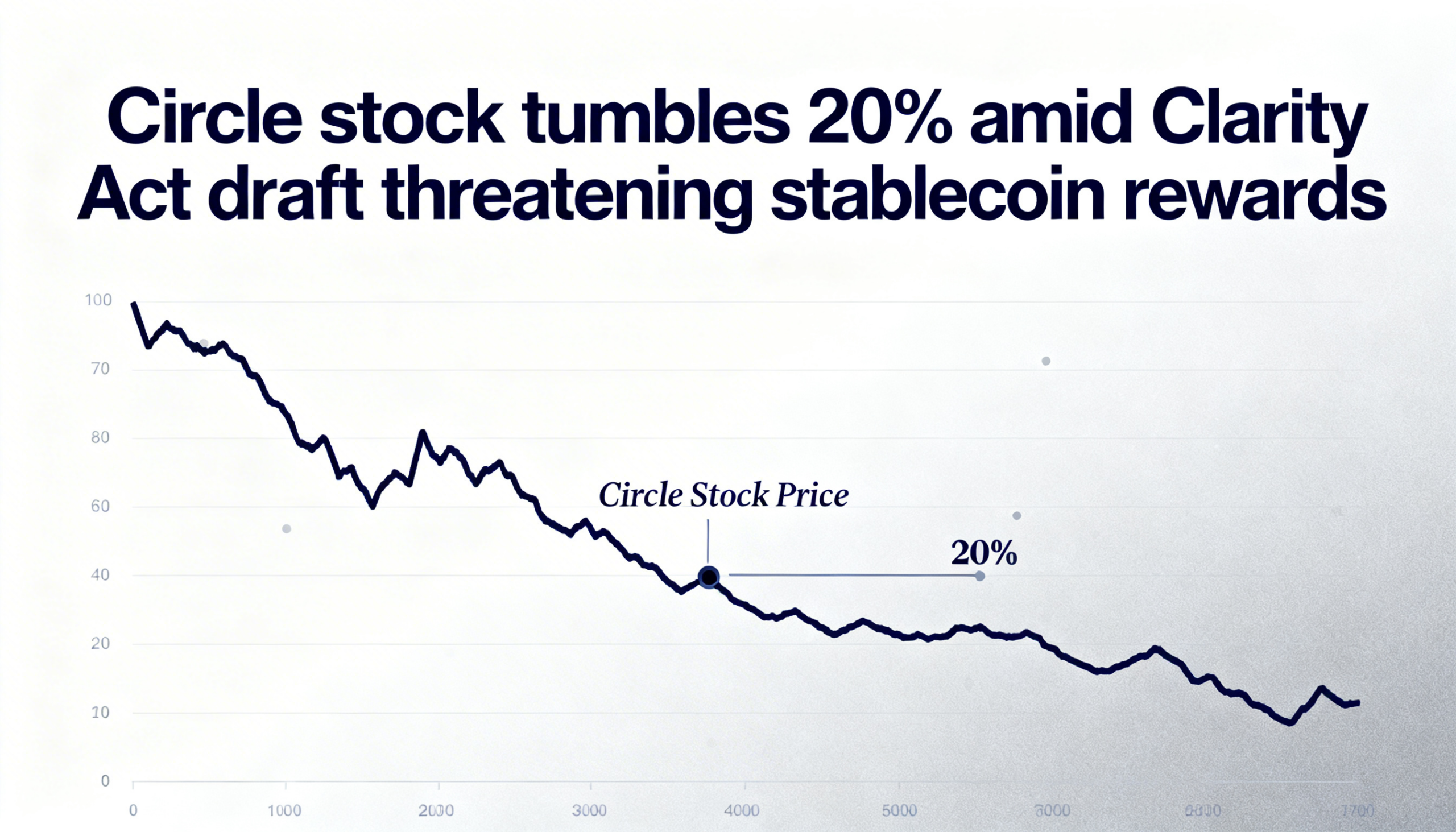
Shares of Circle tumbled on Tuesday after a fresh draft of U.S. stablecoin legislation raised concerns about restrictions on yield, triggering a broad pullback in crypto-linked stocks.
The company’s stock fell 20%, reversing part of a strong rally that had more than doubled its value in recent weeks. Coinbase, which derives a portion of its revenue from USDC, also dropped करीब 10% amid the same pressure.
The decline was driven by developments surrounding the Clarity Act, which could limit or eliminate rewards on stablecoin holdings. Analysts say the proposal may prohibit yield on passive balances and restrict structures that resemble interest-bearing deposits.
Such a move could weaken Circle’s near-term growth prospects while also reducing the attractiveness of holding USDC over the longer term. Yield has been a key driver of stablecoin adoption, whether through lending mechanisms or platform incentives, and removing it could limit the evolution of stablecoins beyond payments.
The proposal builds on the GENIUS Act, which already bars direct yield payments but allows issuers to distribute income generated from reserve assets. Circle currently earns interest on USDC reserves and shares a portion with Coinbase, which then uses it to fund user rewards.
The latest draft of the Clarity Act aims to close that loophole by restricting anything deemed “economically equivalent to interest,” potentially cutting off a major incentive for holding stablecoins.
At the same time, Tether—Circle’s primary competitor—announced it has engaged a Big Four accounting firm to conduct a full audit of its reserves. If successful, the move could strengthen confidence in USDT and increase competitive pressure on USDC.
Despite the sharp sell-off, some analysts view the reaction as overdone. Circle had gained roughly 170% since early February prior to the drop, significantly outperforming the broader market and leaving the stock vulnerable to a correction on negative news.
Long-term sentiment, however, remains relatively positive. Analysts note that stablecoin use cases continue to expand, supporting growth in the sector. Coinbase could also benefit in the near term, as USDC-related revenue—part of which is currently paid out as rewards—could see improved margins if payouts are reduced.
Some also expect alternative incentive structures, such as loyalty-based programs, to emerge if direct yield mechanisms are restricted.
While regulatory uncertainty may weigh in the short term, Circle continues to hold a significant share of a rapidly growing market, and its longer-term outlook remains intact.