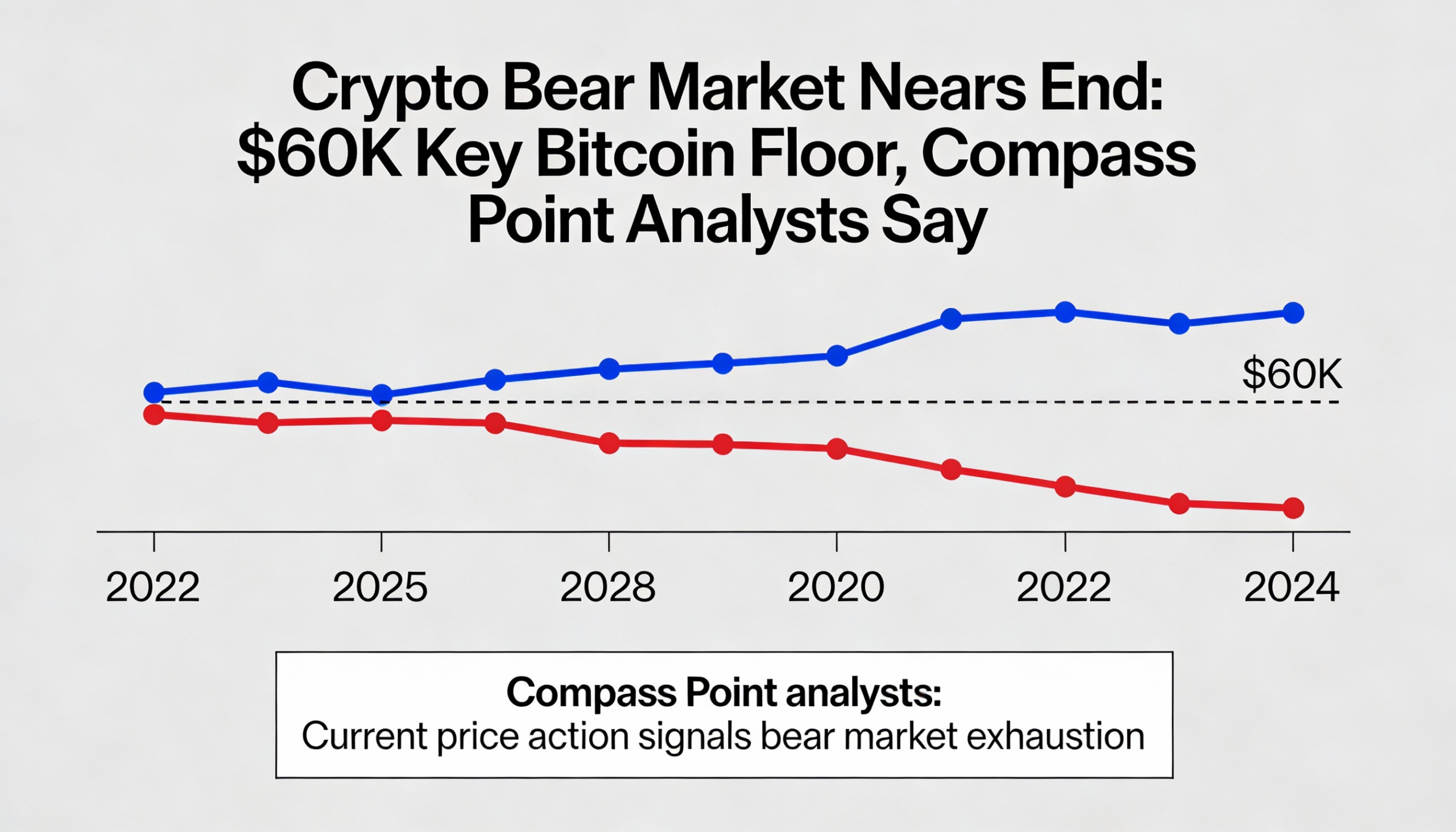
Bitcoin may be approaching a bottom in its current downturn, but analysts at Compass Point say a deeper decline would likely require a broader selloff in U.S. equities.
“While near-term risks remain skewed to the downside, we believe the crypto bear market is in its final innings,” Compass Point analysts Ed Engel and Michael Donovan wrote in a report on Monday. “Further downside would likely require a U.S. equity bear market.”
In their base-case scenario, the analysts expect bitcoin to find a floor between $60,000 and $68,000—a range that has historically attracted buying from long-term holders. They said on-chain data shows strong support in that zone, with roughly 7% of bitcoin held by long-term investors (those holding for six months or longer) acquired within that price range. Compass Point’s base case places a bottom near $65,000.
Bitcoin slipped below $81,000 earlier this month and fell as low as $74,532 over the weekend, a level the analysts said aligns closely with the average cost basis of both bitcoin ETF investors and the broader market. Since Jan. 15, bitcoin exchange-traded funds have recorded roughly $3 billion in net outflows. With more than half of ETF assets now sitting at a loss, Compass Point warned that outflows could remain elevated, while the $81,000–$83,000 range may now act as overhead resistance.
The firm also flagged a lack of technical and on-chain support between $70,000 and $80,000, describing the range as an “air pocket.” Less than 1% of long-term holder supply was acquired in that zone, increasing the risk of further selling pressure if prices remain weak.
If bitcoin were to break below the $60,000–$68,000 support range, Compass Point said the next potential downside target would be near $55,000—but only under more extreme conditions. Historically, bear-market bottoms have occurred below the average cost basis of all bitcoin holders, which currently sits around $55,000.
However, the analysts noted that breaching that level has typically required significant external stress. During the 2022 downturn, bitcoin fell below its average cost basis only after the combination of a U.S. equity bear market and multiple high-profile crypto bankruptcies.