From yield prospects to custody trade-offs, here’s how direct ETH ownership compares with staking ETFs.
For much of crypto’s history, investing in ether—the native token of the Ethereum blockchain—was straightforward. Investors bought ETH on platforms such as Coinbase or Robinhood or transferred it to self-custody wallets like MetaMask, holding the asset directly and tracking its price.
The introduction of staking changed that equation. By locking up ETH to help validate transactions on the network, investors could earn rewards, turning a purely price-driven asset into a potential source of passive income.
As digital assets have moved closer to traditional finance, investment options have multiplied. Spot ether exchange-traded funds (ETFs) now offer price exposure through conventional brokerage accounts, broadening access while adding new considerations for investors.
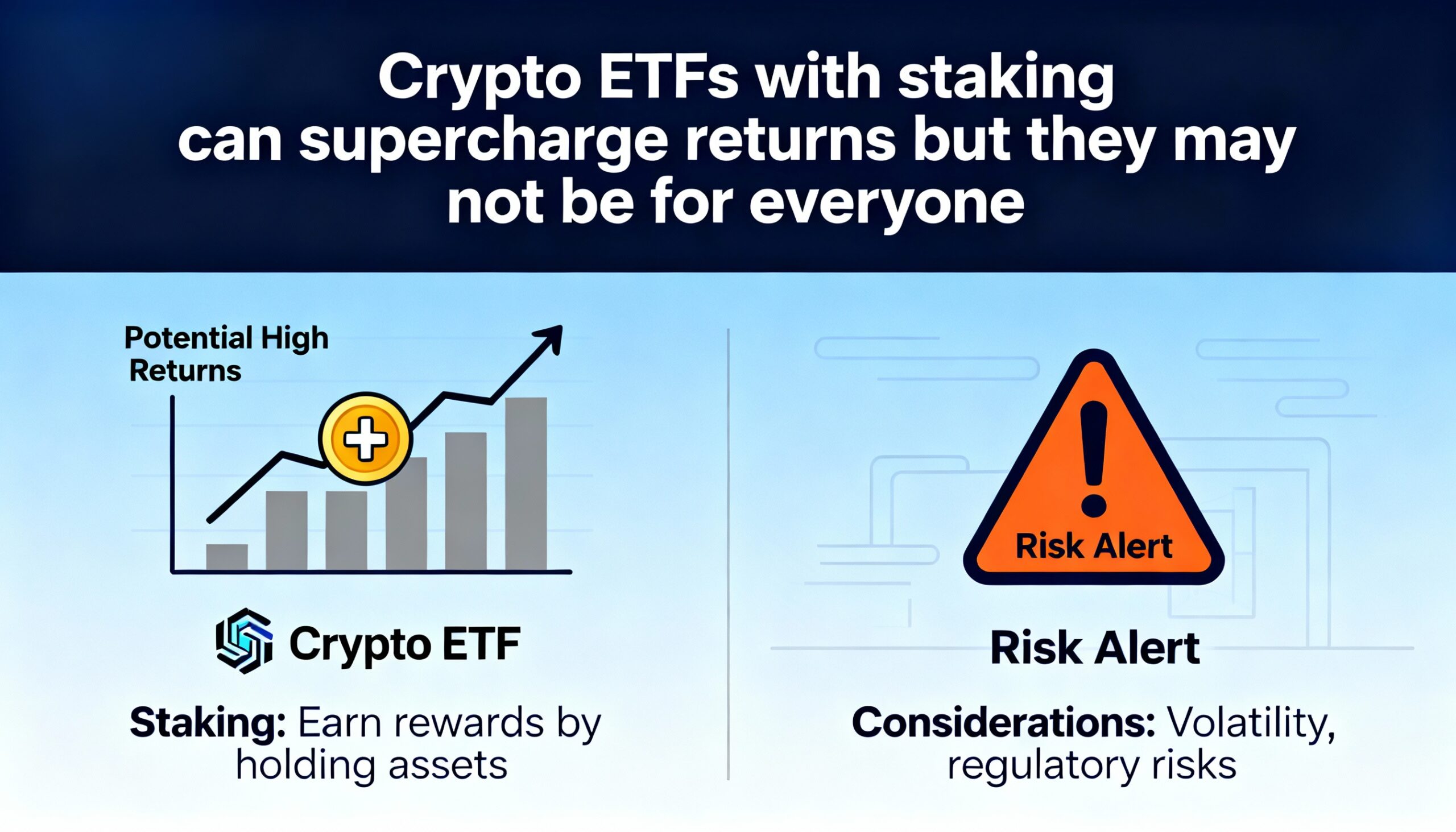
Some of those ETFs have gone a step further by incorporating staking. These products aim to deliver both price appreciation and yield, allowing investors to earn staking rewards without interacting with crypto wallets or exchanges.
Earlier this month, Grayscale became the first issuer to distribute staking rewards through its Ethereum Staking ETF (ETHE). The fund paid $0.083178 per share. With ETHE trading near $25.87 at the time, a $1,000 investment would have produced roughly $82.78 in staking income.
The development underscores a growing question for investors: Is it more efficient to hold ETH directly, or to gain exposure through a staking ETF?
Control versus convenience
At the heart of the decision is a trade-off between control and convenience.
Buying ETH directly through exchanges such as Coinbase or Robinhood gives investors ownership of the underlying asset. Returns are driven by price movements, and the exchange acts as custodian. Investors who stake through Coinbase can earn annual rewards typically ranging from 3% to 5%, net of commissions, while retaining the ability to unstake, transfer, or use their ETH within the broader crypto ecosystem.
Ether ETFs take a more hands-off approach. Investors buy shares through a brokerage account, and the fund acquires and holds ETH on their behalf. When staking is involved, the ETF stakes the tokens and distributes rewards to shareholders, bundling yield generation into a traditional investment vehicle.
Fees play a significant role in shaping outcomes.
Grayscale’s Ethereum Trust (ETHE), for example, charges a 2.5% annual management fee, regardless of market performance. Any staking rewards are further reduced by fees paid to staking providers before distributions reach shareholders.
By contrast, Coinbase does not charge a management fee for holding ETH but takes a commission of up to 35% on staking rewards. According to the company, this commission applies to several proof-of-stake assets, including ether, with lower rates available to subscribers of its premium plans.
“There is no fee to stake your assets,” Coinbase says in its disclosures. “Coinbase takes a commission based on the rewards you receive from the network.”
As a result, effective staking yields are often higher for investors who stake directly through exchanges, even after commissions. Still, ETFs may appeal to those seeking simplicity, regulatory clarity, and access through standard brokerage accounts.
For these investors, staking ETFs resemble dividend-paying funds, offering regular income alongside price exposure—except the yield is generated by blockchain activity rather than corporate earnings.
Risks and limitations
The simplicity of staking ETFs comes with important limitations. Staking rewards are not fixed.
Ethereum staking yields fluctuate based on network conditions and the total amount of ETH staked. Current annual yields are around 2.8%, according to CoinDesk data, but they can rise or fall over time.
Operational risks also remain. If a validator underperforms or is penalized, an ETF could lose a portion of its staked ETH. Similar risks exist when staking through exchanges such as Coinbase, though direct holders retain more flexibility to manage their positions.
Access is another key difference. Investors holding ETH directly—even on centralized platforms—can generally transfer it to wallets, unstake it, or deploy it in decentralized finance applications. ETF investors cannot. Their exposure is limited to buying and selling shares during market hours, with no ability to move or independently use the underlying ETH.
Ultimately, staking ETFs prioritize ease and familiarity, while direct ETH ownership offers greater control and potentially higher net yields. The right choice depends on whether an investor values convenience or autonomy within the crypto ecosystem.