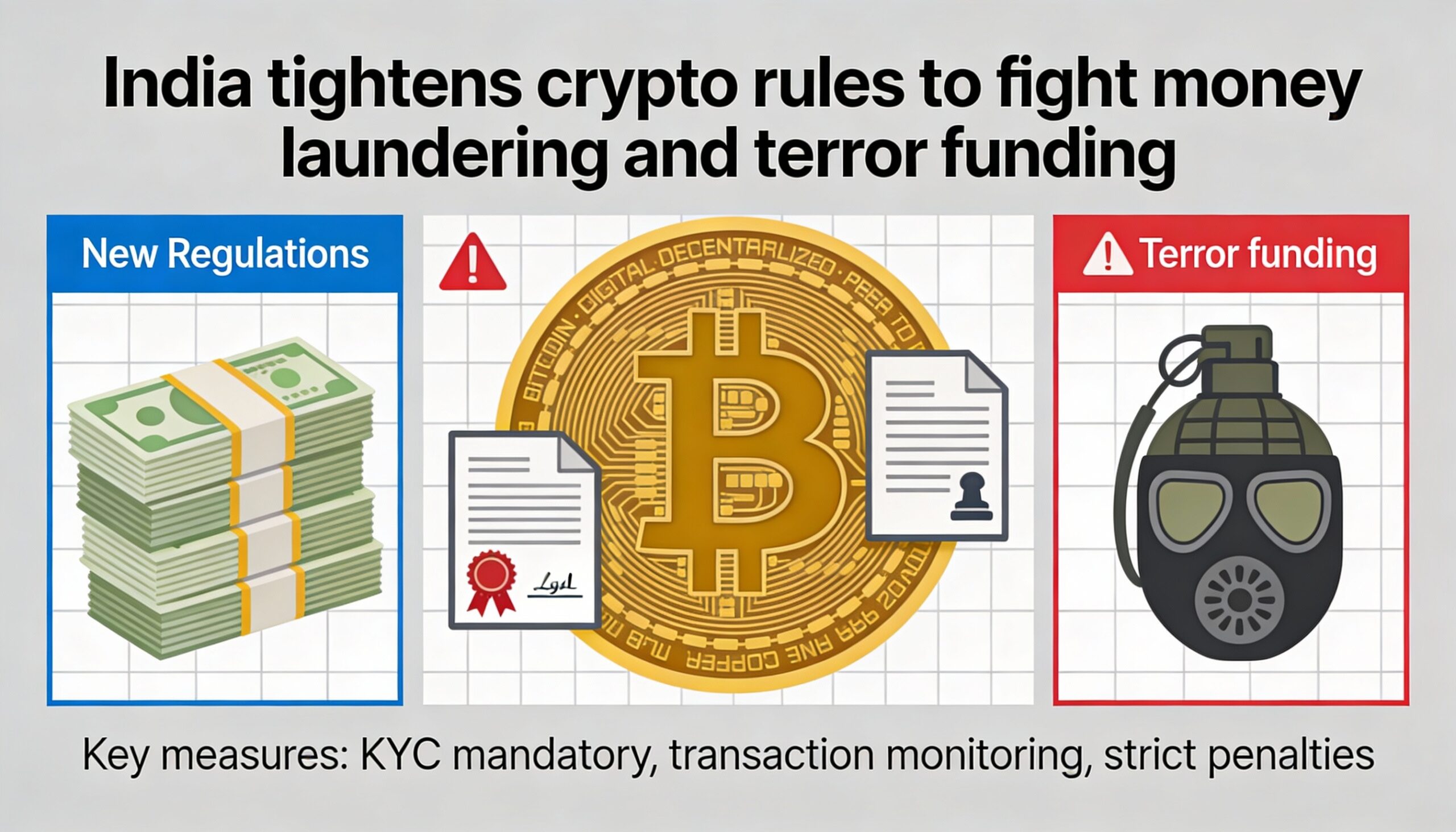
India Tightens Crypto Regulations with Stricter KYC Measures
India’s Financial Intelligence Unit (FIU) has announced enhanced identity verification requirements for cryptocurrency exchanges to curb money laundering and terrorist financing, according to the Press Trust of India.
Under the updated rules, effective Jan. 8, exchanges must verify users with a live selfie that captures blinking to confirm liveliness, along with detailed logging of geographical coordinates, date, time, and IP address. In addition to the mandatory Permanent Account Number (PAN), platforms are required to collect government-issued IDs such as passports, driver’s licenses, Aadhaar cards, or voter IDs, and confirm mobile numbers and email addresses via one-time passwords (OTPs).
Bank account ownership is verified using the “penny-drop” method, which involves sending a small refundable charge of 1 rupee (INR). High-risk users—including those connected to tax havens, FATF-listed jurisdictions, politically exposed persons, or certain non-profit organizations—must undergo enhanced due diligence checks every six months.
Exchanges are prohibited from supporting initial coin offerings (ICOs) and initial token offerings (ITOs), citing “heightened and complex” risks of money laundering and terrorist financing. Platforms cannot use transaction-mixing tools such as tumblers and must register with the FIU, report suspicious activity, and retain user data for at least five years.
India continues to treat cryptocurrencies as virtual digital assets (VDAs) under the Income Tax Act, 1961. While citizens may buy and sell VDAs on FIU-registered platforms, they cannot use them as legal tender or to make payments for goods and services.