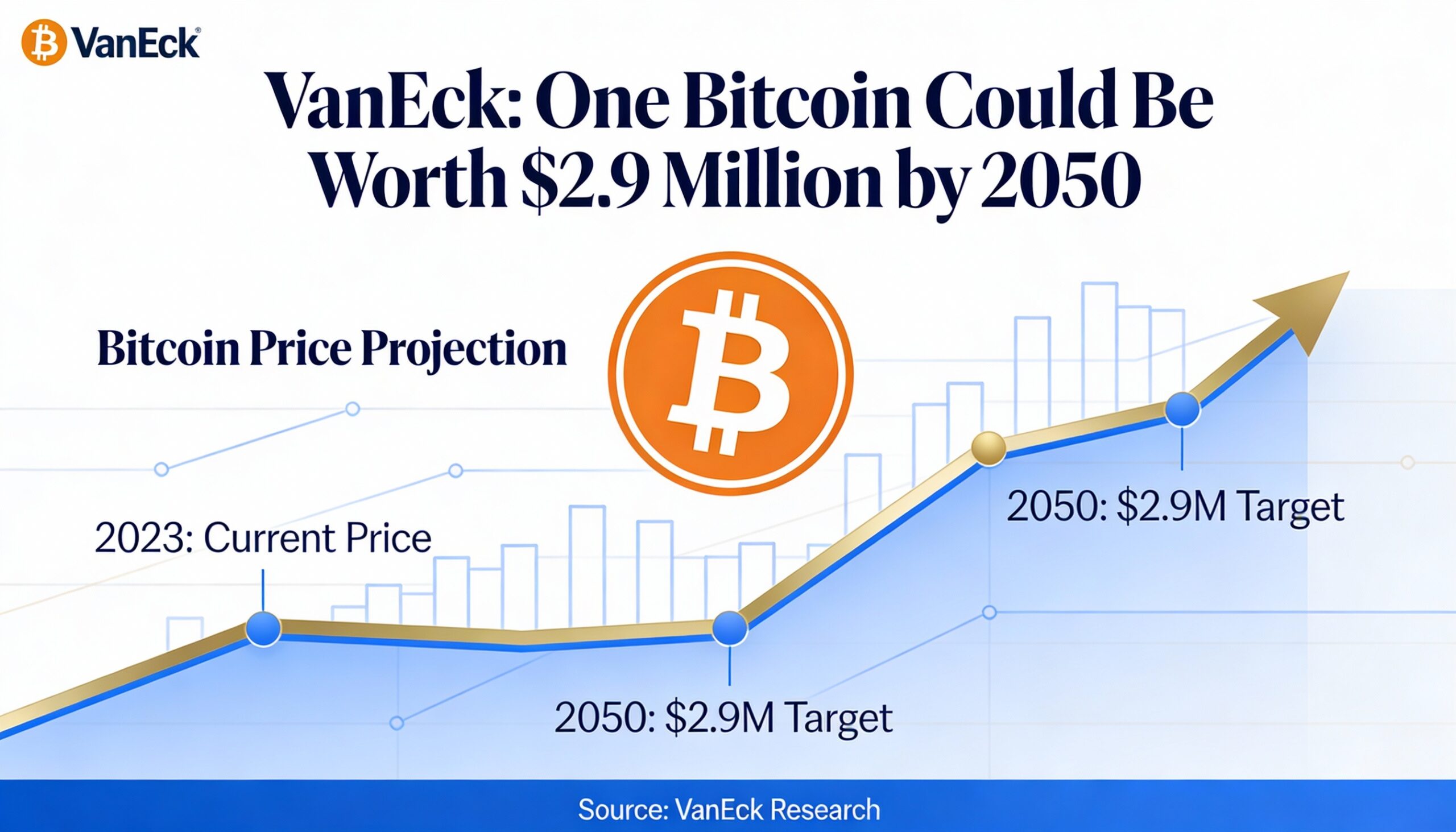
VanEck has outlined a long-term framework suggesting bitcoin could reach roughly $2.9 million by 2050, according to a research blog post published Thursday.
The post, titled “Bitcoin Long-Term Capital Market Assumptions,” was authored by Matthew Sigel, VanEck’s head of digital assets research, and Patrick Bush, a senior investment analyst. The analysis presents what the firm describes as a base-case valuation model for bitcoin extending through 2050, estimating an annualized return of around 15% over the period.
Rather than framing this as a price target, VanEck positions it as a valuation exercise, focused on how bitcoin could be utilized if adoption expands well beyond its current role as a trading asset. The model does not rely on traditional equity metrics, instead projecting value through adoption scenarios.
A core assumption in the base case is bitcoin’s use as a settlement asset in global trade, potentially handling between 5% and 10% of international trade volume. Another key assumption is that central banks may gradually allocate a small portion of their reserves to bitcoin, reflecting a long-term diversification away from sovereign currencies.
These assumptions represent a major shift from today’s reality. VanEck notes that bitcoin currently plays a negligible role in trade settlement and is not held as a reserve asset by major central banks. The firm emphasizes that achieving this base-case scenario would require regulatory clarity, robust operational infrastructure, and political acceptance, all of which remain uncertain.
The analysis also highlights the volatility that would likely accompany such adoption. VanEck models long-term annualized volatility between roughly 40% and 70%, comparable to frontier markets rather than traditional financial assets. Even in its bear-case scenario, however, the firm expects positive long-term returns, reflecting bitcoin’s increasing structural relevance.
Macroeconomic factors play a central role in VanEck’s framework. The post notes that bitcoin’s historical price movements have tracked global liquidity trends more closely than equities or commodities. Correlations with broad money supply growth, coupled with a weakening link to the U.S. dollar, suggest that bitcoin’s drivers may be becoming more global over time.
From a portfolio perspective, VanEck suggests that small allocations—typically 1% to 3%—can enhance risk-adjusted returns in diversified portfolios. The firm stresses that this does not make bitcoin low-risk, but indicates that, when position sizes are limited, its volatility does not translate proportionally into overall portfolio risk.