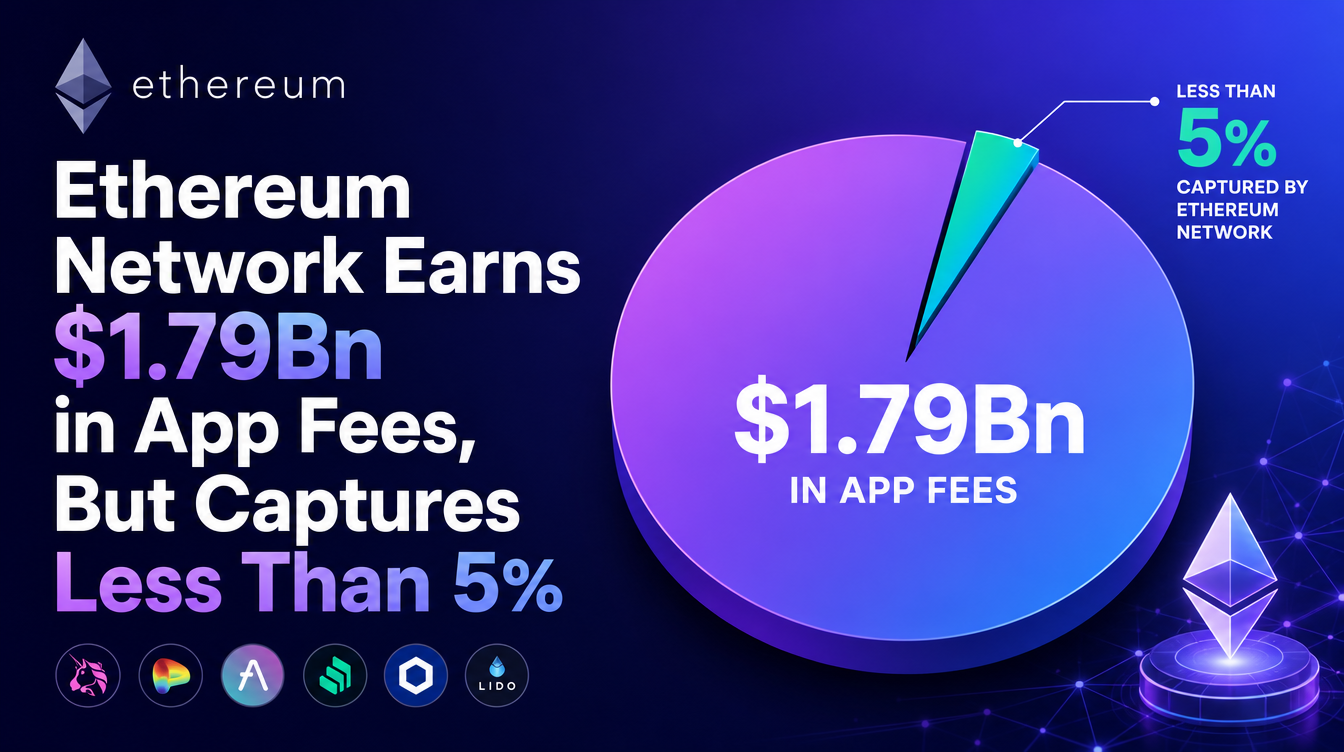
Ethereum’s application layer generated $1.79 billion in fees during Q2 2026, while layer-2 networks processed around 1,270 user operations per second and real-world assets worth $17.2 billion were recorded on-chain.
Despite these strong activity metrics, ETH continues to trade below $2,000, sitting nearly 60% below its August 2025 peak of roughly $4,950. The network is seeing real adoption growth, but the amount of economic value flowing back to the ETH token has not increased at the same pace, creating a major structural concern for the ecosystem.
On-chain analyst @Tanaka_L2 highlighted the widening gap in a July 31 analysis, showing that Ethereum’s base layer captured only 4.9% of the economic value produced by applications built on top of it during the second quarter.
Ethereum’s layer-1 generated $88.4 million in Real Economic Value, compared with the $1.79 billion generated by applications across the ecosystem. This imbalance helps explain why ETH has struggled compared with both its previous performance cycles and Bitcoin, which is down about 11% in 2026 while ETH has fallen closer to 32%.
The decline in Ethereum’s value capture appears to be linked to structural changes in the network rather than normal market volatility. Layer-2 rollups have become the primary driver of user activity, with Tanaka’s data showing approximately 1,270 user operations per second across rollups compared with only 20.4 on Ethereum’s mainnet.
Low Blob Fees Challenge ETH’s Supply Narrative
Ethereum’s rollup-focused scaling approach has successfully reduced transaction costs, but the introduction of cheaper blob fees has weakened the fee-burning mechanism that previously supported ETH’s scarcity narrative.
Over a recent seven-day period, blob fee activity resulted in only around 0.22 ETH being burned, highlighting the limited impact of current L2 fee generation on ETH supply reduction.
With annual ETH supply growth estimated at 0.85% and staking yields around 2.6%, the fundamentals behind the “ultrasound money” narrative have become less powerful. The ETH/BTC ratio has also dropped to multi-year lows as Bitcoin continues benefiting from steady institutional demand.
Ethereum has additionally faced pressure from ETF outflows and the absence of a strong demand catalyst. The market is now focused on whether institutional adoption and tokenization trends can create a stronger long-term demand case for ETH.
A Shift Toward Ethereum as Settlement Infrastructure
Tanaka argues that Ethereum’s previous identity as a fee-generating network no longer fully represents its future potential. He believes ETH should increasingly be viewed as reserve collateral and a settlement asset for institutional tokenized finance.
Under this approach, the growth of on-chain financial markets would create demand for ETH through collateral use and settlement activity rather than traditional retail transactions.
Current ecosystem data supports parts of this argument. Ethereum hosts approximately $299.4 billion in stablecoins, while tokenized real-world assets on the network have reached about $17.2 billion.
Tanaka says Ethereum’s key advantages are its institutional liquidity, trusted settlement layer, and the large amount of ETH locked through staking. These factors could become more important as financial institutions expand their blockchain-based operations.
However, he identified three conditions that must emerge before this thesis can translate into stronger ETH demand:
- L2 activity needs to create meaningful competition for Ethereum’s limited throughput capacity.
- Stablecoins and tokenized assets must see greater usage and transaction turnover rather than simply remain stored on-chain.
- Institutions need to hold ETH as a reserve asset instead of only using Ethereum infrastructure.
So far, none of these factors has reached a scale large enough to significantly impact ETH’s economics.
The Future of Ethereum’s Value Capture
Ethereum’s next phase depends on whether increasing network activity can eventually translate into stronger revenue generation for the base layer.
If real-world asset settlements and stablecoin transactions grow enough to push demand for blob space beyond available capacity, Ethereum could see renewed fee pressure and stronger ETH burn activity.
That scenario would allow Ethereum’s investment in scaling to eventually benefit the token itself. However, if usage continues expanding while L1 revenue remains limited, ETH’s value proposition could remain under pressure and the ETH/BTC ratio may continue weakening.
ETH’s near-term price outlook also remains influenced by macro conditions. Compared with Bitcoin, Ethereum has shown a stronger relationship with Nasdaq movements and currently lacks a clear catalyst capable of solving its value capture challenges.
Tanaka describes Ethereum’s current stage as a period of intentional economic compression: the network prioritized cheaper execution and broader adoption, while delaying direct financial benefits for ETH holders.
The market’s key question is whether this delayed value capture will eventually lead to a major repricing of ETH or become a permanent feature of Ethereum’s modular architecture.