Bitcoin’s onchain signals are showing their strongest improvement since early February, but analysts say underlying market structure still points to resistance ahead rather than a clear path to new highs.
In a note shared with CoinDesk on Thursday, Bitfinex analysts said spot ETF outflows and a more hawkish Federal Reserve are effectively forming a “macro ceiling” that makes a new all-time high unlikely unless there is a major geopolitical catalyst.
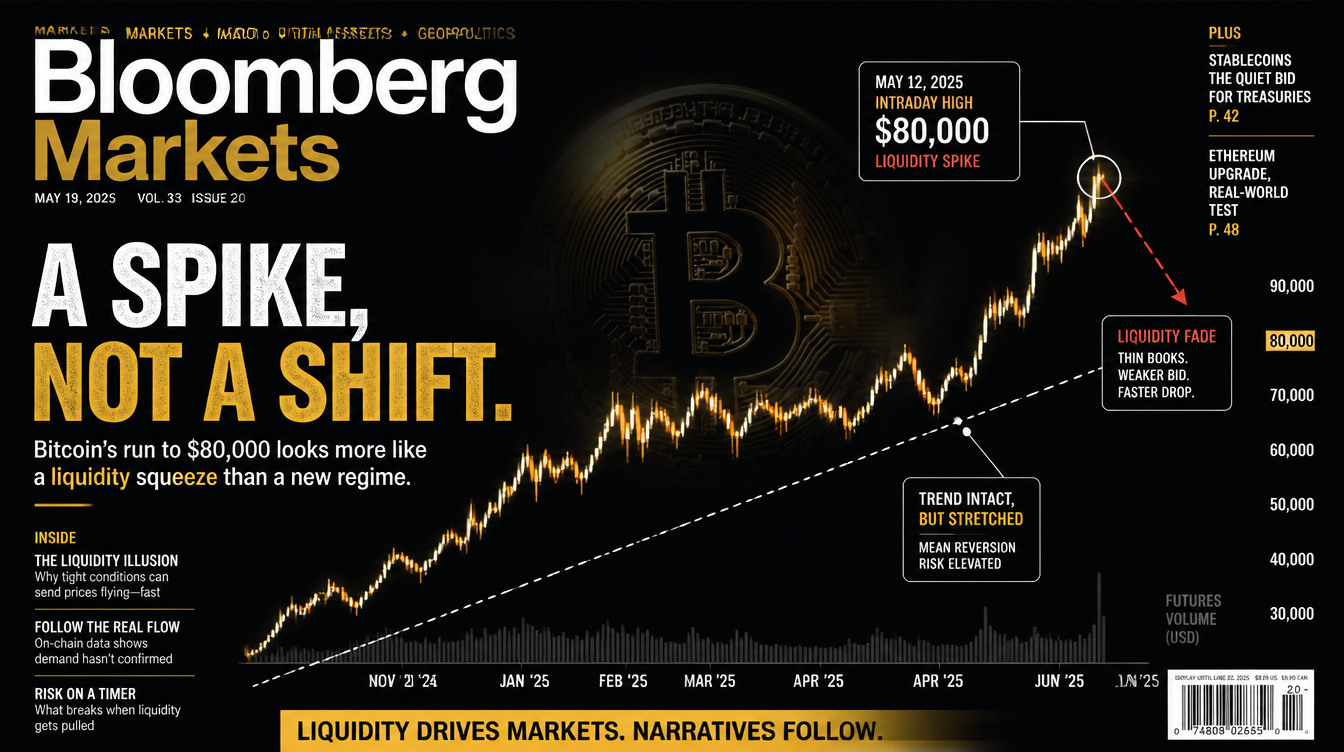
Long-term holders have accumulated roughly 4 million BTC—an increase of about 300% since late 2025—but have also begun locking in profits at a faster pace. Following Bitcoin’s rally above $82,000 on May 11 and subsequent pullback into the $79,000–$81,000 range, these holders have been realizing around $180 million in daily profits.
According to Bitfinex, that level of profit-taking remains relatively modest compared to previous cycles, suggesting controlled distribution rather than panic selling. The greater concern lies in realized losses, which are currently averaging about $479 million per day. In healthier market conditions, that figure tends to sit closer to $200 million. Until losses compress back toward that range, Bitfinex argues the onchain recovery remains incomplete.
At the same time, derivatives positioning is adding another layer of complexity. Glassnode data shows nearly $2 billion in short gamma exposure clustered around the $82,000 strike. This creates what analysts describe as a “gamma trap,” where market makers must hedge aggressively as prices move through the zone—amplifying volatility and potentially pulling price toward that level in the short term.
However, analysts warn this dynamic can be misleading. Jason Fernandes, co-founder of AdLunam, noted that while dealer hedging can accelerate moves toward $82,000, it can also cap momentum once the positioning is unwound. In his view, gamma exposure is amplifying price action rather than confirming a sustainable breakout.
On the institutional side, sentiment appears weaker. Corporate buyers have largely stepped back, with purchase volumes reportedly down around 80% compared to last month. At the same time, U.S. spot Bitcoin ETFs recorded $635 million in outflows on May 13—the largest single-day exit since January—highlighting fading demand from key investor cohorts.
Market analyst Mati Greenspan of Quantum Economics described the $79,000–$85,000 range as less of a hard ceiling and more of a transitional zone where the market is consolidating rather than trending decisively.
Macro conditions are also weighing on sentiment. Following the Senate confirmation of Kevin Warsh as Federal Reserve Chair amid 3.8% inflation, markets are increasingly pricing in a “higher for longer” interest rate environment. Fernandes noted that expectations now include the possibility of no rate cuts this year—or even potential hikes—adding pressure on risk assets like Bitcoin.
Against this backdrop, Bitfinex analysts expect price action to remain range-bound, with a possible push toward $82,000–$84,000 followed by consolidation. Fernandes described the current structure as “incomplete capitulation,” arguing that until daily realized losses fall closer to $200 million and institutional demand returns, the $85,000 level remains the key battleground for the cycle.