Bitcoin continues to trade on the back foot, holding below its 200-day simple moving average even after a key regulatory milestone in Washington, with rising U.S. Treasury yields emerging as a likely drag on price action.
Despite the Senate Banking Committee advancing the Clarity Act—bringing it closer to a full Senate vote—bitcoin remains under pressure. The weakness coincides with a steady rise in Treasury yields, particularly at the short end of the curve.
The two-year U.S. Treasury yield climbed to 4.05% during Friday’s Asian session, its highest level since June 2025. The move marks a 13-basis-point increase this week and a surge of more than 65 basis points since March, reflecting shifting expectations around Federal Reserve policy.
Recent inflation data has played a key role in that repricing. Stronger-than-expected CPI and PPI readings for April have raised concerns that inflation could remain persistent, fueled by higher energy costs and geopolitical tensions tied to the Iran conflict.
As a result, markets are rapidly adjusting their outlook for interest rates. With the Fed’s benchmark rate currently in the 3.50%–3.75% range, the rise in short-term yields suggests investors are beginning to price in at least one additional rate hike.
Data from CME’s FedWatch tool shows the probability of a December rate increase has jumped to over 44%, up sharply from 22.5% just a week ago. This marks a significant shift from earlier in the year, when markets were expecting multiple rate cuts before the end of 2026.
The bond market’s message contrasts with President Donald Trump’s preference for significantly lower borrowing costs. Trump has advocated for rates as low as 1% to stimulate economic growth, but under Federal Reserve Chair Jerome Powell, policymakers have maintained a more cautious stance, keeping rates near current levels after gradual cuts from around 5% in 2022.
Attention is also turning to future Fed leadership. Trump’s favored candidate, former governor Kevin Warsh, is widely seen as more supportive of aggressive rate cuts, though for now policy remains firmly in Powell’s hands.
For investors, rising yields are reshaping the landscape. Higher Treasury rates increase the opportunity cost of holding non-yielding assets like bitcoin and gold, making risk-free government bonds comparatively more attractive. Treasuries also play a central role in global financial markets, serving as key collateral across funding systems and liquidity operations.
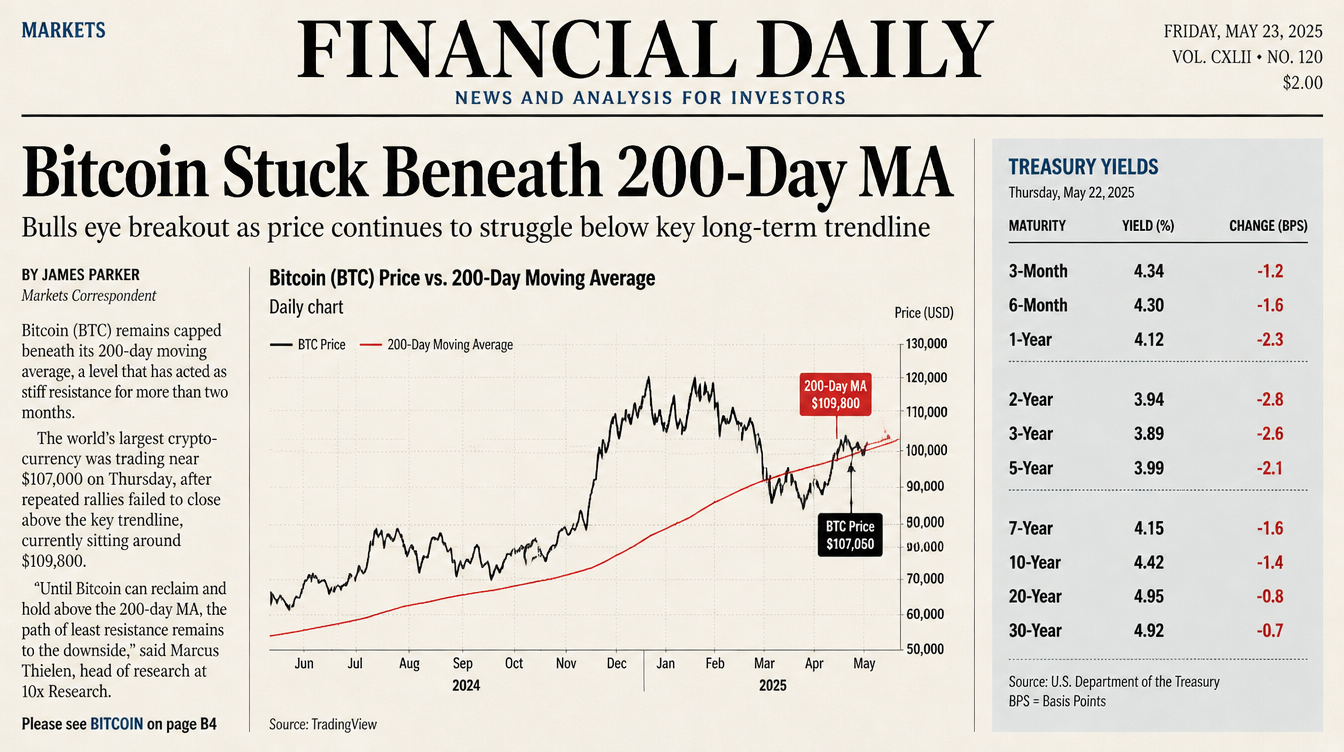
Against this backdrop, bitcoin’s inability to reclaim its 200-day moving average—currently just above $82,000—signals lingering uncertainty around the broader trend. The cryptocurrency is trading near $81,000, flat on the day but still below this key technical level, which many view as a threshold for a sustained bullish breakout.
Gold is also feeling the pressure, down 0.7% on the day at $4,614.
One segment that could benefit from the current environment is tokenized Treasuries. As yields rise, demand for blockchain-based access to government debt is increasing. Assets locked in these protocols have climbed to record highs above $15 billion, according to rwa.xyz, highlighting growing interest in yield-generating instruments on-chain