Here’s a fully paraphrased version of your passage with improved flow, clarity, and originality:
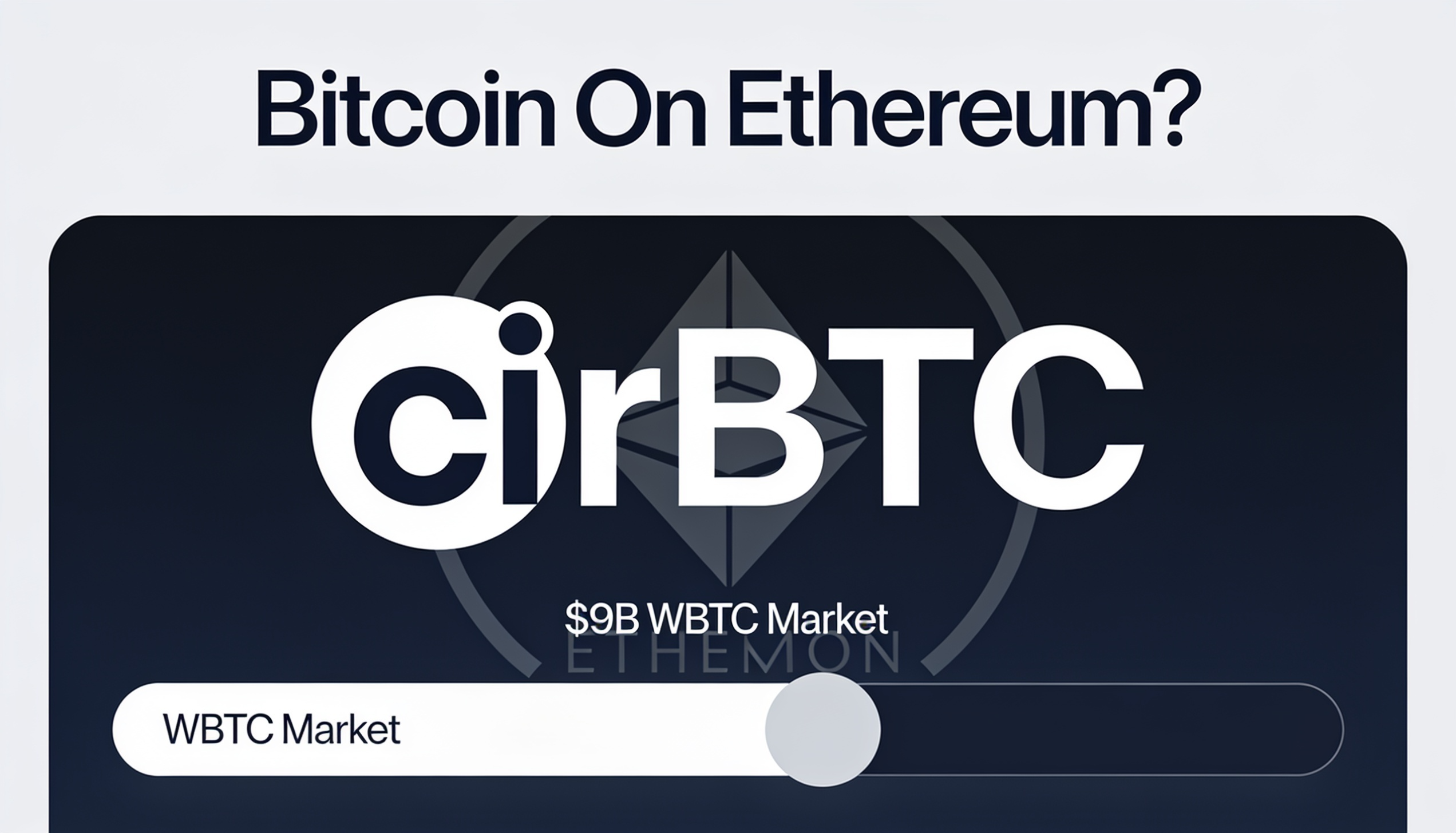
Circle has introduced cirBTC, a 1:1 Bitcoin-backed ERC-20 token deployed on the Ethereum mainnet, directly challenging the dominant WBTC ecosystem, which currently controls around $9 billion in market value and roughly 85% of the wrapped Bitcoin market. Unlike existing competitors, cirBTC emphasizes real-time on-chain reserve verification without depending on third-party attestations.
Launched on June 8, 2026, cirBTC is designed primarily for institutional users, including OTC desks, market makers, lending platforms, and DeFi protocols that require Bitcoin exposure as collateral within Ethereum-based financial systems.
The competitive landscape is already well established. BitGo’s Wrapped Bitcoin (WBTC), launched in 2019, has long been the market leader, while Coinbase’s cbBTC, introduced in 2024, has become the strongest institutional challenger, reaching nearly $5.9 billion in market capitalization.
Circle is positioning cirBTC as a transparency-first alternative, leveraging its institutional credibility built through years of issuing USDC.
cirBTC’s Reserve Model and Real-Time Verification
The key innovation behind cirBTC is its integration with Chainlink Proof of Reserve, which enables continuous, on-chain verification of underlying Bitcoin collateral. Each cirBTC token minted on Ethereum is backed by BTC held in segregated, regulated custody, with reserves verifiable in real time across publicly visible Bitcoin wallet addresses. This removes the need for monthly audit reports, custodian assurances, or delayed off-chain verification processes.
This approach differs significantly from WBTC, where BitGo serves as the sole custodian and provides wallet transparency, but still relies on centralized control and multisignature governance for operational changes.
Following concerns raised during the RenBTC collapse and broader skepticism around custodial bridge transparency, Circle is targeting a well-known trust gap in the market. By using Chainlink’s automated verification system, cirBTC shifts reserve validation from periodic audits to continuous on-chain confirmation.
Bitcoin reserves remain fully separated from Circle’s corporate balance sheet, while issuance and redemption are handled through Circle Mint, its institutional liquidity platform. This infrastructure mirrors the system used for USDC and extends it into Bitcoin-backed assets, allowing institutions to maintain native BTC exposure while using cirBTC within DeFi without selling their underlying holdings.
Competition in the Tokenized Bitcoin Market
The total supply of tokenized Bitcoin across all wrappers is estimated at $15–20 billion as of Q2 2026, representing less than 2% of Bitcoin’s total market capitalization of approximately $1.7 trillion.
While still relatively small, this segment is widely viewed as either a structural ceiling or a major growth opportunity. Current trends suggest the latter, as institutional adoption of on-chain Bitcoin exposure has accelerated significantly since 2024, particularly through regulated wrapper products.
At present, WBTC dominates with roughly 119,000 BTC in circulation, valued near $8–9 billion. cbBTC follows with approximately $5.9 billion in market value and has shown faster early-stage growth than most competing products.
A number of exchange-backed tokens—issued by platforms such as Kraken, Binance, Bitget, and OKX—make up the remainder of the market but remain fragmented.
Circle’s entry does not immediately disrupt this hierarchy, but it introduces a highly trusted issuer with global institutional reach, something most exchange-native wrappers cannot fully match.
A key differentiator for cirBTC is neutrality. Unlike exchange-issued tokens, Circle does not operate a centralized exchange, trading venue, or lending platform. This separation reduces concerns about conflicts of interest or data leakage.
For institutional participants, this matters. Firms using cirBTC as collateral in DeFi markets avoid exposing trading activity to competing exchanges, reducing informational risk for market makers, hedge funds, and prime brokerage clients.