Here’s a clear paraphrased version of the full set of updates, rewritten in a cohesive news style:
Fresh U.S. inflation data released on Thursday came in mixed, while the European Central Bank delivered its first interest rate hike in nearly three years.
Attention now turns to Friday’s trading session, which will be shaped by the long-awaited public debut of SpaceX. The company has priced its shares at $135, according to an SEC filing, in a landmark offering expected to be among the largest in market history.
SpaceX sold 555.6 million shares at that price, raising $75 billion and surpassing Saudi Aramco’s 2019 IPO to become the biggest public listing on record. The firm will begin trading on Nasdaq under the ticker SPCX, entering the market with an estimated fully diluted valuation of around $1.8 trillion.
Despite generating roughly $19 billion in annual revenue from launches, government contracts, and its rapidly expanding Starlink business, the valuation places SpaceX at a premium multiple. The company also holds a significant bitcoin position—18,712 BTC as of March 31—worth nearly $1.2 billion at current prices.
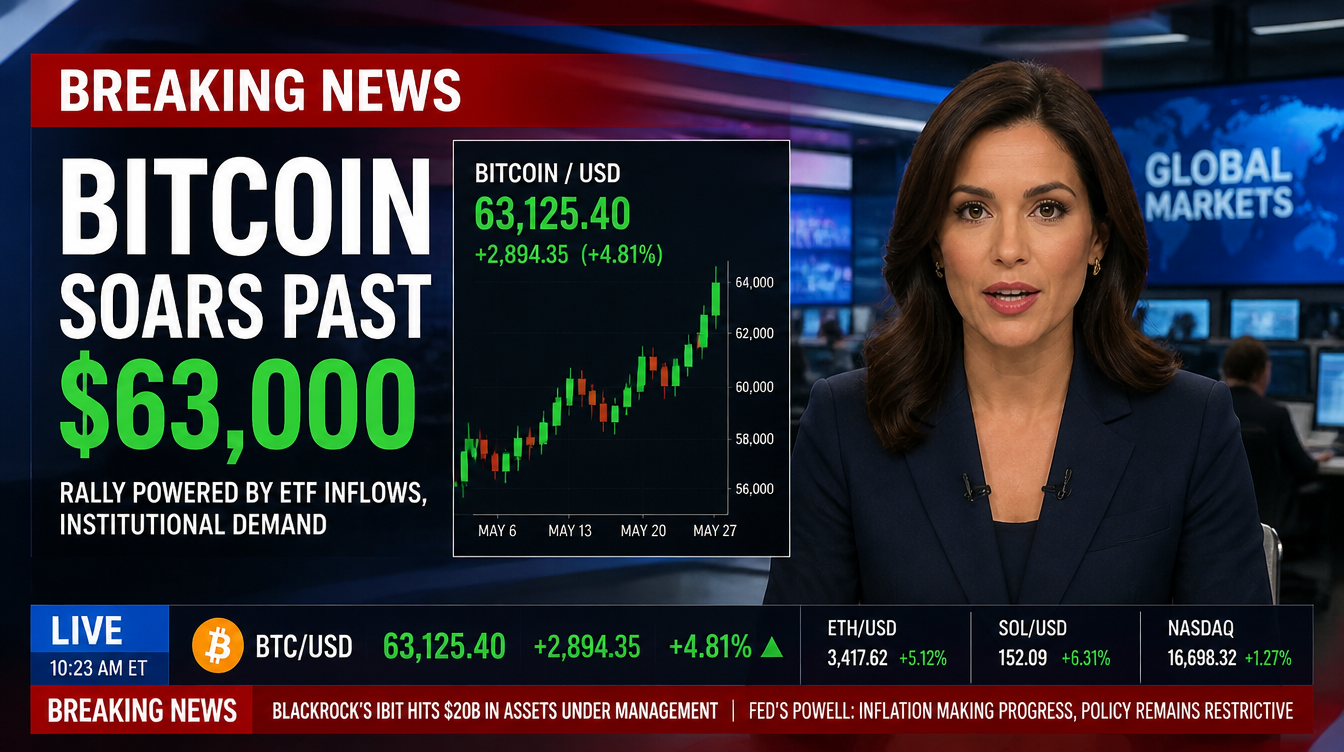
Markets were broadly upbeat ahead of the listing, with crypto and equities rallying on renewed risk appetite following reports that President Trump called off planned military strikes against Iran. The Nasdaq rose about 2.4% and the S&P 500 gained 1.8%, while bitcoin climbed to around $63,500, up roughly 2.5% over 24 hours.
Crypto-linked equities also advanced, with Coinbase up 3.6%, Galaxy Digital gaining 8.8%, and Strategy rising 4.3%. Strategy’s high-yield STRC preferred shares edged higher but remained below par, indicating investors are still pricing in elevated risk.
Earlier in the session, markets surged after Trump posted on Truth Social that diplomatic progress with Iran had reached senior leadership levels, leading him to cancel planned strikes. The announcement pushed equities to intraday highs, sent oil prices down about 3%, and pulled U.S. Treasury yields lower, while bitcoin held near $63,400.
Investor interest in the SpaceX IPO has been intense. BlackRock reportedly placed orders worth at least $5 billion, while total retail demand has reportedly exceeded $70 billion, according to Bloomberg. However, only a small portion of that demand is expected to be filled.
Retail investors have also been selling technology stocks to raise cash ahead of the IPO, particularly in semiconductor and AI-related names, contributing to recent weakness in those sectors.
At the same time, Bitcoin market structure showed mixed signals. The Coinbase Premium Index briefly plunged to deeply negative levels, suggesting aggressive selling on U.S. exchanges relative to offshore markets, even as prices briefly dipped below $63,000 following PPI data.
ETF flows remained a key pressure point, with U.S. spot Bitcoin ETFs recording $213.85 million in outflows in a single day and more than $5.7 billion in cumulative redemptions since mid-May.
Some analysts warn that Bitcoin’s correction may not be over. One strategist suggested the market could still retest $50,000, arguing that capital is rotating into IPOs and AI-related assets while traders hedge amid macro and geopolitical uncertainty. A move to that level would represent a deep drawdown more consistent with previous cycle lows.
Meanwhile, liquidity appears to be shifting toward the SpaceX offering. Reports suggest retail investors have placed over $70 billion in orders, with expectations that only around 20% of the IPO will be allocated to them, leaving significant unfilled demand that could support secondary-market performance.
Broader corporate Bitcoin-related activity also remains under pressure. Several publicly listed “Bitcoin treasury” firms continue to sell portions of their holdings to manage debt or liquidity needs, adding to market supply even as sentiment weakens.
On the macro front, U.S. producer price data showed mixed signals. Headline PPI rose more than expected, while core readings came in softer, leaving markets uncertain about inflation’s direction. Bitcoin slipped modestly on the release before stabilizing near $62,500.
In Europe, the ECB’s first rate hike in nearly three years marked a major policy shift, driven by rising inflation pressures linked in part to energy costs and geopolitical tensions.
Gold eased to a six-month low while Bitcoin held relatively steady above $63,000, though both assets remain under pressure from higher rate expectations. Bitcoin is still down sharply month-to-date, alongside weakness in gold and broader risk assets.
Across derivatives markets, Bitfinex margin longs climbed above 90,000 BTC for the first time since late 2023, suggesting rising leveraged bullish positioning even as price action remains fragile. Historically, similar spikes have preceded both accumulation phases and volatile corrections.
Overall, markets appear to be entering a transition phase—caught between macro uncertainty, geopolitical developments, and a major liquidity event in the form of SpaceX’s record-breaking IPO.