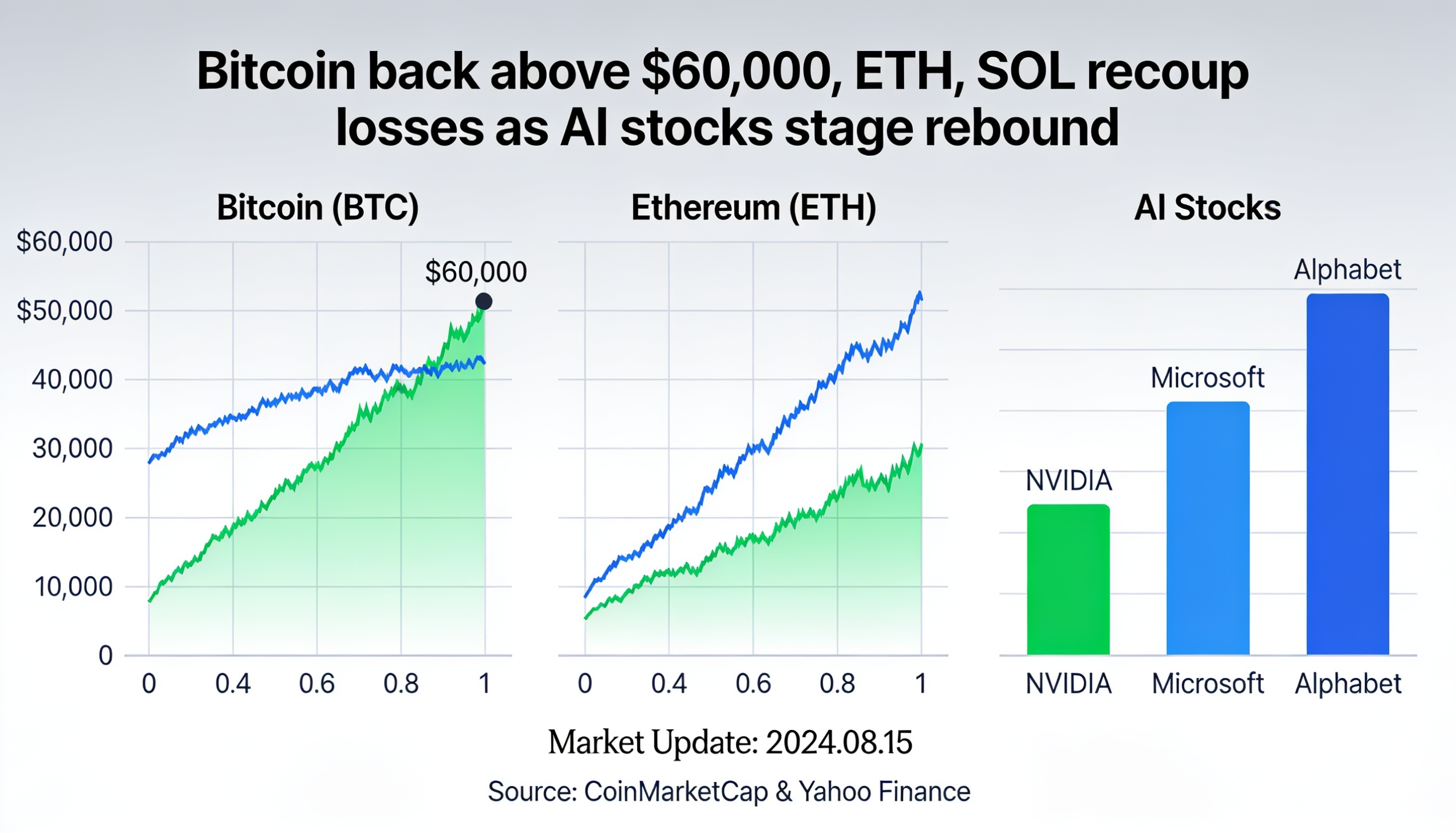
The token briefly sank to the $59,000 level before buyers stepped in to provide support, though weekly losses remain significant across the market. Even with a strong outlook from Micron boosting equities and oil prices continuing to slide, cryptocurrencies failed to keep pace with the rebound.
Crypto assets faced intense selling pressure this week, with bitcoin slipping below $60,000 despite a sharp recovery in technology stocks that had previously weighed on sentiment.
Bitcoin dropped to nearly $59,200 late Wednesday before rebounding to around $60,700 on Thursday. The asset is down 2.9% over the past 24 hours and 5.4% on a weekly basis, according to CoinDesk data.
Altcoins saw deeper declines. Ether fell 2.8% to $1,616, extending its weekly loss to 7.9%. XRP declined to $1.07, down 9.2% over the week, while Solana slipped to $68. Dogecoin and Hyperliquid’s HYPE were among the hardest hit, dropping 11.9% and 11.7%, respectively. Tron stood out as the only major token posting gains, rising 1.9% during the same period.
Meanwhile, the AI-driven trade that had earlier dragged crypto lower reversed direction overnight.
Micron, the largest U.S. memory chip manufacturer, surged roughly 15% after delivering a sales forecast that exceeded Wall Street expectations, reigniting optimism around AI-related spending. Nasdaq 100 futures climbed 1.8%, South Korea’s Kospi jumped as much as 6%, and Brent crude fell below $73 per barrel as supply resumed through the Strait of Hormuz.
Pressure on crypto markets appears increasingly internal. The break below $60,000 reflects persistent outflows from U.S. spot bitcoin ETFs, a more hawkish Federal Reserve stance, and a U.S. dollar that has strengthened to a seven-month high, according to FxPro chief market analyst Alex Kuptsikevich.
A stronger dollar makes dollar-denominated assets like bitcoin more expensive for international buyers and typically diverts capital away from riskier assets.
FxPro also pointed to a longer-term concern: bitcoin is trading near its 200-week moving average, a key indicator tracking roughly four years of price action.
Historically, when bitcoin has approached this level, declines have been prolonged rather than short-lived—lasting about nine months in 2015, six months in 2018, and roughly six quarters after the 2022 downturn. This trend raises the possibility of an extended “crypto winter” instead of a quick recovery.
In the near term, Kuptsikevich highlighted the $61,800–$62,000 range as a critical zone where a concentration of orders could either trigger a rebound through short covering or act as resistance.
If support gives way, $55,000 may emerge as a potential cycle low. He advised traders to focus on managing risk rather than chasing market direction.
Attention now turns to upcoming U.S. inflation data, particularly the Federal Reserve’s preferred price index.
A stronger-than-expected reading would reinforce the Fed’s hawkish stance and a firm dollar, adding further pressure on crypto markets. A softer reading, however, could ease both. For now, crypto is no longer reacting to oil or geopolitical developments that dominated earlier in June, instead facing headwinds from ETF outflows and weak demand that equity market gains have yet to offset.