In today’s Bitcoin news, Malaysian authorities shut down an illegal crypto mining syndicate after carrying out four raids on July 22 and 23 in coordination with Tenaga Nasional Berhad (TNB).
Police arrested three local men and seized 71 mining rigs, with the group believed to be generating between RM80,000 and RM100,000 (about $25,000) in monthly profits.
The operation, codenamed Ops Letrik, highlights the enduring appeal of illegal mining in Johor. By stealing electricity, the syndicate eliminated its biggest cost, turning a potentially unprofitable setup into a high-margin operation—while leaving TNB to absorb the losses.
The development comes as Bitcoin (BTC) dipped 0.4% in the past 24 hours to $65,300 after slipping below $66,000. The $65,000 level is currently holding as key support.
How the Syndicate Ran the Operation
The raids were led by the Johor Contingent Police Headquarters’ Criminal Investigation Department (D4) alongside TNB’s Southern Region SEAL team.
Authorities targeted three residential properties and one shophouse in Iskandar Puteri, Johor Bahru Utara, and Kulai. Each site was rented for RM5,000 to RM6,000 per month, with rental details still under investigation.
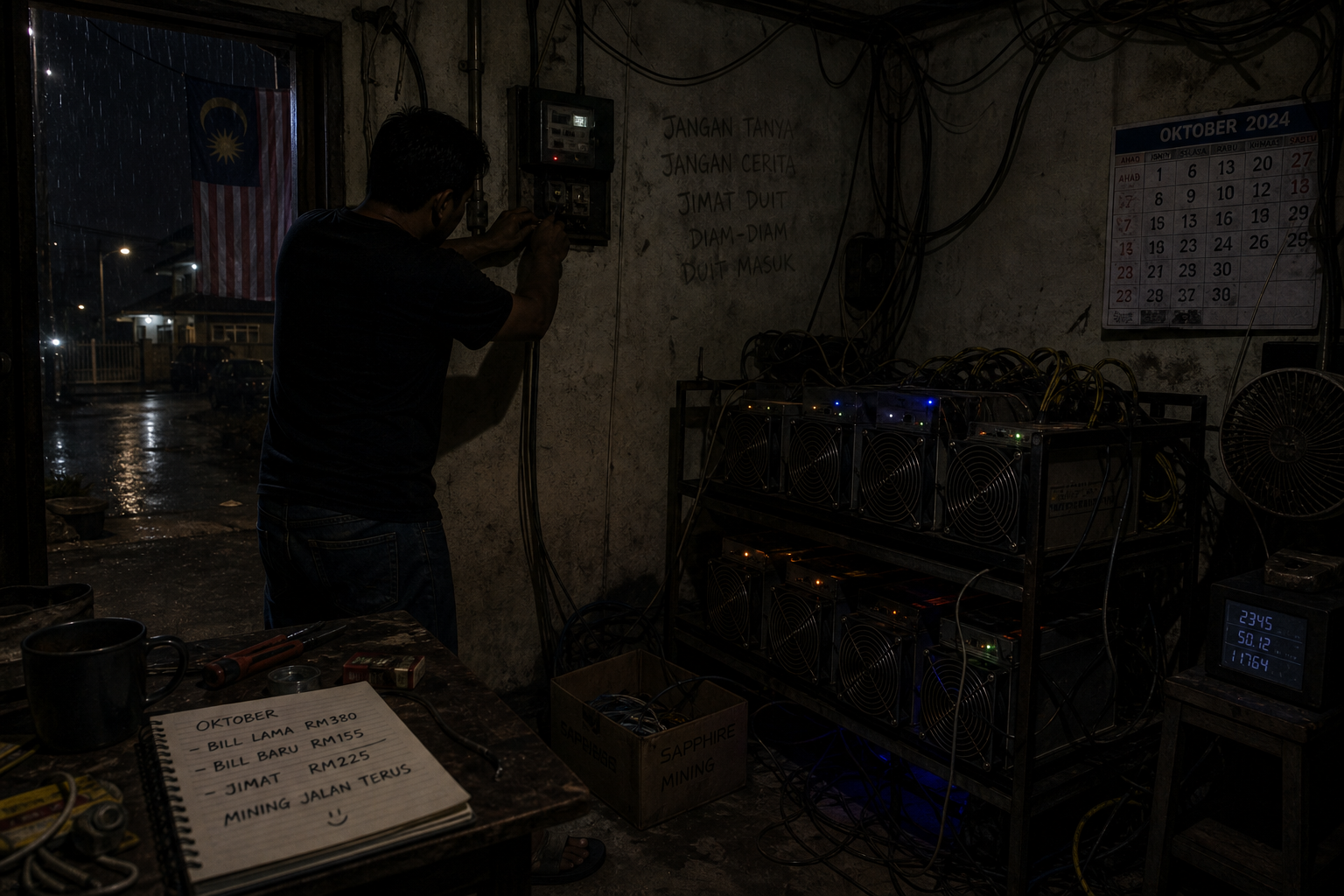
The group used direct tapping—illegally bypassing electricity meters with hardwired connections—to power their mining rigs without paying for energy.
In just one month, the stolen electricity caused losses of RM67,502.30 to TNB. Meanwhile, the syndicate generated multiple times that amount in Bitcoin revenue, underscoring the profitability of power theft.
Seized items included 71 mining machines, computers, laptops, routers, monitors, keyboards, a mobile phone, and two vehicles.
Police said one suspect managed all four locations, while the other two handled technical setup and wiring. The suspects, aged 26 to 46, were reportedly earning around RM5,000 each per month.
All three remain in custody until July 26, with authorities continuing to track additional individuals linked to the network.
Legal Risks and Ongoing Crackdown
The case is being investigated under Section 427 of the Penal Code and Section 37(1) of the Electricity Supply Act 1990, which together carry penalties including fines of up to RM100,000 and prison terms of up to five years.
Despite these risks, the profit potential continues to drive illegal mining. Authorities have responded by increasing enforcement activity rather than relying solely on legal deterrence.
Between January 2025 and June 2026, Johor police conducted 16 raids tied to illegal mining, seizing 158 machines and recording nearly RM1 million in losses for TNB.
Malaysia’s Power Theft Problem
The Johor case reflects a broader national issue. Illegal crypto mining in Malaysia has evolved into a structured underground industry, heavily reliant on electricity theft.
With legitimate mining margins squeezed by energy costs and rising network difficulty, stealing power removes the biggest expense—making operations profitable regardless of market conditions.
This dynamic explains why such syndicates persist despite repeated raids and prosecutions, while legitimate operators continue to bear full operational costs.
Police say investigations are ongoing, with more suspects potentially linked to the syndicate still under scrutiny.