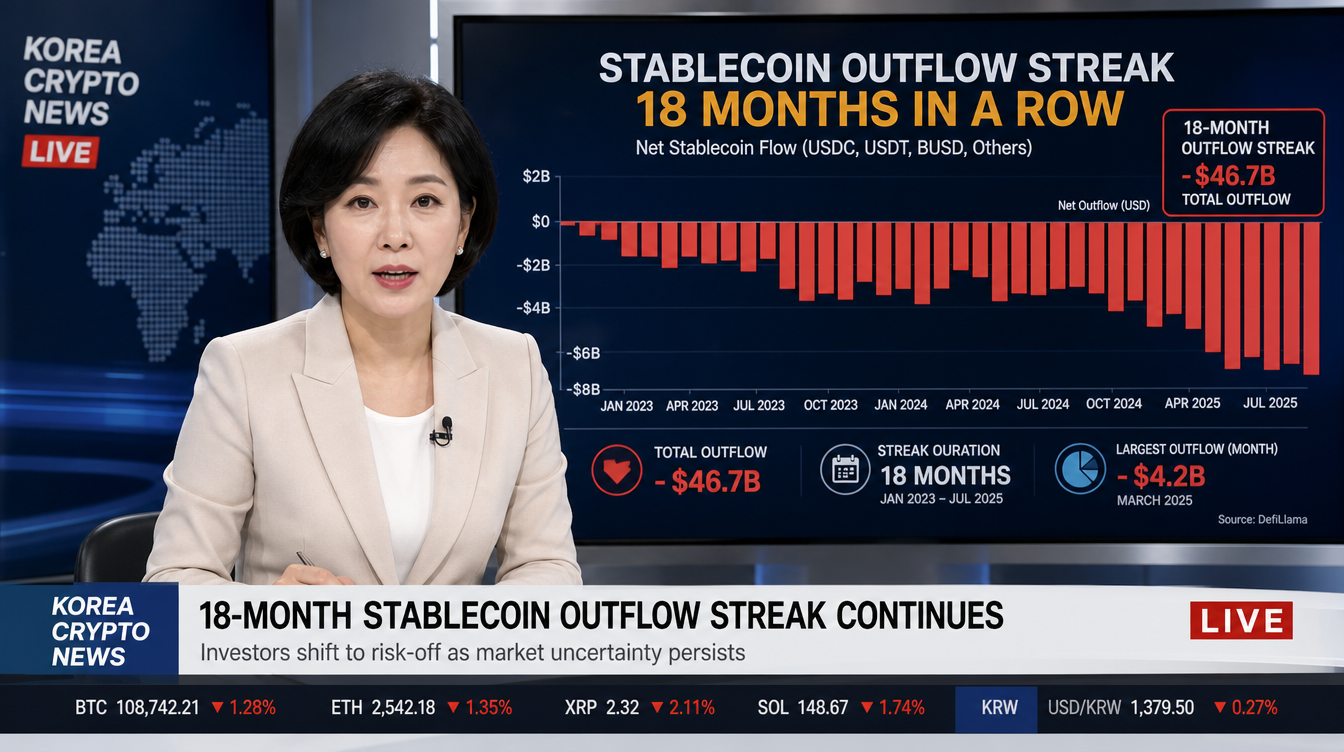
South Korea’s largest crypto exchanges recorded $367 million in net stablecoin outflows during June 2026, extending an 18-month pattern driven largely by restrictions on domestic crypto products.
Data from the Financial Supervisory Service (FSS) showed that the country’s five biggest won-based exchanges — Upbit, Bithumb, Coinone, Korbit, and Gopax — transferred 2.76 trillion won worth of stablecoins to overseas platforms in June while receiving 2.20 trillion won back. The resulting net outflow reached 560.3 billion won, or approximately $367 million.
The latest figures mark the 18th consecutive month of net stablecoin outflows since the trend began in January 2025. Rather than signaling widespread investor fear, the movement reflects a structural gap between the products available on South Korean exchanges and those offered by global crypto platforms.
Many Korean traders are sending stablecoins overseas to gain access to investment products that remain restricted or unavailable under domestic regulations.
The data was released as the overall cryptocurrency market capitalization stood at $2.22 trillion, down 1.1% over the previous 24 hours. Total daily crypto trading volume was approximately $16.9 billion.
Regulatory Limits Push Investors Toward Overseas Platforms
South Korea’s leading exchanges operate under the Specific Financial Information Act, which requires strict anti-money-laundering compliance and limits access to products such as leveraged derivatives, decentralized finance (DeFi), liquid staking, and many real-world asset (RWA) investment opportunities.
A Korea Times report published on Aug. 2 noted that June’s stablecoin outflows represented 77.6% of Korean investors’ net purchases of foreign stocks.
During the second quarter of 2026, net stablecoin outflows totaled about 1.69 trillion won, surpassing the 1.62 trillion won recorded in net purchases of overseas equities. The figures suggest stablecoins have become a major route for retail investors seeking exposure to international markets and higher-risk products.
FSS data indicates that several popular crypto services remain unavailable through licensed domestic exchanges. Overseas platforms such as Binance and Bybit have gained attention among Korean traders by offering products linked to major Korean stocks and other global assets.
The stablecoin market share among domestic exchanges has also changed significantly. Coinone recorded the highest average daily stablecoin trading volume in June at 84.58 billion won, capturing 34.8% of the market after launching zero-fee trading for Circle’s USDC in October 2025.
Bithumb ranked second with 75.57 billion won in daily volume and a 31.1% share, while Upbit followed with 73.03 billion won and a 30.1% share, according to FSS data cited by Korea Times.
This represents a sharp shift from January 2025, when Upbit controlled 53.5% of stablecoin trading volume, Bithumb held 42.5%, and Coinone accounted for just 1.8%.
Despite these changes, the overall trend of offshore stablecoin movement has continued. Coinone’s zero-fee initiative appears to have redistributed local trading volume rather than keeping more funds within South Korea.
Upbit remains the country’s largest crypto exchange by overall trading activity. CoinGecko data cited by Korea Times showed that Upbit handled around 60% of average daily crypto volume in June, while Bithumb accounted for about 32%.
However, within the stablecoin market, these assets are increasingly being used as a bridge for moving funds to overseas platforms rather than simply as trading instruments.
South Korea Reviews Crypto Rules Amid Growing Offshore Activity
The continued movement of stablecoins offshore has increased calls for regulatory reform. Rep. Lee, cited by Korea Times, urged authorities to reconsider investor protection measures and strengthen the country’s digital asset oversight framework.
Lawmakers have raised concerns that Korean investors are accessing high-leverage products through overseas exchanges without the protections available on domestic platforms. They have also highlighted the difficulty of monitoring stablecoin flows outside traditional financial channels.
Discussions among policymakers have included potential rules for won-backed stablecoins, security token offerings, and institutional crypto custody services, though no specific timeline for new legislation has been announced.
The issue appears to be driven by differences in available products rather than restrictions on capital movement. Closing the gap may require broader regulatory updates covering derivatives, DeFi services, staking, and other emerging crypto sectors.
Until locally licensed exchanges can provide a wider range of services similar to international platforms, stablecoins are likely to continue flowing offshore. June’s figures suggest the trend has become a lasting feature of South Korea’s crypto market rather than a short-term reaction.