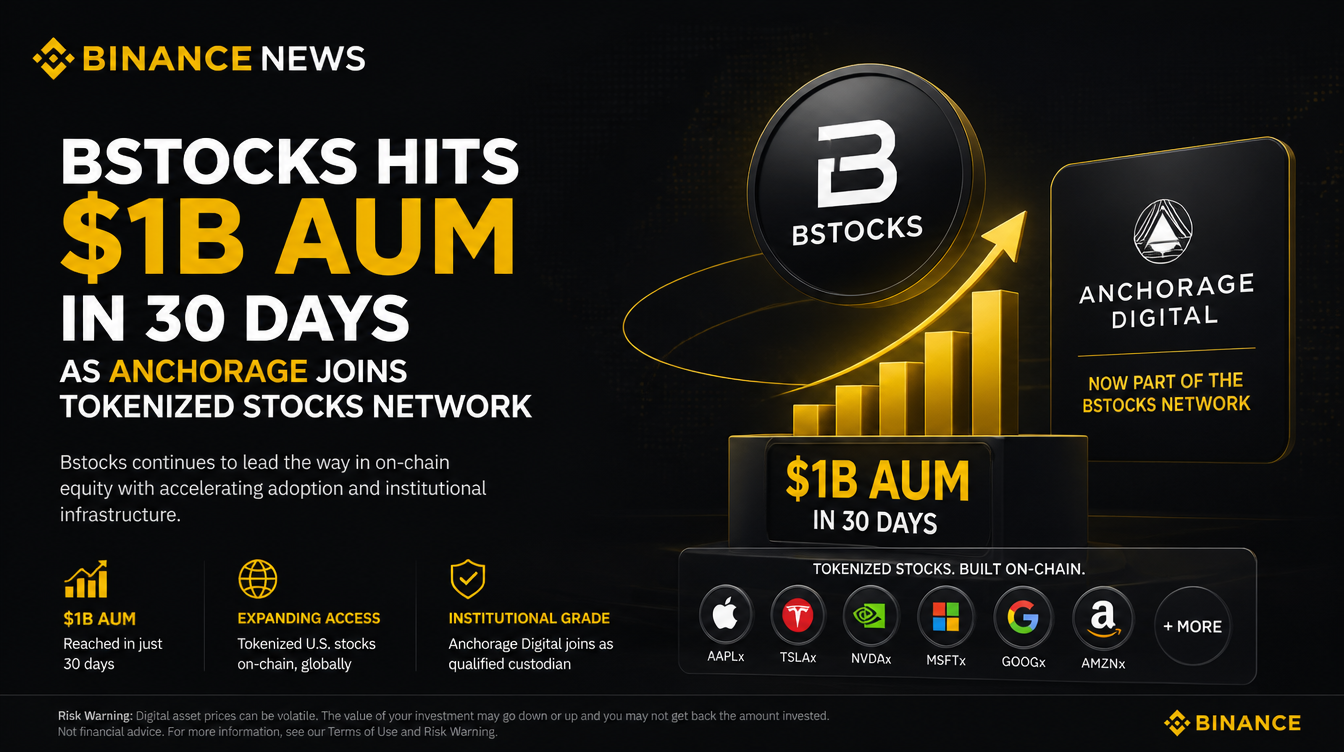
Binance’s tokenized equities platform, Bstocks, crossed $1 billion in assets under management within 30 days of launch, as Anchorage Digital joined its Triparty Banking network to bolster institutional settlement.
Introduced on June 1, 2026, Bstocks rapidly scaled to $1 billion in AUM in its first month, generating $3 billion in cumulative trading volume and averaging $42 million in daily inflows.
On June 30, Binance confirmed that Anchorage Digital—the first federally chartered crypto bank in the U.S.—had integrated into its Triparty Banking framework. The move marks the debut of Anchorage’s Atlas institutional settlement platform on a crypto exchange.
The milestone signals a broader shift in markets: tokenized equities are moving beyond experimentation into a viable asset class. Bstocks’ monthly activity already surpasses the weekly volumes of platforms such as Backed Finance and Ondo Finance, which averaged $35–40 million combined over the same period.
Platform Structure and Adoption Trends
Bstocks gives eligible non-U.S. users access to more than 7,000 U.S.-listed stocks and ETFs, enabling fractional investing from as little as $5 using stablecoins. The platform operates through ADGM-regulated Nest Trading and U.S. clearing broker Alpaca Securities.
Exposure is delivered via BEP-20 tokens on BNB Chain, issued by BTech Holdings under a Financial Services Regulatory Authority-approved framework. These tokens track economic performance but do not confer voting rights or dividends.
Adoption has been strongest in emerging markets, which account for 73% of new users. Trade sizes skew small, with 40% under $100, while fractional shares make up 35% of total volume.
With only 11% of adults globally holding brokerage accounts, Bstocks is targeting a significant access gap. Binance executive Shunyet Jan pointed to rising demand among younger investors and underserved retail segments.
Technology stocks dominate activity, comprising 71% of holdings and generating 23 times the trading volume of other sectors. Semiconductor names alone account for 48%. Binance expects the platform to reach $10 billion in AUM by year-end 2026.
The trend aligns with broader growth in tokenized real-world assets, as blockchain rails increasingly support traditional financial exposure.
Anchorage Integration and Institutional Market Structure
By integrating Anchorage Digital, Binance is reshaping how institutions manage collateral and custody. Clients can now hold assets with Anchorage and deploy them as collateral for trading on the exchange.
Eligible collateral includes crypto assets, U.S. dollar deposits, and tokenized real-world assets. The model mirrors traditional finance, where custody and execution are separated.
Binance CEO Richard Teng said the shift reflects the maturation of institutional crypto markets, while Anchorage CEO Nathan McCauley noted that the setup allows firms to access exchange liquidity without compromising asset security.
Binance is offering zero-fee Triparty services for institutions through December 31, 2026, with tiered pricing scheduled for 2027. The exchange reiterated that it does not serve U.S. customers.
Competitive Dynamics and Off-Exchange Settlement
The Binance-Anchorage partnership is part of a broader wave of off-exchange settlement integrations in 2026. BitMEX has partnered with Zodia Custody, Bitget has integrated Fireblocks, and KuCoin Institutional has adopted Ceffu’s MirrorX platform to accelerate off-chain settlement.
The shift highlights a new phase in institutional crypto adoption, where infrastructure, custody segregation, and regulatory alignment are becoming as critical as liquidity.
Anchorage Digital, valued at $4.2 billion and backed by Andreessen Horowitz and Goldman Sachs, brings strong regulatory standing, with licenses in Singapore and New York.
As regulatory frameworks evolve—including proposals like the CLARITY Act—exchanges that align with regulated custody providers may gain an edge in both institutional adoption and policy engagement.