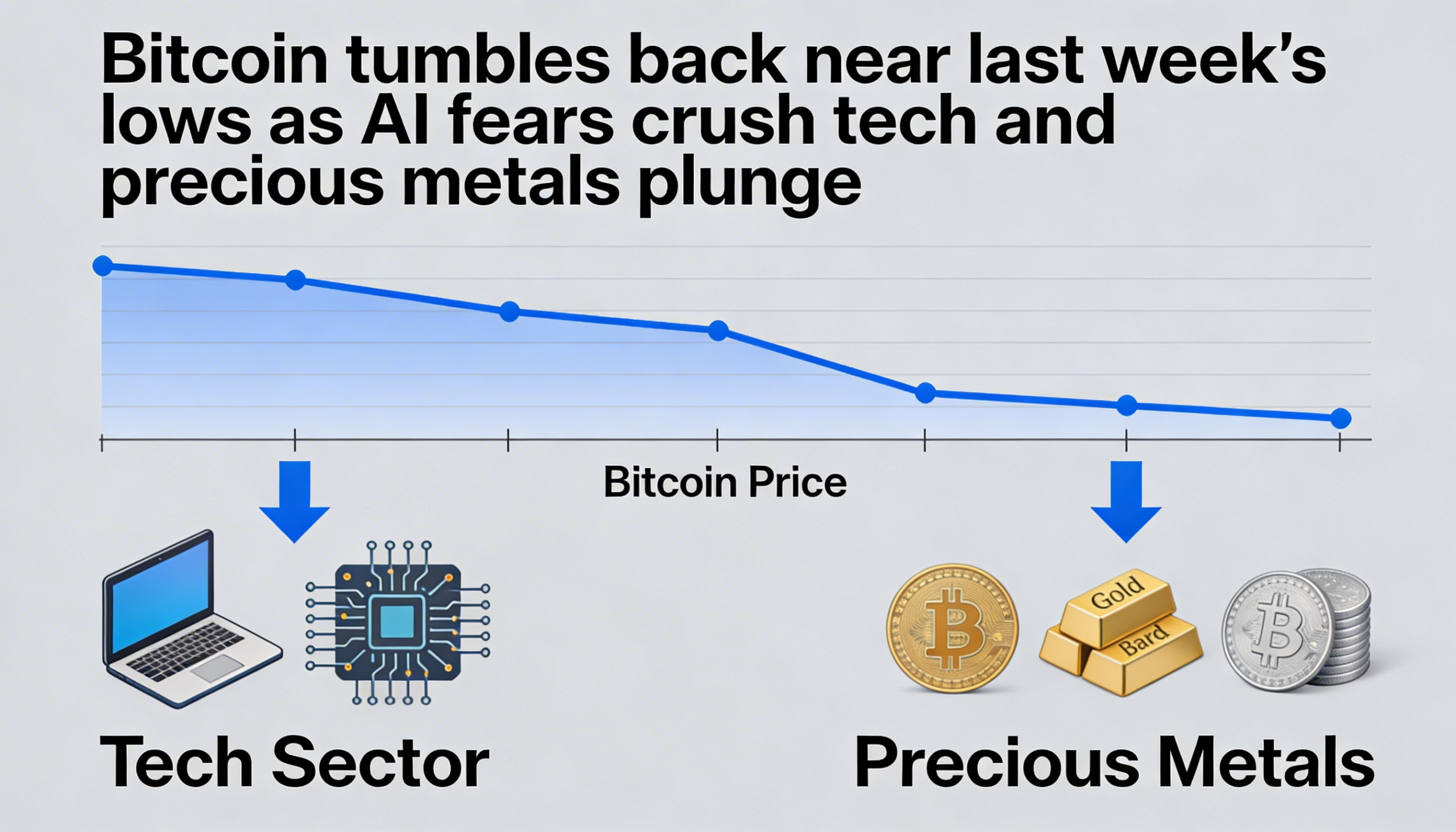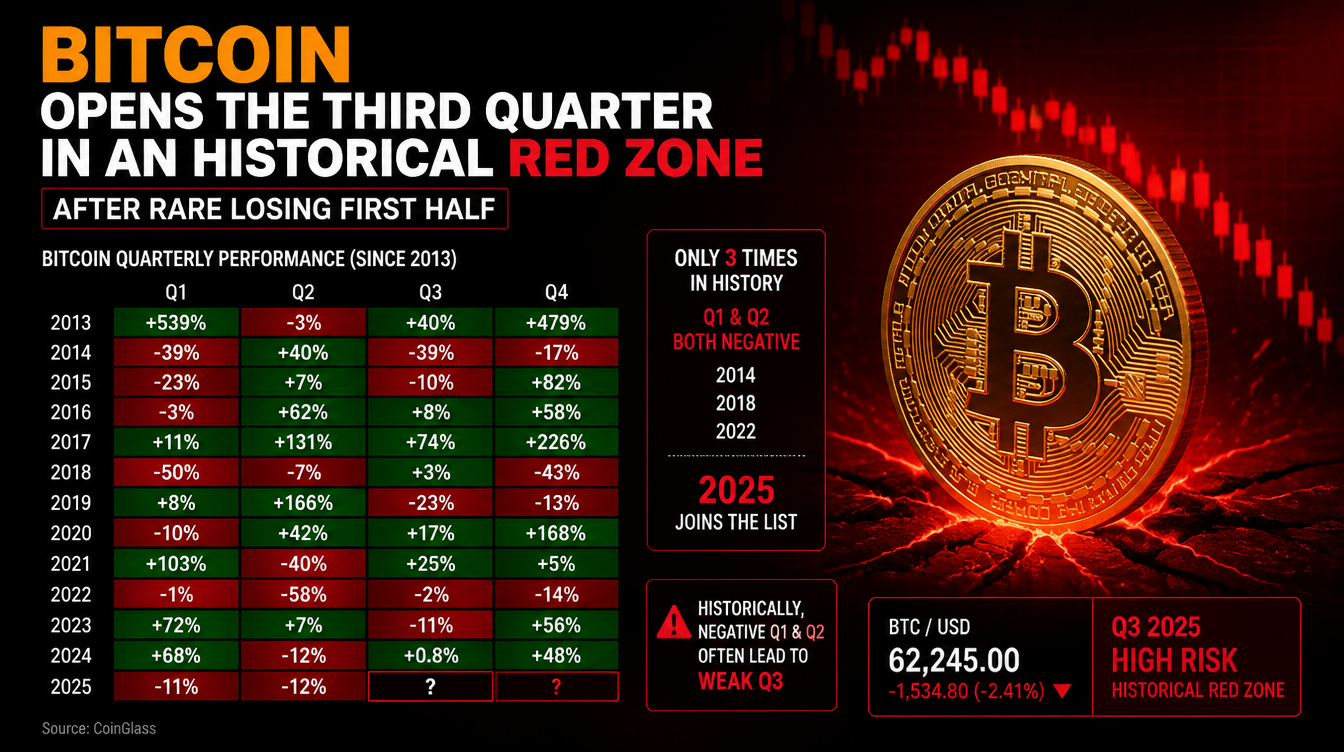
Bitcoin posted losses in both Q1 and Q2 of 2026, becoming only the third time in its history that it has begun a year with two consecutive quarterly declines. In the previous two cases—2018 and 2022—the second half of the year offered no meaningful recovery.
Bitcoin (BTC) finished the first half of 2026 in the red across both quarters, marking one of its rarest and weakest starts to a year. The cryptocurrency dropped 22.2% in Q1 and another 14.09% in Q2, according to Coinglass data, and was trading just above $59,000 as the third quarter began on Wednesday.
Only twice before has bitcoin opened a year with back-to-back quarterly losses, in 2018 and 2022—both of which ultimately ranked among its worst full-year performances.
In those cycles, the second half failed to reverse the trend. In 2018, Q3 saw a modest 3.6% gain before Q4 collapsed 42%. In 2022, Q3 declined 2.6% and Q4 fell nearly 15%.
Both periods were defined by major bear-market catalysts—2018 driven by the unwinding of the ICO boom, and 2022 shaped by the collapse of Terra and the failure of FTX.
Seasonally, bitcoin typically shows the opposite pattern. Q4 has historically been its strongest quarter, averaging a 77% gain with a median near 48%, often compensating for earlier weakness. By contrast, Q3 is usually the weakest period, often flat or slightly negative.
However, in both 2018 and 2022, those seasonal trends broke down as broader bear-market conditions overwhelmed typical cycles, turning the usually strong fourth quarter into a period of heavy losses.
While the sample size is small, the pattern suggests that when bitcoin begins a year this weakly, it has often reflected deeper structural stress rather than short-lived corrections.
Whether 2026 follows that same path remains uncertain, with current selling pressure appearing more gradual than panic-driven.
Recent data points to continued outflows from U.S. spot bitcoin ETFs, subdued onchain activity, and capital rotation into AI equities, which have outperformed sharply while crypto has lagged.
A stronger U.S. dollar—boosted further by the yen’s drop to a 40-year low—has added additional headwinds for risk assets.
FxPro analyst Alex Kuptsikevich has identified $40,000 as a key downside level if conditions deteriorate further. The third quarter has begun with a modest gain of around 1%, leaving the broader trend unresolved.