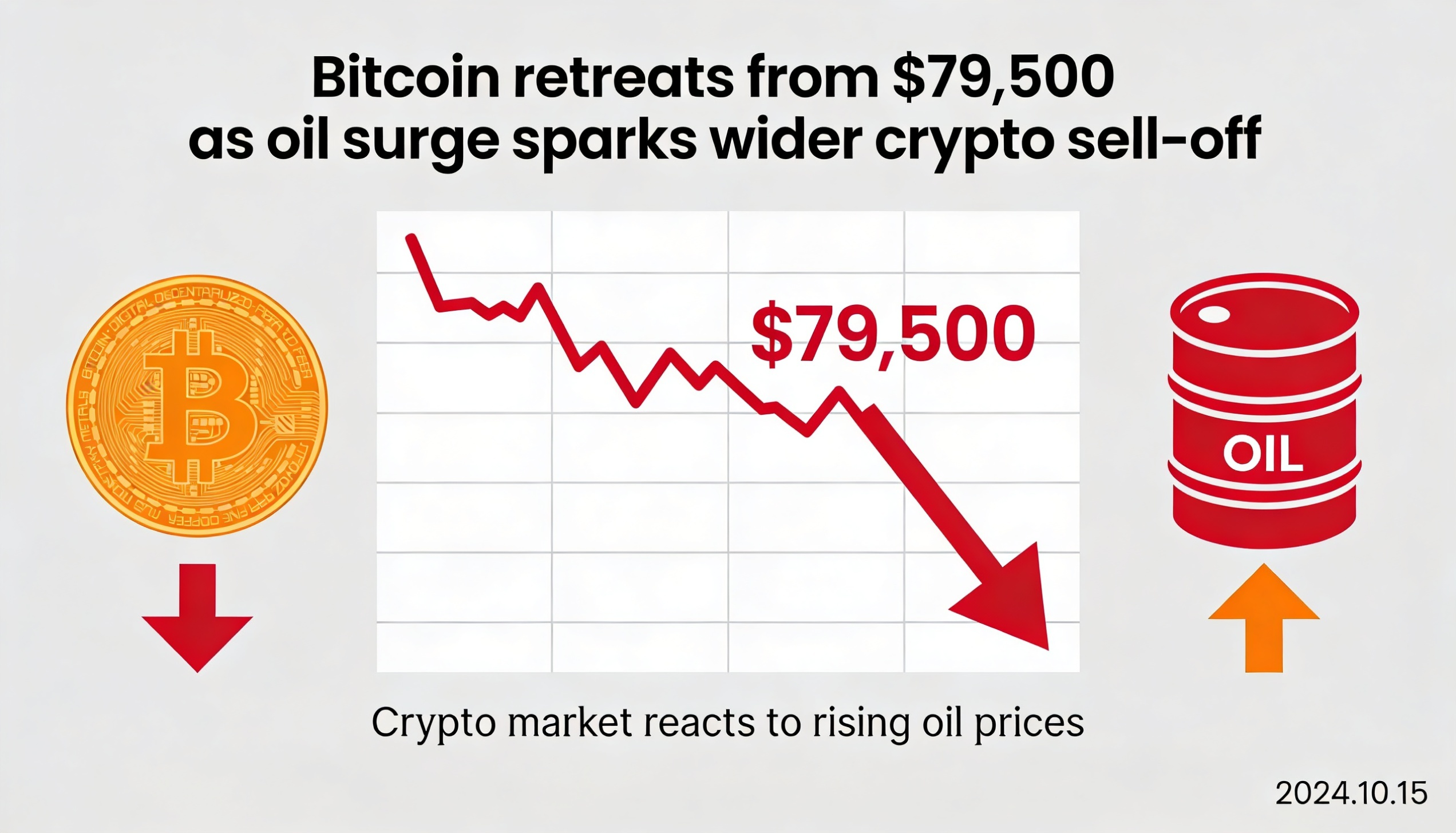
Bitcoin (BTC) failed to hold above $80,000, reversing sharply lower and weighing on broader crypto markets as rising oil prices dampened risk appetite. The move saw bitcoin drop roughly 2% after briefly touching an intraday high near $79,480.
The rally began around 23:00 UTC alongside the U.S. equity and CME futures open, a period typically marked by heightened volatility. However, momentum faded into the Asian session, and by 05:30 UTC bitcoin broke lower after repeated failures at the $80,000 level, sliding back toward $77,800.
Macroeconomic pressure added to the downside, with Brent crude rising to $107 per barrel — its highest level since the U.S.–Iran ceasefire period began. Sentiment was further influenced by reports that U.S. President Donald Trump canceled planned talks involving U.S. officials in Pakistan over the weekend.
Ether (ETH) traded near $2,320, down 2.2% over the same period, slightly outperforming weaker altcoins but still tracking the broader risk-off tone.
Crypto liquidations totaled nearly $300 million in the past 24 hours, with short positions accounting for a large share after being squeezed during bitcoin’s brief rally toward $79,500.
In derivatives markets, XRP led gains in open interest among major tokens, rising 2.5% to 1.82 billion XRP — its highest level in a week. Combined with negative funding rates and weakening cumulative volume delta, the positioning suggests a cautious and defensive setup across majors.
Analysts noted that persistently negative bitcoin funding rates are increasingly linked to institutional hedging activity rather than outright bearish conviction.
Elsewhere, HBAR, CC, XLM, and HYPE also saw notable increases in open interest. In contrast, SUI recorded the most negative cumulative volume delta, signaling sustained aggressive selling. Sentiment was further pressured after a hack of the Sui-based DeFi protocol Scallop, where attackers reportedly stole around 150,000 SUI tokens worth just over $140,000.
Despite spot volatility, implied volatility for bitcoin and ether has continued trending lower over the past month, pointing to relatively subdued expectations for future price swings. This mirrors calmer conditions in traditional markets, including a lower VIX and continued strength in U.S. equities such as the Nasdaq.
Options data from Deribit shows a persistent tilt toward put positioning across most maturities, though longer-dated ether contracts appear less bearish than bitcoin equivalents. The $80,000 bitcoin call strike remains the most heavily positioned level, with over $1.5 billion in notional open interest. Positive dealer gamma at this strike suggests market makers may sell into strength and buy dips, helping to contain volatility around this key level.
Flow data from Laser Digital indicates increasing interest in risk reversals over outright puts, suggesting traders are positioning for volatility rather than directional downside.
Altcoins saw the sharpest pressure during the 05:30 UTC selloff, with Lido (LDO) leading losses after falling roughly 17% and erasing prior gains.
The CoinDesk 20 (CD20) Index slipped 1.5%, while the DeFi Select Index (DFX) dropped 2.3%. The Smart Contract Platform Select Index (SCPX) underperformed, down 2.5%.
A few tokens bucked the trend, including PENGU, JUP, and CHZ, which gained 9.1%, 4%, and 3.1%, respectively.
Meanwhile, CoinMarketCap’s “Altcoin Season” index held steady at 39/100, remaining in neutral territory and well below last month’s peak of 51/100.