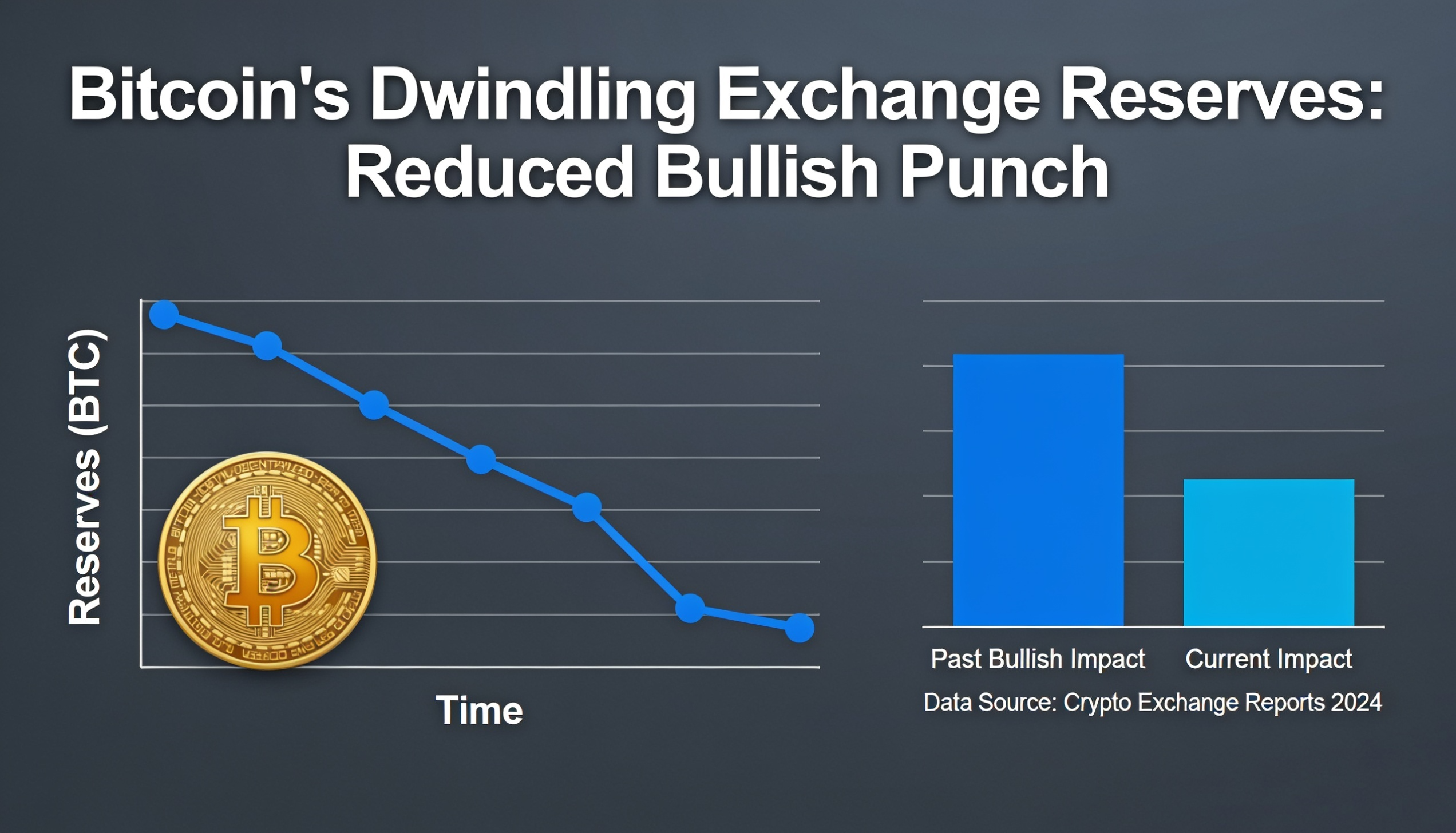
Bitcoin’s falling exchange reserves no longer provide the same bullish signal
Santiment revealed that Bitcoin’s exchange supply has declined to its lowest level since 2017, while Ethereum’s exchange-held supply has reached its lowest point since 2015. The analytics firm said the trend alone does not ensure higher prices but could help create a stronger foundation for the next crypto market expansion.
One of Bitcoin’s most widely followed long-term bullish indicators continues to gain attention, although its influence has diminished compared with earlier market cycles.
Traditionally, analysts have interpreted falling BTC balances on centralized exchanges as a bullish sign. The assumption is that when investors move Bitcoin into private wallets, fewer coins remain available for selling, reducing market supply and potentially supporting price growth.
This narrative has remained popular throughout Bitcoin’s history, with many investors viewing declining exchange balances as a sign of long-term accumulation.
“Historically, prolonged declines in exchange reserves have often appeared before extended bull market periods,” said Mark Zalan, CEO of GoMining, a tokenized retail mining platform. However, he warned that predicting the exact timing of the next rally is impossible, adding that anyone claiming certainty is likely speculating rather than forecasting.
Despite its historical reputation, the indicator has become less reliable. Bitcoin’s exchange supply has remained near record lows for months, yet prices have struggled to recover and remain far below previous highs.
Some industry experts believe the metric has lost accuracy because it does not reflect the growing role of institutional custody, ETFs, and decentralized finance.
“Low exchange supply used to be seen as a straightforward bullish indicator,” said Eneko Knorr, CEO of Stabolut. “But we have experienced extremely low exchange balances for more than a year. The market has evolved, and much of the crypto supply has simply moved into other areas, including DeFi, staking platforms, yield opportunities, and institutional vaults.”
Santiment recently highlighted that Bitcoin and Ethereum reserves on exchanges have reached historic lows, calling the trend one of the strongest long-term signals in crypto. The firm estimates that exchange-held Bitcoin represents about 6.6% of circulating supply, while Ethereum’s exchange supply accounts for roughly 4.3%.
“Bitcoin and Ethereum are showing one of crypto’s most promising long-term indicators: coins are remaining off exchanges,” Santiment said, noting that fewer assets are immediately available for selling despite ongoing market uncertainty.
Because Bitcoin and Ethereum together represent nearly two-thirds of the entire crypto market, Santiment believes reduced exchange supply could support the conditions needed for another sustained bull cycle. However, the firm emphasized that the market has not fully entered that phase yet.
The crypto market has evolved beyond exchange balances
The meaning behind declining exchange reserves has changed as the cryptocurrency industry has matured.
Bitcoin leaving exchanges does not always mean investors are simply placing coins into long-term storage. Some BTC is converted into wrapped assets such as WBTC and moved into decentralized finance applications, where it can still be traded, borrowed against, or used as collateral.
A similar shift has occurred with spot Bitcoin ETFs. As investor demand increases, ETF providers purchase Bitcoin through exchanges or OTC markets and transfer those holdings into institutional custody solutions.
While this reduces visible exchange balances, ETF shares continue trading actively in traditional financial markets, providing investors with liquid exposure to Bitcoin.
Analysts argue that exchange reserve data does not fully capture this growing financial infrastructure around Bitcoin. This has become increasingly important as ETF adoption expands. Coinglass data shows that U.S. spot Bitcoin ETFs hold around $73 billion in assets, representing more than 641,400 BTC. Ethereum ETFs hold approximately $13.7 billion, equivalent to about 7.7 million ETH.
“The bigger story is that this metric reflects the transition away from the traditional exchange custody model,” said Ben Nadareski, CEO of Solstice. “The key question is not only how much crypto leaves exchanges, but where those assets are moving.”
According to Nadareski, Bitcoin is increasingly moving into two main areas: regulated institutional custody and productive on-chain financial applications.
The historical link between declining exchange supply and market rallies is also not guaranteed. In 2022, exchange reserves remained relatively low even as Bitcoin experienced a major price collapse.
Bitcoin accumulation remains strong despite weaker indicator
Although exchange balances may no longer serve as a perfect bullish measure, broader Bitcoin accumulation trends remain strong among companies, institutions, and long-term holders.
“More than 130 publicly listed companies now hold Bitcoin on their balance sheets, while spot ETFs continue absorbing BTC into regulated custody,” Zalan said.
According to Bitcoin Treasuries data, public companies hold around 1.26 million BTC, private companies hold approximately 281,752 BTC, government entities hold nearly 649,954 BTC, and DeFi protocols control about 369,595 BTC. ETFs and exchanges collectively hold roughly 1.62 million BTC.
The same data shows treasury companies hold approximately 7.25 million ETH.
Including nearly 7 million BTC stored in dormant wallets, almost 11.2 million Bitcoin is currently outside active circulation. That represents about 56.5% of Bitcoin’s circulating supply of roughly 20.05 million coins.