Brent crude gained nearly 4% as escalating U.S.-Iran tensions pushed energy prices higher, while Asian semiconductor stocks remained pressured following the market shock caused by China’s latest AI developments.
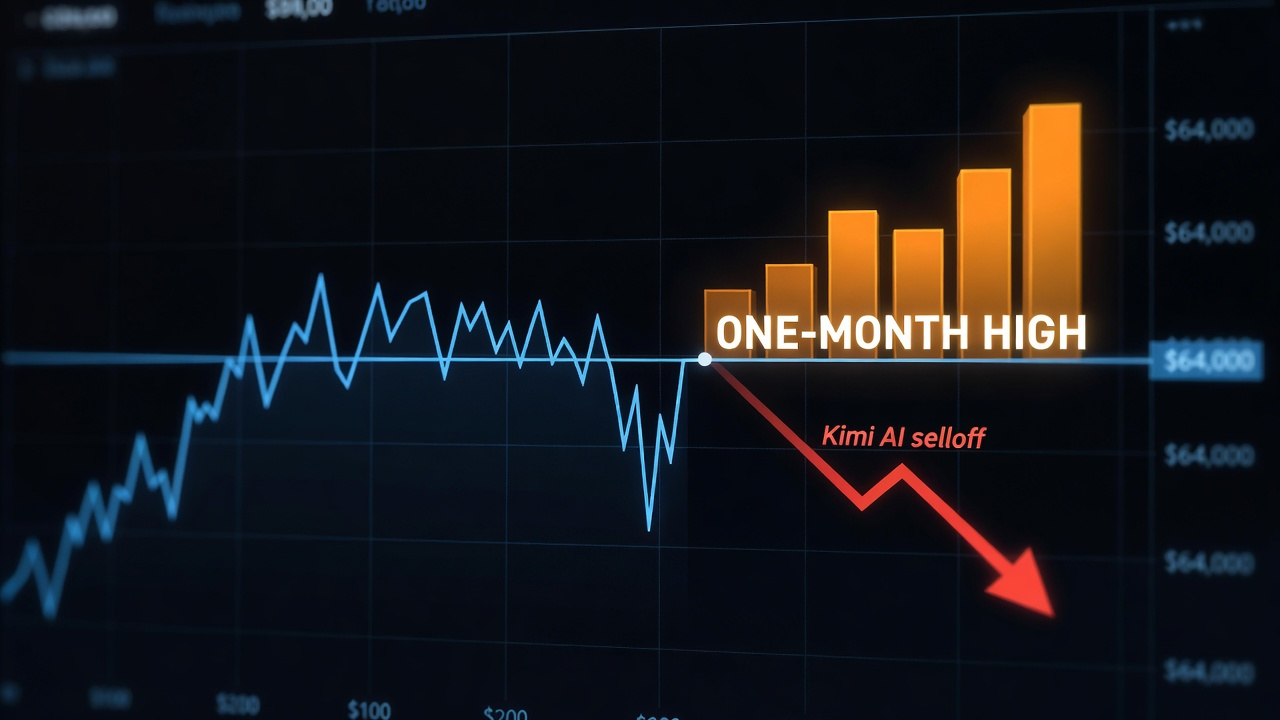
Bitcoin traded around the $64,000 mark on Monday as investors weighed the impact of rising oil prices linked to geopolitical conflict against continued uncertainty in equity markets after Moonshot AI’s latest Kimi model triggered a selloff at the end of last week.
The largest cryptocurrency was trading near $64,200, showing little change on the day but remaining about 3% higher over the past week. Around $18 billion worth of bitcoin changed hands during the session. Ether continued to lead among major cryptocurrencies, trading near $1,860 and gaining 5% over the previous seven days.
Most other large-cap tokens moved within a narrow range. XRP stayed close to $1.09, Solana traded around $76, BNB eased to $565 and dogecoin remained near $0.07. Hyperliquid’s HYPE was the biggest underperformer, falling 10% over the week to $60 as broader risk aversion weighed on the market.
Oil emerged as the biggest market mover, with Brent climbing as much as 4% to $91.42 per barrel, reaching its highest level since June. The increase came as U.S. and Iranian strikes intensified, bringing back inflation concerns that had previously faded following softer U.S. price data.
AI-related stocks and technology shares continued recovering from Friday’s selloff. Moonshot AI’s Kimi K3, a Chinese open-weight model that topped a major coding benchmark, sparked concerns about the strength of the AI sector and triggered declines in semiconductor stocks, which also pressured crypto markets.
The impact spread across Asian markets on Monday, with South Korea’s Kospi dropping 3.5% as trading resumed after a holiday. U.S. futures were more stable, with Nasdaq 100 futures gaining 0.5%, but investors continued to assess the implications of China’s AI advances.
For bitcoin, the market is caught between two opposing forces. Higher oil prices caused by geopolitical uncertainty could fuel inflation concerns and affect expectations for Federal Reserve policy, while weakness in AI and chip stocks has pressured an area of the market that bitcoin has recently tracked closely.
This week’s market direction may depend more on corporate earnings than economic data. With few major U.S. reports scheduled, investors will focus on results from Alphabet, Tesla and Intel to gauge whether AI-related investment remains strong.
After last week’s decline in AI and semiconductor stocks, those earnings reports could determine whether the sector’s growth momentum continues and whether crypto miners shifting toward AI data-center operations can maintain investor confidence.