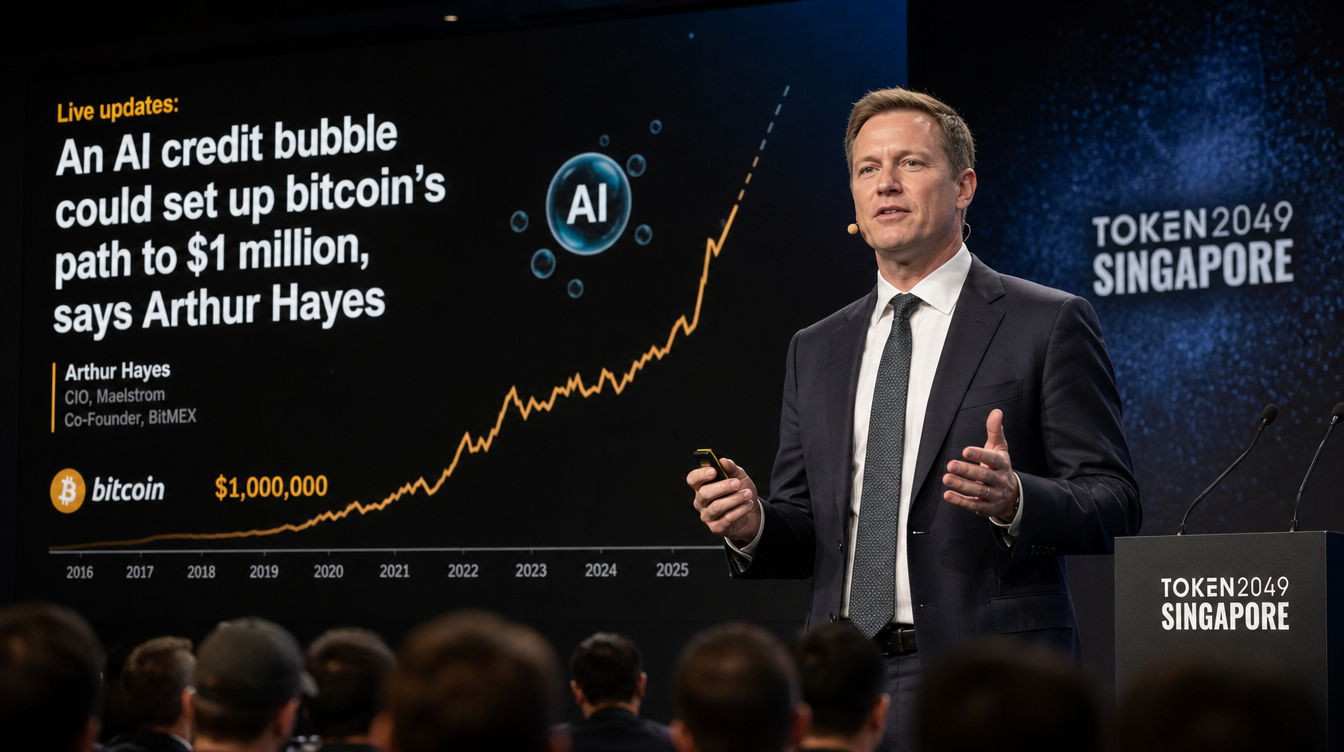
Maelstrom co-founder Arthur Hayes believes excessive leverage in AI infrastructure spending could eventually trigger a major credit crisis. He expects policymakers to respond with bailouts and expanded money supply, which he says could become a significant driver for bitcoin’s next major move.
Circle shares fall as analysts assess ARC token contribution to future growth
Circle shares dropped roughly 3% in pre-market trading after the stablecoin issuer posted an earnings beat but missed revenue expectations.
Clear Street said Circle’s adjusted EBITDA matched market forecasts despite revenue coming in 2% below estimates. The firm pointed to a stronger-than-expected RLDC margin of 41.2% and suggested that improved business fundamentals may have helped balance concerns around Coinbase’s Hyperliquid partnership. It added that Circle’s underlying operations appear healthier if the company records the expected $160 million from ARC token sales this year.
Compass Point offered a similar mixed view, saying Circle’s improved 2026 guidance was largely boosted by one-off ARC token pre-sales. The firm also highlighted progress on the Arc blockchain, Circle Payments Network, and AI-powered payment solutions.
TeraWulf boosts AI infrastructure expansion through Anthropic agreement
TeraWulf released its second-quarter results after announcing a $19 billion, 20-year data-center lease agreement with Anthropic. The contract covers 401 MW of capacity at its Kentucky Justified campus, with high-performance computing leasing contributing 71% of the company’s Q2 revenue.
The company is also developing 336 MW at its Lake Mariner facility and added a gigawatt-scale Kentucky campus in May. TeraWulf shares gained more than 1% in pre-market trading.
ADP report shows weaker-than-expected July private hiring
Private payroll growth slowed in July, with ADP reporting only 44,000 new jobs compared with 98,000 in June. The figure was also below economists’ expectations of 70,000.
Markets showed little immediate reaction as traders focused on Friday’s government employment report, which is expected to provide a clearer view of labor market conditions.
Citadel posts strong monthly gains amid AI trade rebound
Citadel’s flagship Wellington fund jumped 5.9% in July, marking its strongest monthly performance in four years, according to CNBC. The fund has gained 12% year-to-date.
The firm’s tactical trading and equity funds also delivered double-digit returns during July. Some of the gains came after Citadel acquired positions linked to Situational Awareness, an AI-focused portfolio managed by Leopold Aschenbrenner, as those holdings recovered sharply following a major selloff.
SpaceX losses deepen after earnings as capex concerns weigh
SpaceX shares extended their post-earnings decline, falling 11% to $111.80 before the market opened.
JPMorgan increased its price target for the company from $225 to $240 but warned that SpaceX could face nearly $200 billion in annual capital spending during 2027 and 2028, putting pressure on future cash flow.
The bank also pointed to an upcoming lock-up expiration involving 911.5 million shares, which could significantly increase the available share supply.
Curve founder says market volatility remains a boost for DeFi
Michael Egorov, founder of Curve Finance and Yield Basis, said the uncertainty weighing on financial markets could actually create opportunities for decentralized finance.
Egorov argued that interest-rate decisions have a smaller impact on DeFi than many investors believe. While higher rates support demand for tokenized Treasury products, he said on-chain yield opportunities could become more attractive if the Federal Reserve begins cutting rates.
He explained that volatile markets generate more trading activity, increasing fee revenue for liquidity providers. Unlike stable returns from lending or Treasury assets, trading fees can rise sharply during periods of market stress.
Egorov believes volatility is a core advantage for DeFi rather than a major risk.
Bitfinex says bitcoin’s future depends on real Treasury yields
Crypto exchange Bitfinex said bitcoin’s broader market outlook is closely tied to the 10-year U.S. Treasury real yield.
The exchange noted that the yield has never maintained levels above 2.5% during bitcoin’s history and is currently around 2.41%. A sustained move above that threshold, Bitfinex warned, could eliminate a key macro advantage for BTC.
Higher bond yields since the Iran conflict began in late February have pressured risk assets, although stocks have continued reaching record highs while bitcoin and gold have struggled to keep pace.
Zcash leads crypto rebound as major tokens show limited gains
Privacy-focused cryptocurrency Zcash emerged as the strongest performer during the latest market recovery.
ZEC gained nearly 6% over the past 24 hours, outperforming bitcoin and ether, which rose only 0.6% and 0.3%, respectively. Other notable gainers included PUMP, HYPE, and LIT.
Hayes compares AI boom to 2008 crisis and sees bitcoin benefiting
Arthur Hayes believes the AI investment boom is driven by excessive credit rather than sustainable earnings growth, making it more similar to the 2008 financial crisis than the dot-com bubble.
The BitMEX co-founder said technology companies are financing huge data-center expansions with debt while relying on hardware that loses value quickly. He believes the turning point will come when AI capital spending stops accelerating, potentially between late 2027 and 2028.
According to Hayes, lending could continue beyond that point until weaker AI-related borrowers begin failing, creating a broader credit shock. He expects governments in the U.S. and China to intervene with large-scale support and money creation.
Hayes argues that the resulting liquidity wave could eventually send bitcoin toward $1 million.
For now, he views the recent AI-driven market decline, including Korea’s leveraged selloff, as a temporary pullback within a longer-term bull market.
Bitcoin traded near $64,200 on Wednesday, remaining largely unchanged for the week and continuing to move within the range established since May.