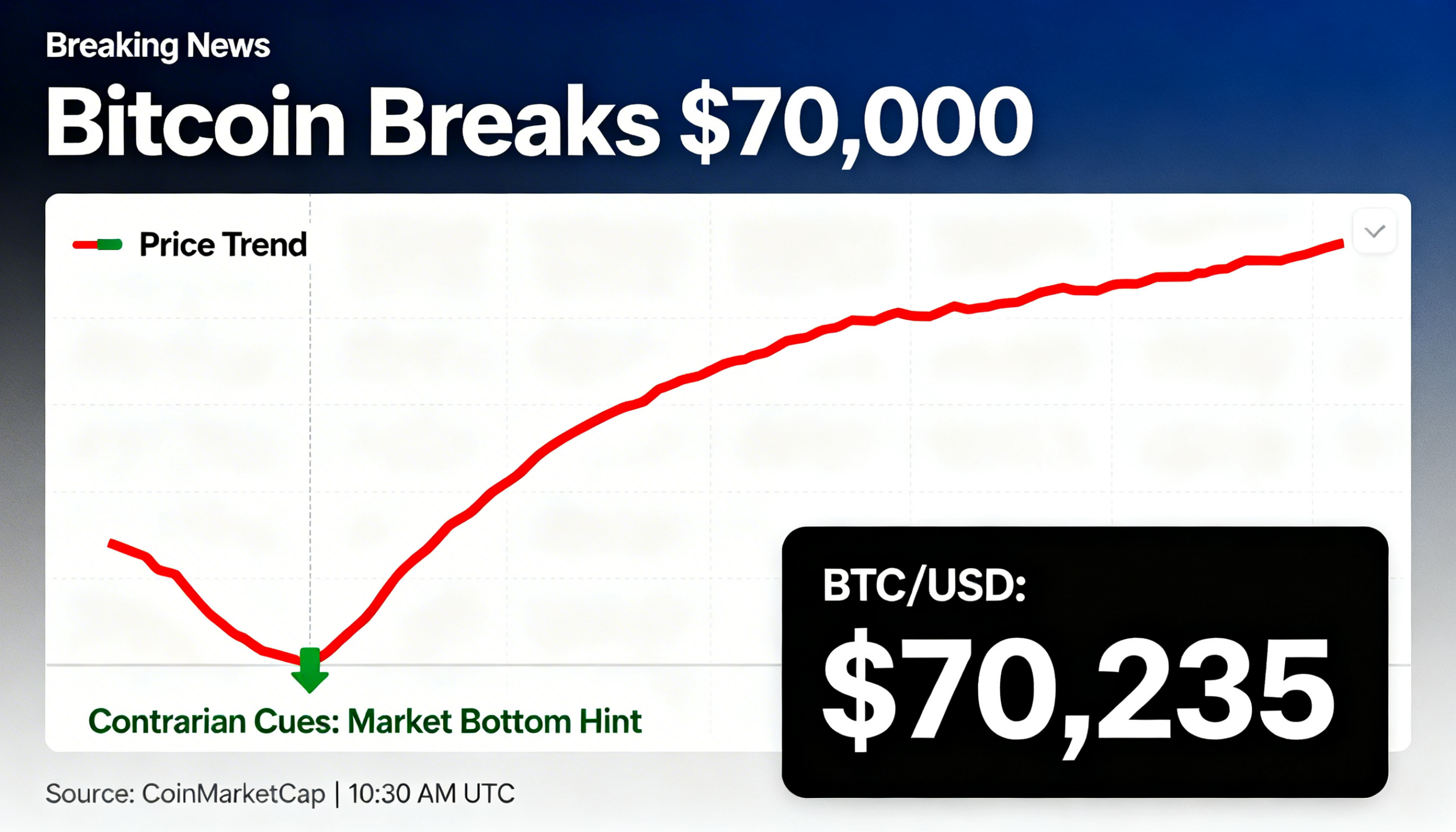
Bitcoin (BTC) extended its losses on Friday, falling below $70,000 for the first time since August as the cryptocurrency market faced another wave of selling. The asset declined 3.5% since midnight UTC, while total liquidations across the crypto market exceeded $1.6 billion in 24 hours. Expectations of higher U.S. interest rates and a strengthening dollar further weakened demand for digital assets.
Ethereum (ETH), the second-largest cryptocurrency, also suffered a sharp decline, with both major assets reaching price levels not seen in 12 weeks. Traders increasingly positioned for another Federal Reserve rate increase next month, pushing Treasury yields and the dollar higher while reducing appetite for riskier investments.
Bitcoin dropped as low as $67,770 after breaking below the closely watched $70,000 threshold. This marked its weakest level since August 19. Ethereum similarly touched $1,900, its lowest price since August 18, while the CoinDesk 20 Index declined 2%.
The market downturn coincided with renewed strength in the U.S. dollar. CME FedWatch figures indicated that traders were pricing in an 88% chance of a 25-basis-point rate hike next month, compared with a 12% probability of a larger 50-basis-point increase. Expectations shifted following inflation figures that exceeded market forecasts.
The U.S. Dollar Index climbed above 103, reaching its highest level since April 2025. Rising dollar strength and bond yields have created additional obstacles for cryptocurrencies by making traditional financial assets more attractive.
Pressure also came from the technology sector. Nvidia shares declined 4% following Thursday’s resignation of CEO Jensen Huang. As Bitcoin has maintained a close relationship with technology stocks, weakness in major tech companies added to the negative market sentiment.
Bitcoin Sell-Off Triggers $1.64 Billion in Crypto Liquidations
The latest price decline caused significant losses for leveraged traders. CoinGlass data showed that approximately $1.64 billion in crypto positions were forcibly closed over 24 hours, with long positions accounting for nearly 88.7% of the liquidations.
Bitcoin led the losses with approximately $916 million in liquidated positions, while Ethereum recorded another $289 million.
Institutional investment flows also remained weak. U.S. spot Bitcoin ETFs experienced $47.7 million in net outflows on Thursday, according to Farside Investors. This marked their sixth consecutive session of withdrawals, bringing the combined outflow total to approximately $1.44 billion.
Market participants are now monitoring October producer price index (PPI) data, which is expected later today. Economists anticipate a 0.4% monthly increase. The Federal Reserve’s next policy meeting is scheduled for December 8–9.
Crypto Futures Activity Surges as Traders Exit Positions
Derivatives market activity increased sharply during the latest downturn. Crypto futures trading volume climbed 58.3% to $269.1 billion over 24 hours, while total open interest declined 4.6% to $120.2 billion. The combination suggests that traders were reducing exposure and closing existing positions.
Liquidations increased 513.7% to $1.64 billion, with bullish positions responsible for approximately 88.6% of the losses. Market-order activity also favored sellers, who accounted for 51.9% of total taker volume.
Bitcoin futures represented more than half of all liquidations, with $916 million in forced closures. Long positions accounted for 95.2% of Bitcoin-related liquidations. Open interest declined 5.4% against a 5.9% price drop, suggesting that much of the change reflected Bitcoin’s falling valuation rather than a significant net withdrawal of capital.
Funding rates for Bitcoin also turned moderately negative, indicating that short sellers were paying long traders to maintain their positions. The largest single liquidation was a $31.1 million Bitcoin long position on Hyperliquid, triggered at approximately $72,250.
Ethereum derivatives recorded similar weakness. Around $289 million in ETH positions were liquidated, with bullish traders accounting for 89.5% of the total. Open interest declined 4.1%, compared with a 4.9% fall in Ethereum’s price. Negative funding rates further indicated increasing demand for bearish exposure.
Other major altcoins experienced more substantial position reductions. Solana’s open interest fell 8.6% against a 3.6% price decline, while Zcash recorded an 8% drop in open interest alongside a 3.8% price decrease. Dogecoin’s open interest also declined 7.3%, compared with a 3.4% fall in its market price.
Negative funding rates extended across several leading cryptocurrencies, including BTC, ETH, XRP, SOL and TRX. This indicates that traders were increasingly favoring short positions and paying funding costs to maintain bearish bets.
Cumulative volume delta (CVD) data also showed widespread selling pressure. All major cryptocurrencies recorded negative readings over 24 hours, indicating that aggressive market selling exceeded buying activity. Bitcoin posted the weakest figure, followed by UNI, DOGE and SUI.
Options activity reflected growing concerns about further downside. Bitcoin’s one-week 25-delta skew increased to approximately 14%, showing that investors were paying more for put options to protect against price declines than for comparable call options.
One-week implied volatility briefly reached 43% before settling around 40%, suggesting that traders continued to anticipate price fluctuations without aggressively pricing in an even larger move. Ethereum options activity was concentrated around the $1,800 put contract expiring November 20, whose strike price was approximately 7.5% below the prevailing ETH price.
Altcoins Extend Declines as Crypto Sentiment Remains Deep in Fear
The broader digital asset market also struggled as selling pressure spread across several sectors. Aave-related developments gained attention after Nasdaq-listed BTCS revealed that it had sold Ethereum at a loss to protect its approximately $64 million borrowing position from liquidation. CoinDesk estimates that the company’s loan could face liquidation if ETH falls toward $1,717.
The CoinDesk DeFi Select Index (DFX) dropped 3.5% since midnight UTC, recording the largest decline among sector indexes. Aero (AERO) was among the weakest assets in the CoinDesk 100, falling 8%.
Solana declined 2.4% and slipped below $80 despite the Depository Trust & Clearing Corporation (DTCC) adding the blockchain to its tokenization plans, with a potential rollout targeted for 2027.
Cardano-associated privacy blockchain Midnight (NIGHT) also reversed part of its recent rally, losing 5.7% after gaining 11% over the previous week.
A small group of tokens managed to post gains despite the broader downturn. Near Protocol (NEAR) advanced 2.6%, making it the strongest performer among the nine advancing CoinDesk 100 constituents. Falcon Finance (FF) gained 2.5%, while Kite (KITE) increased 2.2%. No clear catalysts were identified behind these moves.
CoinMarketCap’s Altcoin Season Index climbed to 48 from 39 on Thursday, suggesting that selected altcoins were beginning to outperform Bitcoin. However, the indicator remains below the 75-point threshold generally associated with a full altcoin season.
Meanwhile, the Crypto Fear and Greed Index stood at 19, indicating extreme fear among investors. Continued Bitcoin losses, persistent ETF withdrawals and heavy leveraged liquidations are keeping market sentiment under pressure and reinforcing concerns about further downside.