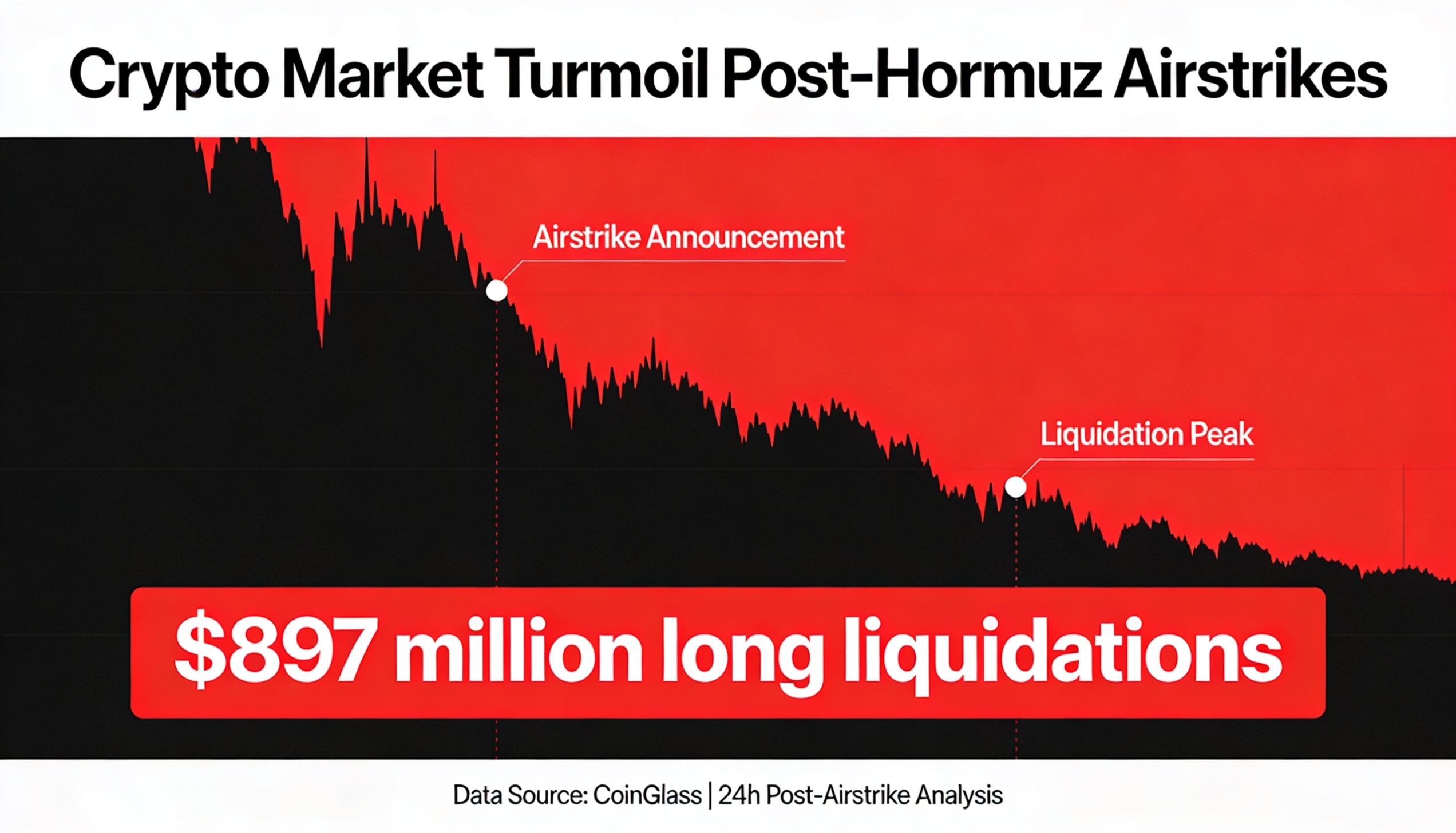
Bitcoin slid to its lowest level since mid-April on Thursday, while ether dropped below the $2,000 threshold, as U.S. airstrikes in the Strait of Hormuz rattled global markets and triggered a wave of liquidations in leveraged positions.
BTC fell to around $73,400, down roughly 1.2% on the day after briefly touching its weakest level since April 13 during early trading hours. Ether underperformed, slipping 1.5% and breaking below $2,000 for the first time since late March.
The downturn followed a sharp move higher in oil prices after the strikes disrupted ceasefire expectations. Crude surged from $92 to as high as $96 per barrel before stabilizing near $94, reigniting inflation concerns and pressuring risk assets broadly.
U.S. equity futures mirrored the cautious tone, with contracts tied to the S&P 500 and Nasdaq 100 edging lower ahead of the American session.
In derivatives markets, nearly $960 million in positions were liquidated over the past 24 hours, with long positions accounting for approximately $897 million of the total. The imbalance points to a steady unwinding of bullish bets rather than a sudden volatility-driven flush.
Bitcoin open interest remained largely unchanged overall, though CME futures saw a notable 9.85% decline to $7.56 billion, suggesting reduced activity in regulated markets even as offshore perpetual futures held steady. Funding rates remained close to neutral, indicating limited appetite for aggressive leveraged positioning.
Ether, however, saw open interest climb to a record 16.39 million ETH, equivalent to about $32.6 billion, even as prices declined. The divergence suggests traders are increasingly building short positions rather than stepping in to buy the dip.
Elsewhere, XRP open interest dipped slightly alongside softer prices, signaling that bullish positions may be unwinding rather than new bearish bets forming. Funding rates across major altcoins, including XRP and SOL, turned negative on most exchanges, reflecting a broader tilt toward short positioning.
Options markets are also in focus, with roughly $8 billion in contracts set to expire on Deribit. Bitcoin accounts for the bulk of that figure, with max pain positioned near $75,000 — just above current spot levels — while significant open interest remains concentrated at higher resistance levels.
Despite the macro-driven selloff, implied volatility remains subdued. Deribit’s DVOL index is hovering near the lower end of its yearly range, even as options skew indicates growing demand for short-term downside protection.
The weakness extended across the broader crypto market, with the CoinDesk Computing Select Index dropping nearly 3% after midnight UTC. Thin liquidity in several altcoin pairs exacerbated price swings, leading to sharp but short-lived dislocations.
Some tokens experienced outsized moves, including a brief 30% drop in Humanity protocol (H) before a rapid rebound. AI-related tokens such as RENDER and FET, along with DeFi assets like JUP and ETHFI, also posted notable losses.
Market sentiment has deteriorated further, with CoinMarketCap’s Altcoin Season Index falling to its lowest level in over three months, underscoring a growing risk-off environment across digital assets.