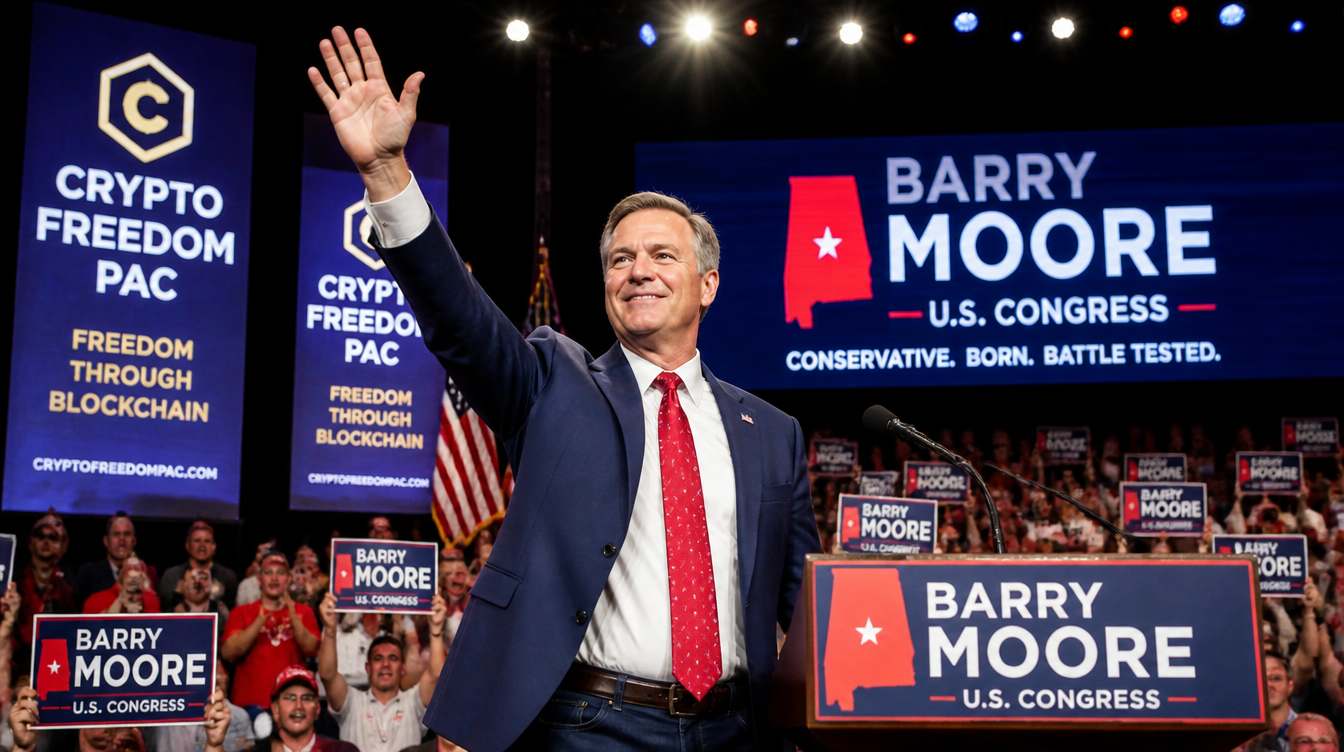
Barry Moore’s victory in Alabama’s Republican Senate primary runoff delivered a major win for the cryptocurrency industry’s political network, which invested more money in his campaign than any other congressional race this election cycle.
Crypto super PAC Fairshake and its affiliated groups spent more than $12 million backing Moore, helping the congressman defeat former Navy SEAL Jared Hudson in Tuesday’s runoff election. Moore had fallen short of the 50% threshold in Alabama’s initial primary in May, forcing a second round of voting.
The result is a significant boost for the crypto industry’s efforts to elect pro-digital asset lawmakers. Moore, a strong supporter of President Donald Trump, has backed every major crypto-related bill during his time in the House of Representatives and is now favored to win November’s general election in heavily Republican Alabama.
Fairshake hailed the outcome as proof of its growing political influence. The group remains the crypto sector’s largest election spending vehicle and still has roughly $150 million available to deploy in future races, according to spokesperson Geoff Vetter.
Moore’s win comes after a rare disappointment for the crypto-backed PAC in Illinois, where it spent more than $10 million opposing Democratic Senate candidate Juliana Stratton, who ultimately secured her party’s nomination. Even so, Fairshake has maintained a strong success rate in primary contests across the country.
Moore is seeking to succeed Republican Senator Tommy Tuberville, who left the seat open to pursue a gubernatorial bid. He also received support from Fellowship PAC, another group aligned with crypto industry interests.
The industry-backed PAC network also scored another victory this week in Oklahoma, where Representative Kevin Hern won the Republican Senate nomination after receiving approximately $735,000 in support from Fairshake. Like Moore, Hern was endorsed by Trump.
Funded primarily by major crypto firms such as Coinbase, a16z Crypto and Ripple, Fairshake entered the 2026 election cycle with nearly $193 million in cash reserves. Rather than focusing directly on cryptocurrency policy, the group typically funds independent advertising campaigns highlighting candidates’ broader political strengths.
That strategy has helped the industry establish itself as one of the most influential forces in U.S. campaign finance, with a growing roster of pro-crypto candidates advancing through the 2026 election cycle.