SEC-CFTC Crypto Framework Progresses as CLARITY Act Faces Delays
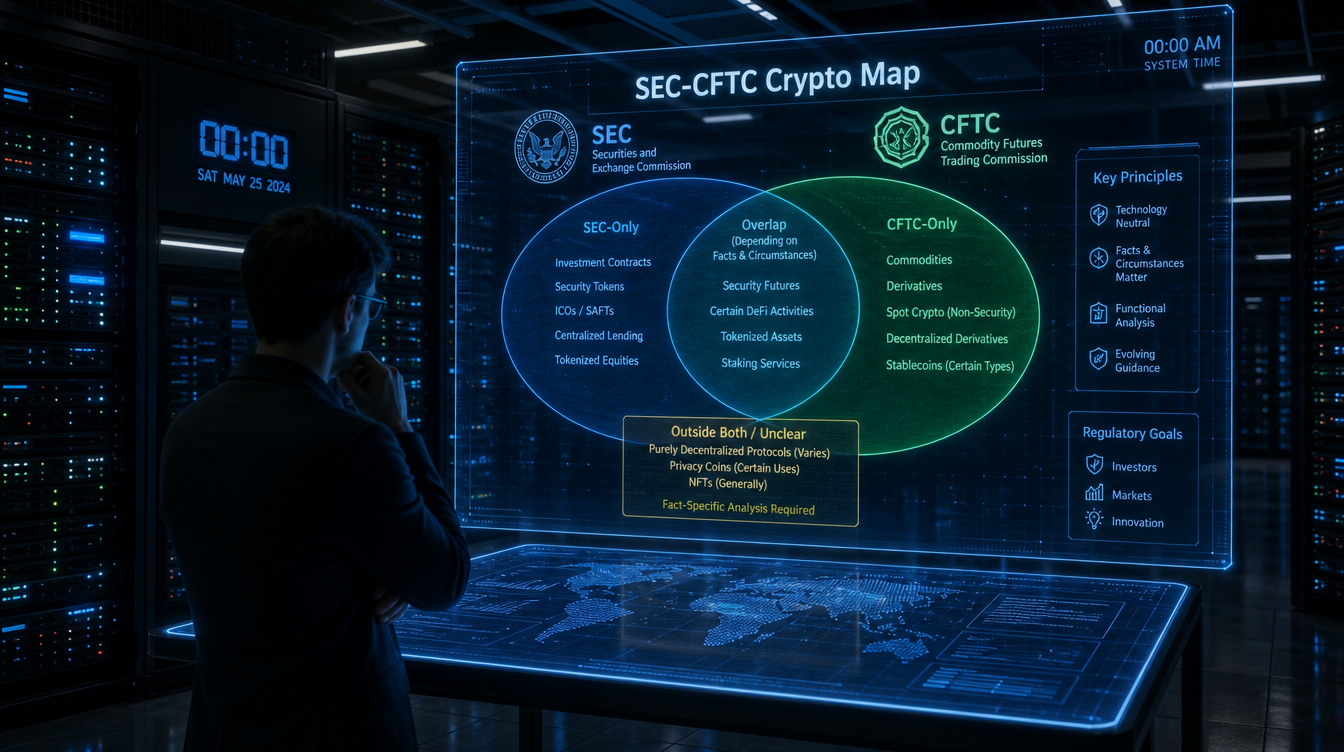
The SEC and CFTC have moved to clarify U.S. crypto oversight with a joint framework that divides digital assets into five classifications: digital commodities, digital collectibles, digital tools, stablecoins and digital securities.
The guidance suggests the agencies are unwilling to wait for Congress to settle the long-delayed CLARITY Act before establishing a practical approach to digital-asset regulation.
For exchanges, token developers and traders, the framework offers a preliminary guide to how different assets may fall under federal oversight. However, because it is regulatory guidance rather than legislation, its authority could change with future agency decisions.
The announcement comes as cryptocurrency markets await the latest U.S. CPI figures. Bitcoin is currently consolidating around $64,000, and the inflation report could provide the catalyst for its next significant move.
New Crypto Classification System Fills Legislative Gap
The SEC-CFTC framework generally places digital commodities, collectibles, tools and stablecoins outside the securities category, while digital securities remain clearly within the SEC’s regulatory domain.
The SEC has nevertheless maintained that it can assert authority over particular assets classified as nonsecurities depending on their circumstances. This caveat leaves some questions unresolved.
A key purpose of the proposed market-structure legislation is to establish clearer statutory boundaries between the SEC and CFTC. Until Congress reaches an agreement, the agencies’ latest interpretation effectively fills part of that regulatory gap.
Ian Katz, managing partner at Capital Alpha, said regulators are continuing to act because waiting exclusively for legislation could leave the industry without practical guidance for too long.
SEC Chair Paul Atkins made a similar argument at the DC Blockchain Summit, characterizing the new framework as a necessary step after a lengthy period of uncertainty.
Atkins has also indicated that a wider regulatory package could include exemptions for startups and fundraising activities, alongside a safe harbor for digital assets that develop beyond securities treatment. Such provisions would typically require congressional legislation to establish permanently.
Senate Debate Keeps CLARITY Act in Limbo
The House approved the CLARITY Act last July, but the bill has struggled to advance through the Senate.
The Senate Agriculture Committee has moved forward with its portion without Democratic support, while the Banking Committee has encountered its own obstacles, including Coinbase withdrawing its backing.
Stablecoin rewards remain a major sticking point. Banks have called for stronger restrictions, while crypto firms argue that limiting rewards could make digital assets less competitive with traditional financial products.
President Trump has criticized the banking industry over the GENIUS Act and has urged Congress to accelerate work on crypto market-structure legislation.
Senators Angela Alsobrooks and Thom Tillis have reportedly reached a bipartisan understanding on stablecoin rewards, although the details have yet to be fully disclosed.
David Carlisle of Elliptic said the joint SEC-CFTC interpretation offers the industry some additional certainty while lawmakers remain divided.
What Traders Should Watch Next
Passing the CLARITY Act would still require several additional steps even if the Senate Banking Committee advances its version. The Senate would need to reconcile the Banking and Agriculture Committee bills, secure the necessary 60 votes and then work with the House to produce a final version.
The approaching midterm elections could further reduce the window available for lawmakers to complete the process.
Sen. Bernie Moreno has warned that if the CLARITY Act is not passed by May, comprehensive digital-asset legislation could remain out of reach for an extended period.
For investors, the distinction between agency guidance and congressional legislation remains critical. Regulators can revise an interpretation without requiring a vote in Congress, while a federal statute generally provides a much more durable framework.
The SEC-CFTC initiative therefore offers useful short-term clarity, but it does not fully resolve the uncertainty surrounding U.S. crypto regulation. The market will continue watching congressional negotiations to determine whether temporary regulatory guidance eventually gives way to permanent law.