The Cambridge Centre for Alternative Finance (CCAF) has confirmed that Ethereum’s energy consumption has fallen by 99.98% since The Merge. While the upgrade dramatically improved Ethereum’s environmental profile, the report suggests that infrastructure concentration has emerged as the next major issue for institutional investors to assess.
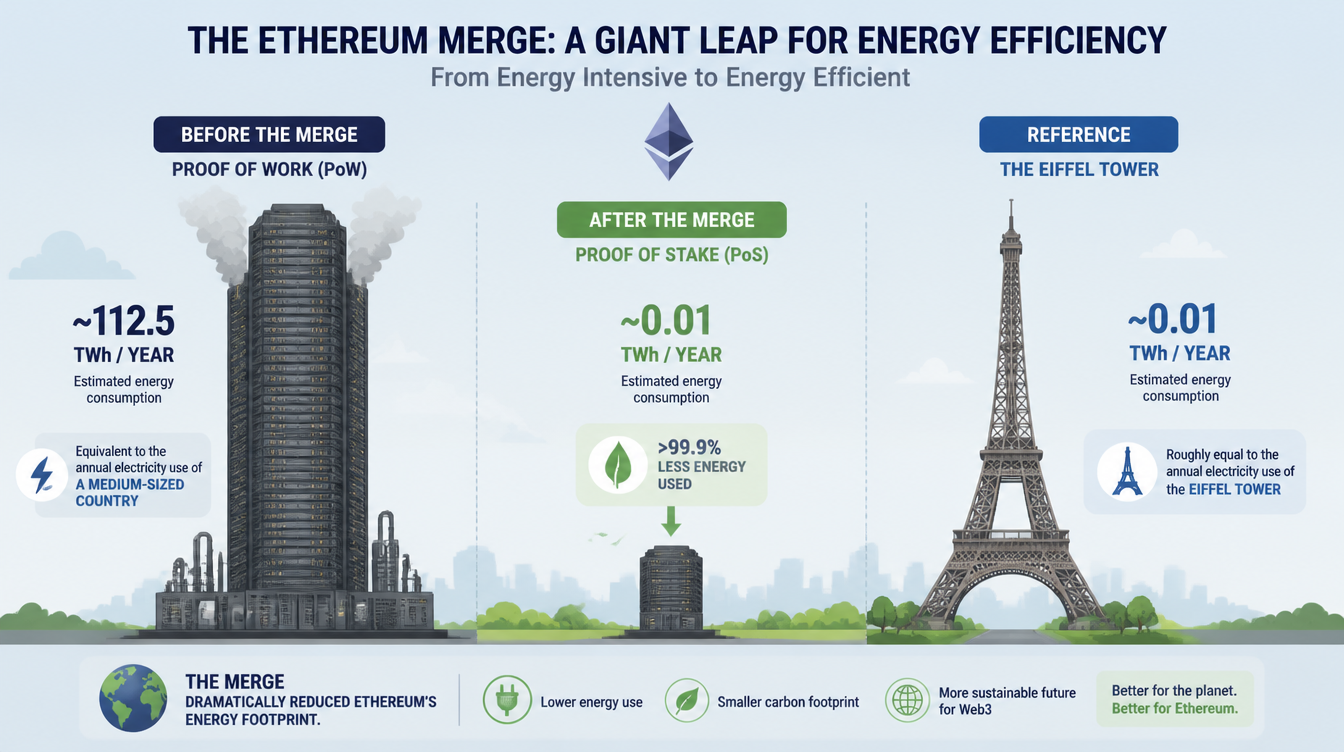
CCAF’s June 2026 study, Ethereum After the Merge – A Change in Power, analyzed the effects of Ethereum’s transition from proof-of-work to proof-of-stake. The research found that Ethereum’s annual electricity demand dropped from 2.4 gigawatts before The Merge to just 7.87 gigawatt-hours per year after the upgrade, equivalent to approximately 0.90 megawatts of continuous power usage.
The report also revealed a major reduction in emissions, with Ethereum’s carbon output falling from 10.3 million tonnes of CO₂ equivalent to about 2.37 thousand tonnes. That represents a 99.98% decrease achieved through a single software-driven change to the network’s consensus mechanism.
The findings underline the scale of Ethereum’s transformation. Completed on September 15, 2022, The Merge replaced energy-intensive mining with proof-of-stake validation, making it one of the largest efficiency improvements ever implemented by a major blockchain. The shift has also significantly improved Ethereum’s position in ESG evaluations used by institutional asset managers.
Ethereum’s Energy Footprint After The Merge
CCAF calculated Ethereum’s energy consumption using a network-based average of 105 watts per node, relying on measured network activity instead of theoretical projections.
The report highlighted the dramatic difference between Ethereum’s energy use before and after the upgrade through real-world comparisons. Before The Merge, Ethereum consumed electricity at a level comparable to Iceland’s national grid. Today, the network’s annual energy demand is roughly comparable to the Eiffel Tower’s yearly electricity consumption.
Compared with traditional financial infrastructure, Ethereum’s footprint is extremely small. CCAF estimates that global banking infrastructure, including data centers, branches, and ATMs, consumes about 260 terawatt-hours annually. Ethereum’s current usage of 7.87 gigawatt-hours is approximately 33,000 times lower.
The network’s carbon impact has similarly declined, with post-Merge emissions reduced to around 2.37 kilotonnes of CO₂ equivalent.
Among major blockchain networks, Ethereum’s post-Merge energy consumption remains lower than Solana, which uses more than 13.4 GWh annually, but higher than NEAR Protocol, which consumes around 5.11 GWh per year. CCAF noted that Ethereum’s energy usage is relatively efficient when measured against its economic value and network activity.
Institutional Focus Moves Toward Infrastructure Risks
With Ethereum’s environmental concerns largely addressed, institutional analysis is shifting toward the resilience and decentralization of the network’s underlying infrastructure.
The CCAF report highlights potential vulnerabilities linked to node distribution, including geographic concentration and reliance on a limited number of cloud hosting providers. Although Ethereum has significantly reduced its energy footprint, these infrastructure dependencies represent a new category of risk.
Future evaluations are likely to focus more heavily on validator distribution, hosting arrangements, and the overall decentralization of the network.
The report could strengthen Ethereum’s appeal among institutions that previously viewed proof-of-work networks as incompatible with ESG requirements. However, investment committees may still need to examine infrastructure concentration, decentralization, and long-term ecosystem sustainability before considering Ethereum’s risk profile fully addressed.