The FIFA World Cup 2026 is underway, featuring 48 national teams, 104 matches, and 16 host cities spread across Canada, Mexico, and the United States. Beyond the expanded tournament format, this edition is shaping up to be the most crypto-connected World Cup ever staged.
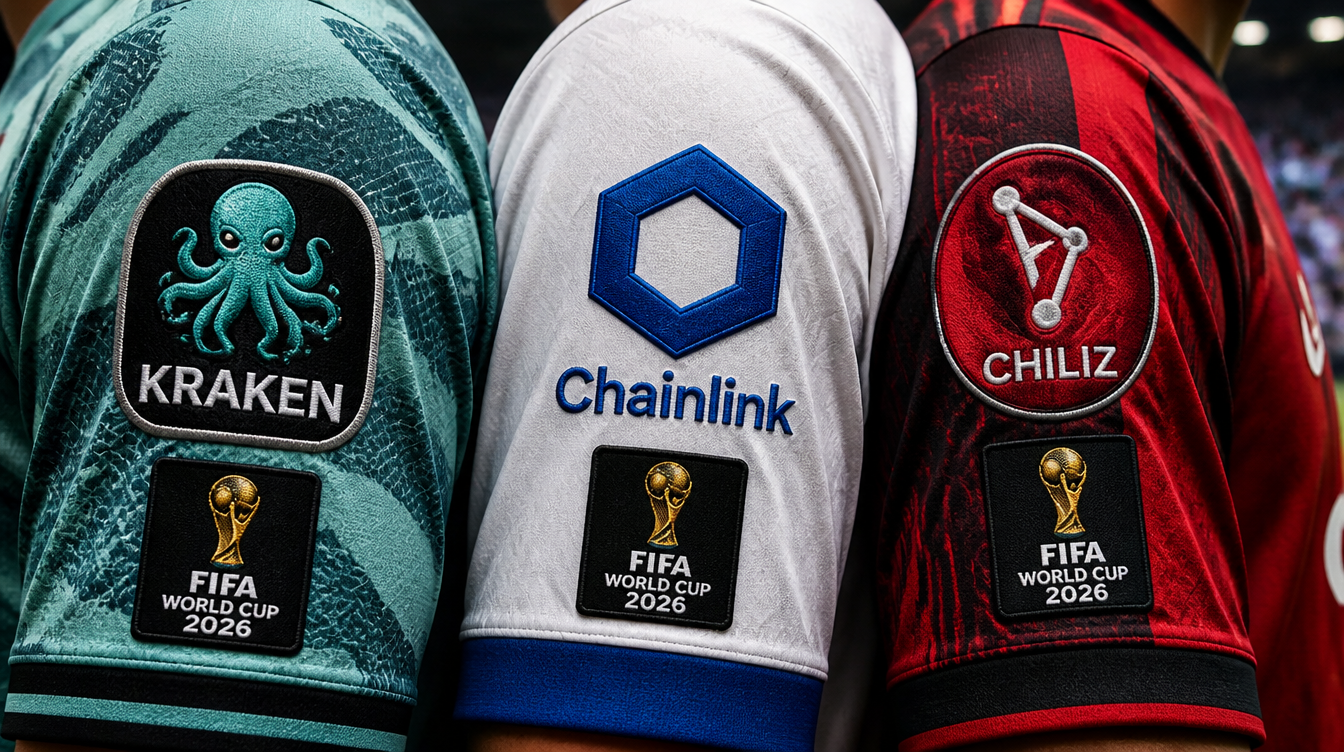
Several major blockchain players are involved. Kraken has joined as FIFA’s Official Crypto Exchange Supporter, ADI PredictStreet is powering the tournament’s first official prediction market using Chainlink’s oracle technology, and Chiliz fan tokens—now available across Solana and Base—are already seeing increased on-chain engagement.
Together, these partnerships represent an unprecedented level of crypto participation at a FIFA World Cup, surpassing anything seen in previous tournaments.
Kraken Brings Crypto to the World’s Biggest Sporting Stage
Kraken secured a unique position as FIFA World Cup 2026’s Official Crypto Exchange Supporter, becoming the only cryptocurrency exchange included in FIFA’s sponsorship ecosystem for this tournament cycle.
The partnership includes fan-focused activations and digital experiences across North America and Europe throughout the tournament, which runs from June 11 through July 19. With FIFA expecting a cumulative global audience exceeding six billion viewers, the deal gives Kraken access to one of the largest audiences in sports.
Operating in more than 190 countries, Kraken views the agreement as an opportunity to introduce crypto services to mainstream consumers on a scale few digital asset companies have ever achieved.
Kraken Co-CEO Arjun Sethi emphasized the global nature of the sport, noting that football unites billions of people simultaneously across countries, cultures, and languages. In his view, financial systems should be equally seamless and borderless.
FIFA Chief Business Officer Romy Gai highlighted innovation and technological advancement as key factors behind the partnership.
While significant, Kraken’s sponsorship remains within FIFA’s Supporter tier, below the organization’s top-level Global Partners, which include major brands such as Adidas, Coca-Cola, Visa, and Hyundai-Kia. No cryptocurrency exchange has yet secured a position within FIFA’s highest sponsorship category.
Chainlink Powers FIFA’s First Official Prediction Market
Another major crypto milestone arrives through ADI PredictStreet, which is serving as FIFA’s inaugural Official Prediction Market Partner for the World Cup.
The platform relies exclusively on Chainlink’s oracle network to deliver verified match data. Match outcomes are sourced from trusted providers, transmitted on-chain through Chainlink’s infrastructure, and used to automatically settle prediction markets without requiring manual oversight or centralized decision-making.
This approach differs significantly from traditional prediction platforms, where market resolutions are often controlled by a central operator.
ADI PredictStreet CEO Dimitrios Psarrakis said the company selected Chainlink because of its ability to provide transparent, verifiable data feeds while supporting large-scale market settlement.
Chainlink Labs Chief Business Officer Johann Eid described prediction markets as a new form of fan engagement that could deepen audience participation during live sporting events.
The initiative also serves as a practical demonstration of how decentralized infrastructure can support real-world event markets at global scale.
FIFA 2026 Highlights Crypto’s Expanding Role in Sports
Taken together, FIFA World Cup 2026 showcases five distinct segments of the crypto industry operating within a single global event: cryptocurrency exchanges through Kraken, oracle infrastructure via Chainlink, prediction markets through ADI PredictStreet, fan engagement and tokenization from Chiliz, and blockchain-based ticketing supported by Avalanche.
No previous FIFA World Cup has featured this level of crypto integration across multiple sectors simultaneously.
The contrast with Qatar 2022 is notable. That tournament primarily relied on a single blockchain-focused partnership involving Algorand, which supported NFT initiatives and digital wallet services. Much of that effort was later scaled back following the crypto market downturn of 2022 and 2023.
This time, FIFA’s blockchain strategy is far more diversified, involving multiple companies, networks, and use cases rather than depending on one ecosystem to represent the industry.
However, an important limitation remains. While crypto companies now have meaningful visibility throughout FIFA’s commercial ecosystem, none have yet broken into the organization’s elite Global Partner tier alongside brands such as Visa, Adidas, and Coca-Cola.
That may become the industry’s next major objective. The success of these initiatives over the tournament’s seven-week run could help determine whether a crypto company is willing—and able—to pursue FIFA’s highest sponsorship level ahead of the 2030 World Cup.